


 Profile
 Settings
 Refer your friends
 Sign out




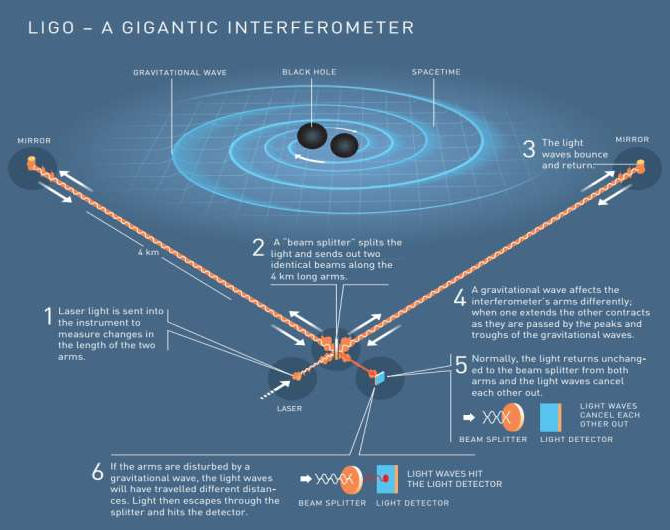
What are Gravitational Waves?
- Gravitational waves are ripples in the fabric of spacetime caused by massive cosmic events like merging black holes or colliding neutron stars.
- They travel at the speed of light, but are extremely weak when they reach Earth.
- First directly detected in 2015 by the Laser Interferometer Gravitational-Wave Observatory (LIGO) from two colliding black holes 1.3 billion light-years away.
How Do We Detect Them?
- Special instruments called interferometers use laser beams and mirrors to measure tiny distortions in spacetime.
- Example: LIGO in the United States (US) has two L-shaped detectors, each with 4-kilometre-long arms.
- Albert Einstein predicted it in his General Theory of Relativity (1916), which was confirmed a century later.
Limitations on Earth:
- Ground-based detectors such as LIGO (US), Virgo (Italy), KAGRA (Japan), and GEO600 (Germany) detect waves only in the 100–1,000 Hertz frequency range.
- Lower-frequency gravitational waves cannot be detected due to Earth’s seismic noise and vibrations.
Moon-Based Detector: LILA
- The Laser Interferometer Lunar Antenna (LILA) is planned for the lunar surface by Vanderbilt Lunar Labs (US).
- Advantages:
- Very low seismic noise.
- Natural vacuum conditions.
- Permanently shadowed polar regions are ideal for observation.
- Two phases:
- LILA Pioneer (this decade) using lunar landers like Chandrayaan and US private landers (Blue Origin, Intuitive Machines).
- LILA Horizon (future phase) requires astronauts to deploy.
Global Projects:
- Laser Interferometer Space Antenna (LISA): European Space Agency (ESA) mission in the 2030s, using three satellites to detect low-frequency gravitational waves.
- DECi-hertz Interferometer Gravitational Wave Observatory (DECIGO): Japan-led mission targeting the decihertz range.
- TianGo: A United States-led initiative for space-based detection.
- Lunar Gravitational-wave Antenna (LGWA): Another proposed lunar-based detector.
- Square Kilometre Array (SKA): World’s largest radio telescope (Australia & South Africa) scanning nanohertz frequencies.
India’s Contribution:
- Indian Initiative in Gravitational-wave Observations (IndIGO) has a roadmap to build LIGO-India in Hingoli district, Maharashtra, by 2030.
- It will be part of the global LIGO network and boost India’s capacity in gravitational wave astronomy.
Why It Matters?
- Opens a new window to study black holes, neutron stars, and the early universe.
- The decihertz frequency range can help detect intermediate-mass black holes, which may be the building blocks of supermassive black holes.
- Monitoring pulsars can potentially turn the entire Milky Way galaxy into a natural gravitational wave detector.
Why in News?
- Scientists are planning to set up the Laser Interferometer Lunar Antenna (LILA) on the moon’s surface to detect low-frequency gravitational waves that Earth-based detectors cannot capture.
