Profile
 Settings
 Refer your friends
 Sign out




Why in News?
- Recent studies from Maharashtra and Gujarat have highlighted that restoring India’s semi-arid grasslands can significantly increase soil carbon storage and strengthen climate resilience.
Distribution of Grasslands
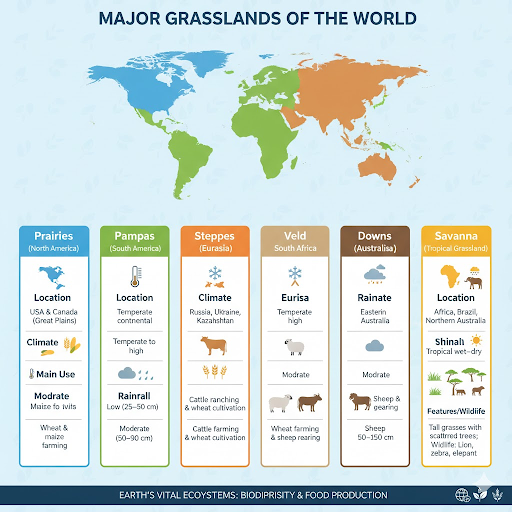
- Grasslands are ecosystems dominated by grasses with very few trees, found in tropical, temperate and alpine regions.
- In India, major grasslands occur in the Deccan Plateau, semi-arid regions, Himalayan pastures, and floodplains.
- They support a large number of livestock, wild herbivores, and rural livelihoods.
- Grasslands occupy a significant portion of the Earth’s land surface and play a key ecological role.
Historical Neglect of Grasslands
- India’s grasslands were labelled as “wastelands” during the British colonial period because they had little timber value.
- Post-independence policies continued this approach by classifying grasslands as unproductive land.
- The National Wastelands Development Board (1985) further reinforced this perception.
- This led to decades of grassland conversion and ecological degradation.
Ecological and Economic Importance
- Grasslands are rich in biodiversity and support unique plant and animal species.
- They form the backbone of pastoral livelihoods across semi-arid regions.
- In Maharashtra alone, the livestock economy was valued at over ₹59,000 crore in 2018–19.
- These ecosystems provide grazing, water regulation and soil protection.
Role of Grasslands in Soil and Carbon Storage
- Grasslands store most of their biomass below ground through deep root systems.
- These roots improve soil structure, increase water infiltration and prevent erosion.
- Grassland soils are rich in stable soil organic carbon (SOC) that can persist for centuries.
- Unlike forests, this carbon remains protected underground even during fires.
CAMPA-Based Grassland Restoration in Maharashtra
- The Maharashtra forest department used CAMPA funds to restore degraded grasslands in Solapur.
- Native grass species such as Dichanthium, Chrysopogon and Cenchrus were replanted.
- The restoration was monitored over one, two and three years.
- This marked a policy shift from tree plantation to grassland restoration.
|
DO YOU KNOW CAMPA
|
Role of Grasslands in Climate Change Mitigation
- By storing carbon in soils, grasslands help in slowing the pace of global warming.
- Grasslands reduce the need for carbon-intensive artificial fodder systems by supporting natural grazing.
- They limit land degradation and desertification, which are major sources of climate-related emissions.
- Restored grasslands contribute to nature-based solutions for climate mitigation.
Grasslands in Climate Adaptation and Drought Resilience
- Grasslands are highly resilient to drought due to their regenerative root systems.
- After dry periods, grasses can regrow quickly and restore vegetation cover.
- Grasslands provide fodder security during climate shocks such as droughts and heatwaves.
- This makes them extremely important for climate-resilient agriculture and pastoral systems.
Banni Grassland of Gujarat and Carbon Sequestration
- Banni in Kutch is India’s largest tropical grassland and was degraded by invasive Prosopis trees.
- Community-led restoration removed these invasive species and revived native grasses.
- Restored patches (wada) showed the highest soil organic carbon among all land-use types.
- Banni stores about 27 metric tonnes of carbon up to 30 cm soil depth.