


 Profile
 Settings
 Refer your friends
 Sign out




Why in News?
- The United Nations recently convened a signing ceremony for the seminal Convention against Cybercrime, where India joined major nations like the United States, Japan, and Canada in abstaining from signing, signaling deep fractures in the global governance of cyberspace.
- A New Global Framework: This is the first multilateral criminal justice instrument to be negotiated in over two decades, aiming to replace the fragmented approach to cyber governance.
- Origin and Adoption: Conceived through a Russia-led resolution in 2017, the text was adopted by the General Assembly in December 2024 despite significant geopolitical division.
- Objective: The convention seeks to standardize the fight against cybercrime by creating a universal legal basis for international cooperation, unlike previous regional agreements.
- Fractured Consensus: While intended to be global, the convention received support from only 72 countries, with major powers on both sides (Western democracies and India) remaining outside the initial signatory list.
- Dual Scope of Criminalization: The treaty mandates the criminalization of both Cyber-Dependent Crimes (e.g., hacking, data interception) and Cyber-Enabled Crimes (e.g., online fraud, child sexual abuse material).
- “Serious Crime” Definition: A controversial provision defines “serious crimes” as any offense punishable by four years or more of imprisonment, allowing states to use the treaty’s powerful cooperation tools for a wide range of non-cyber specific offenses.
- Cross-Border Evidence Sharing: It establishes a 24/7 Network for the rapid exchange of electronic evidence and mutual legal assistance (MLA) to tackle the borderless nature of digital crime.
- Procedural Powers: The convention empowers authorities with broad tools for data preservation, search, and seizure, though critics argue these powers lack robust, universally binding human rights safeguards.
- Sovereignty Clauses: While promoting cooperation, the text includes clauses that allow states to refuse data requests if they prejudice their sovereignty, security, or public order, a feature heavily debated during negotiations.
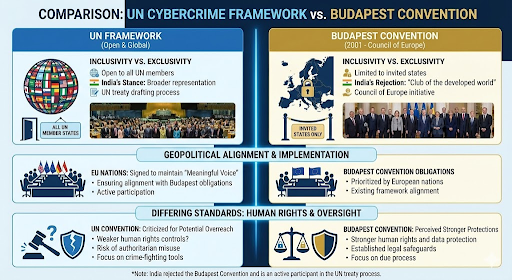
- Loss of Institutional Control: Unlike its passive rejection of Budapest, India actively negotiated the UN treaty but abstained because its proposals to retain control over citizen data were not accepted.
- Data Sovereignty Concerns: India is wary of provisions that might mandate Cross-Border Data Flows without adequate checks, conflicting with its desire to localize data for law enforcement and privacy purposes.
- Privacy and Rights Standards: The broad definitions in the convention could conflict with domestic legal standards established by the Puttaswamy Judgment (2017), creating legal ambiguities regarding user privacy.
- Strategic Autonomy: By abstaining, India avoids getting locked into a framework where it has limited leverage, preferring to maintain Policy Flexibility in a polycentric global order.
