


 Profile
 Settings
 Refer your friends
 Sign out




Why in News?
- DRDO has successfully tested India’s indigenous fighter aircraft escape system using a high-speed rocket-sled trial.
About the test
- The test was carried out at the Rail Track Rocket Sled facility of the Terminal Ballistics Research Laboratory (TBRL), Chandigarh.
- The trial was conducted at controlled high velocity to simulate real emergency conditions.
- It successfully validated three critical functions: canopy severance, ejection seat sequencing, and complete aircrew recovery.
- The test was conducted in collaboration with Hindustan Aeronautics Limited (HAL) and the Aeronautical Development Agency (ADA).
DO YOU KNOWKey terms
|
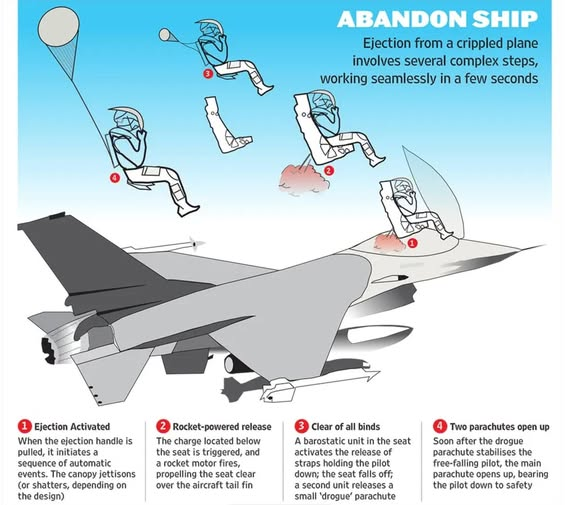
- The ejection system is a life-saving mechanism that allows a pilot to escape from a damaged or uncontrollable fighter aircraft.
- It works by jettisoning the canopy, firing the ejection seat using a catapult and rocket motor, and then deploying a parachute for safe descent.
- Modern systems have “zero–zero capability”, meaning ejection is possible at zero speed and zero altitude.
- The system includes safety features such as limb restraints, neck protection, automatic parachute deployment, and survival kits.
- Ejection involves high g-forces and injury risk, so it is used only as a last-resort emergency measure.
