


 Profile
 Settings
 Refer your friends
 Sign out




Why in News?
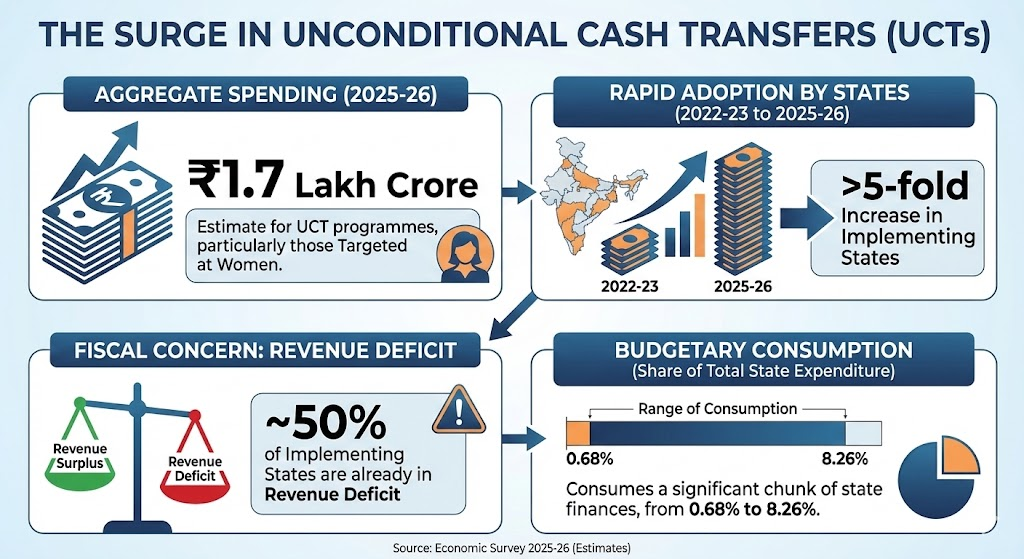
- The Economic Survey 2025-26 has strongly cautioned against the rising trend of Unconditional Cash Transfers (UCT) by States, citing threats to fiscal sustainability, especially as four major states prepare for assembly elections this year.
The Fiscal Burden and Sustainability Concerns
- The rapid scale-up of these transfers raises serious questions about Fiscal Sustainability as they absorb a large portion of the state’s limited revenues.
- In terms of economic impact, these transfers amount to between 0.19% to 1.25% of the Gross Domestic Product (GDP) of the respective States.
- The Survey argues that while transfers provide immediate relief, they become a burden when not complemented by structural investments in Employment and Skill Development.
- There is a fear that the persistence of such schemes creates Fiscal Rigidity, leaving states with very little room to maneuver during economic downturns.
Crowding Out Capital Expenditure
- The Survey notes a shift within state spending where Revenue Expenditure (day-to-day expenses) continues to dominate, accounting for 84% of total expenditure.
- As cash transfers eat up the Available Fiscal Space, the scope for expanding productive Capital Expenditure becomes increasingly constrained.
- Resources that should ideally be used for building critical infrastructure like roads, schools, and hospitals are being diverted to fund consumption-based transfers.
- The Survey explicitly warns that capital expenditure often becomes the Casualty of fiscal pressure, which has adverse implications for the state’s Medium-Term Growth.
Structural Flaws in Policy Design
- A major design flaw flagged by the Survey is that many of these populist schemes lack clear Sunset Clauses, meaning there is no defined end date for the payouts.
- The absence of mandatory Periodic Reviews makes these expenditures rigid, preventing governments from reallocating funds based on changing economic needs.
- States face a difficult Trade-off where funding these schemes often requires increasing fiscal deficits, which further deteriorates their Financial Health.
