


 Profile
 Settings
 Refer your friends
 Sign out




Why in News:
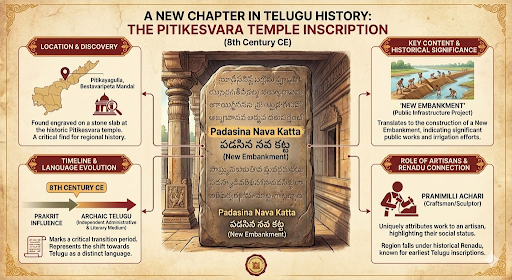
- A rare 8th-century Telugu inscription was recently discovered at Pitikayagulla village in Prakasam district, Andhra Pradesh, offering new insights into early Telugu language evolution.
- Location: Found engraved on a stone slab at the historic Pitikesvara temple in Pitikayagulla village (Bestavaripeta mandal).
- Timeline: The inscription dates back to the 8th Century CE, a critical transition period for the Telugu language.
- Key Content: It contains the phrase “Padasina Nava Katta”, which translates to the construction of a “New Embankment.”
- Role of Artisans: Uniquely, the work is attributed to a craftsman/sculptor named Pranimilli Achari, highlighting the social status and active role of artisans in public infrastructure projects like irrigation.
- Language Evolution: The script represents archaic Telugu, helping historians trace the language’s shift from Prakrit influences to an independent administrative and literary medium.
- Renadu Connection: The region falls under the historical Renadu area (often associated with the Renati Cholas), known for issuing the earliest inscriptions in the Telugu language (instead of Sanskrit).
