


 Profile
 Settings
 Refer your friends
 Sign out




Why in News?
- The Ministry of Statistics and Programme Implementation (MoSPI) released the Draft Indian Statistical Institute (ISI) Bill, 2025, which has triggered widespread protests by academicians and students over concerns of loss of institutional autonomy.
Background and Significance of ISI
- The Indian Statistical Institute (ISI) was founded in 1931 by P.C. Mahalanobis in Kolkata.
- It was originally registered under the Societies Registration Act, 1860, and later under the West Bengal Societies Registration Act, 1961.
- The ISI Act, 1959 declared ISI an Institution of National Importance (INI).
- ISI played a key role in developing India’s planning and statistical system, including the creation of the National Sample Survey Organisation (NSSO).
DO YOU KNOW?
Institution of National Importance (INI)
|
Key Provision of the Draft ISI Bill, 2025
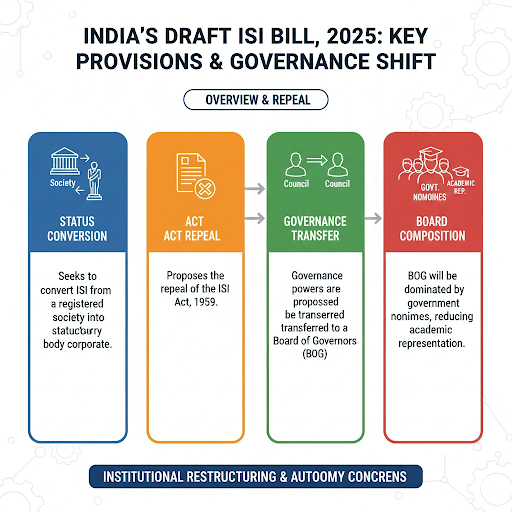
- The Bill seeks to convert ISI from a registered society into a statutory body corporate.
- It proposes the repeal of the ISI Act, 1959.
- Governance powers are proposed to be transferred to a Board of Governors (BoG).
- The BoG will be dominated by government nominees, reducing academic representation.
Governance and Appointment-Related Issues
- Earlier, ISI’s Council had nearly one-third academic representation.
- Under the new Bill, all appointments will be controlled by the Board of Governors.
- Faculty members will have no statutory representation in the new governance structure.
- There are fears of political interference in academic appointments.
Funding and Research Autonomy Concerns
- The Bill introduces a corporate-style funding model.
- Section 29 empowers ISI to generate revenue through fees, consultancy, and sponsored research.
- Critics fear basic research will suffer due to dependence on market-driven funding.
- Long-term non-commercial research may lose priority.
Government’s Justification for the Bill
- The government claims the Bill aims to make ISI globally competitive.
- It states that four review committees, including the R.A. Mashelkar Committee (2020), recommended governance reforms.
- The reforms are linked to ISI’s centenary in 2031.
- The government argues that statutory status will improve administrative efficiency.
