


 Profile
 Settings
 Refer your friends
 Sign out




Why in News:
- Scientists at the Large Hadron Collider have finally solved the mystery of how fragile atomic nuclei called deuterons manage to survive the extreme heat and force of high-speed particle collisions.
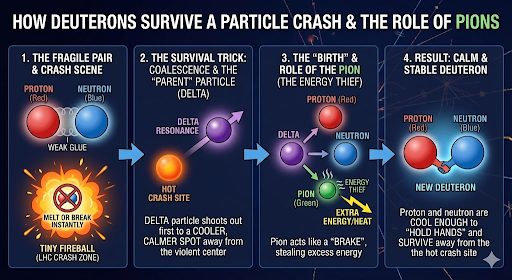
- The Fragile Pair: A Deuteron is simply one proton and one neutron stuck together. The glue holding them is very weak, so they should easily break apart in a violent crash.
- The Crash Scene: The Large Hadron Collider smashes particles together like a high-speed car crash, creating a tiny fireball. If a deuteron formed right in the center of this fireball, it would instantly melt or break.
- The Survival Trick (Coalescence): The study found that deuterons don’t form inside the hot crash zone. They form later and further away.
- The “Parent” Particle (Delta Resonance): A temporary particle called “Delta” shoots out from the crash site first. It travels a short distance away from the violent center to a cooler, calmer spot.
- The “Birth”: After moving away, the Delta particle breaks down (decays) to release a proton/neutron and a Pion.
- Role of the Pion (The Energy Thief): This is the key. For a proton and neutron to stick together, they must be calm (low energy). The Pion acts like a “brake”—it carries away the extra energy/heat.
- Result: Because the Pion steals the excess energy, the proton and neutron are cool enough to “hold hands” and become a deuteron. Since this happens away from the hot crash site, the new deuteron survives.
