Profile
 Settings
 Refer your friends
 Sign out




Why in News?
- The Executive Body of the UNECE Air Convention recently met to advance the formal revision of the Gothenburg Protocol, targeting a significant reduction in health and ecosystem impacts by 2040 by potentially including methane and black carbon as mandatory pollutants.
The Convention on Long-Range Transboundary Air Pollution (CLRTAP)
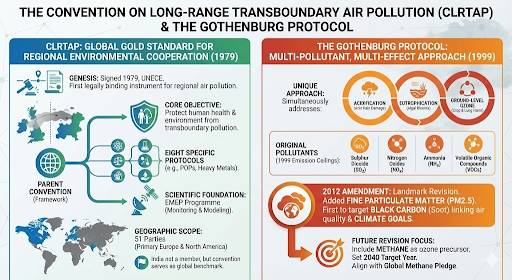
- Genesis: Signed in 1979 under the UNECE, it was the first international legally binding instrument to address regional air pollution.
- Core Objective: To protect human health and the environment from air pollution that travels across national borders (transboundary pollution).
- Framework Nature: It functions as a parent convention with eight specific protocols targeting different substances, such as persistent organic pollutants (POPs) and heavy metals.
- Scientific Foundation: It relies on the EMEP Programme for monitoring and modeling the atmospheric transport of pollutants.
- Geographic Scope: It covers 51 Parties, primarily in Europe and North America. While India is not a member, the convention serves as the global gold standard for regional environmental cooperation.
The Gothenburg Protocol (1999)
- Unique Approach: Known as the multi-pollutant, multi-effect protocol, it simultaneously addresses three environmental issues: acidification, eutrophication, and ground-level ozone.
- Original Pollutants: Established emission ceilings for four major pollutants:
- Sulphur Dioxide
- Nitrogen Oxides
- Ammonia
- Volatile Organic Compounds (VOCs)
- The 2012 Amendment: A landmark revision added Fine Particulate Matter and was the first international treaty to target Black Carbon (soot) as a component to link air quality with climate goals.
- Environmental Targets:
- Acidification: Reduces acid rain that damages soil and water.
- Eutrophication: Limits nitrogen buildup that causes algal blooms in lakes.
- Ground-level Ozone: Reduces “bad ozone” created by NOx and VOCs in sunlight, which harms crops and human lungs.
- Future Revision Focus: Current negotiations aim to include Methane as a mandatory ozone precursor and set a 2040 target year for new reduction commitments, aligning the protocol with the Global Methane Pledge.
DO YOU KNOW?
UNECE Air Convention
|