Profile
 Settings
 Refer your friends
 Sign out




Why in News?
![]()
- India is currently facing the dual challenge of meeting rising domestic food demands while coping with the increasing unpredictability of weather, declining soil health, and growing air pollution, necessitating an urgent shift toward Climate-Resilient Agriculture (CRA).
Understanding Climate-Resilient Agriculture (CRA)
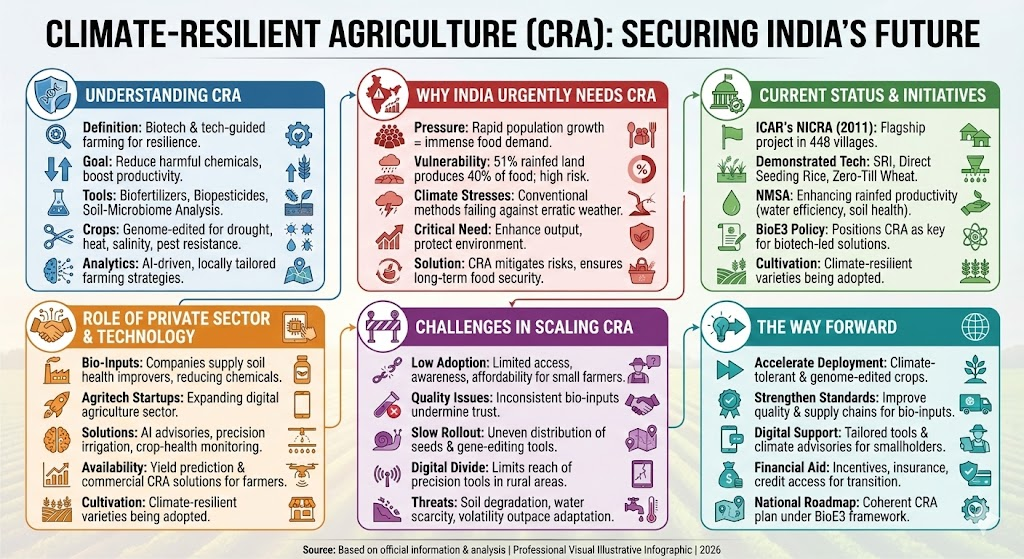
- Climate-Resilient Agriculture refers to the use of biotechnology and complementary technologies to guide farming practices effectively.
- It aims to reduce dependence on harmful chemical inputs while simultaneously maintaining or improving overall agricultural productivity.
- The approach utilizes advanced tools such as biofertilizers, biopesticides, and detailed soil-microbiome analyses to enhance crop health.
- It also incorporates genome-edited crops designed to withstand stressors like drought, heat, salinity, and pest pressures.
- AI-driven analytics are used to integrate environmental variables and generate locally tailored farming strategies for farmers.
Why India Urgently Needs CRA
- India is an agricultural nation with a rapidly growing population, creating immense pressure to ensure reliable and consistent farm productivity.
- Approximately 51% of India’s net sown area is rainfed, yet this land produces nearly 40% of the country’s food, making it highly vulnerable to climate shocks.
- Conventional farming methods are proving insufficient to withstand rising climate stresses such as erratic rainfall and temperature spikes.
- There is a critical need for technologies that can enhance food output while protecting environmental health from further degradation.
- CRA offers a necessary suite of solutions to mitigate risks associated with climate variability and ensure long-term food security.
Current Status and Government Initiatives
- In 2011, the Indian Council of Agricultural Research (ICAR) launched the flagship project National Innovations in Climate Resilient Agriculture (NICRA).
- This project has demonstrated technologies like System of Rice Intensification (SRI), direct seeding of rice, and zero-till wheat sowing in 448 villages.
- The National Mission for Sustainable Agriculture (NMSA) focuses on enhancing productivity in rainfed areas through water use efficiency and soil health management.
- The recently introduced BioE3 policy has positioned CRA as a key thematic area for the development of biotechnology-led solutions.
- Various climate-resilient varieties tolerant to extreme weather conditions are being cultivated to enhance the adaptive capacity of farmers.
Role of Private Sector and Technology
- Leading private companies are actively supplying bio-inputs that improve soil health and reduce the sector’s chemical dependence.
- India has an expanding digital agriculture sector, with numerous agritech startups offering innovative solutions to farmers.
- These startups provide AI-enabled advisories, precision irrigation systems, and tools for crop-health monitoring.
- Technologies for yield prediction and commercialized CRA solutions are increasingly becoming available to the farming community.
Challenges in Scaling CRA
- There is low adoption among small and marginal farmers due to limited access, lack of awareness, and affordability issues.
- Quality inconsistencies in biofertilizers and biopesticides often undermine farmer trust in biological alternatives.
- The rollout of climate-resilient seeds and gene-editing tools remains slow and unevenly distributed across different States.
- A significant digital divide limits the reach of precision agriculture tools and AI-based decision support systems in rural areas.
- Accelerating soil degradation, water scarcity, and climate volatility threaten to outpace current adaptation efforts.
The Way Forward
- India must accelerate the development and deployment of climate-tolerant and genome-edited crops to ensure future food security.
- It is essential to strengthen quality standards and supply chains for biofertilizers and biopesticides to build trust.
- The government should provide digital tools and climate advisories specifically tailored to support small landholders.
- Financial incentives, climate insurance, and improved credit access are critical to support farmers during this transition.
- A coherent national CRA roadmap under the BioE3 framework is needed to align biotechnology, policy, and climate adaptation