Profile
 Settings
 Refer your friends
 Sign out




Why in News?
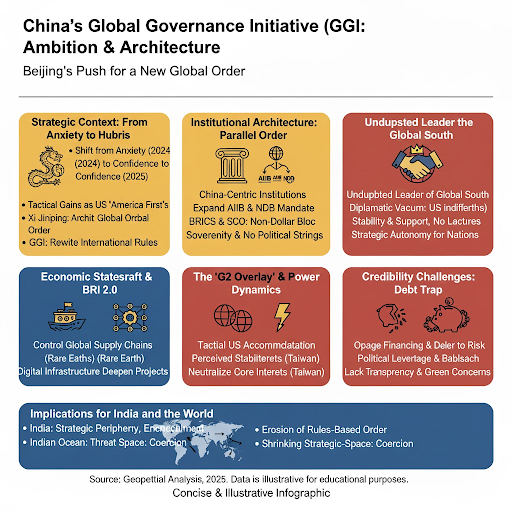
![]()
- As 2026 begins, China has unveiled an assertive strategy to reshape global norms through a Global Governance Initiative (GGI), filling the strategic vacuum left by Western retrenchment and positioning Beijing as the primary stabilizing force for the developing world.
The Strategic Context: From Anxiety to Hubris
- China has shifted from a state of economic anxiety in 2024 to a posture of strategic confidence and regained momentum by mid-2025.
- The leadership in Beijing believes it has secured tactical advantages in the great power competition, particularly as the U.S. turns inward under an “America First” policy.
- President Xi Jinping views the current geopolitical climate as an opportunity to project China not just as a participant, but as an architect of global order.
- This confidence drives the GGI, which seeks to rewrite international rules to favor state-led development models over Western liberal democratic norms.
Institutional Architecture: Building a Parallel Order
- Beijing is aggressively pushing a China-centric institutional architecture that challenges the post-WWII dominance of the IMF and World Bank.
- The strategy involves expanding the mandate and membership of the Asian Infrastructure Investment Bank (AIIB) and the New Development Bank (NDB).
- China is utilizing an expanded BRICS grouping and the Shanghai Cooperation Organisation (SCO) to create an economic bloc independent of the U.S. dollar system.
- These institutions are marketed as alternatives that respect “sovereignty” and do not impose political conditionality like Western institutions do.
Leadership of the Global South
- A core pillar of the GGI is positioning China as the undisputed leader and protector of the Global South against perceived Western neglect.
- Beijing is leveraging the diplomatic vacuum created by the U.S.’s reduced focus on the Indo-Pacific to strengthen ties with Africa, Latin America, and Southeast Asia.
- President Xi promotes China as a stabilizing partner, offering security and economic support without lecturing nations on human rights or internal governance.
- This narrative appeals to developing nations seeking strategic autonomy and diversification away from traditional Western alliances.
Economic Statecraft and BRI 2.0
- The Belt and Road Initiative (BRI) remains the central engine of China’s global governance strategy, but it is being rebooted with a focus on strategic assets.
- China is stepping up diplomatic initiatives and influence operations to secure upstream control of critical global supply chains, from rare earths to energy.
- The initiative now emphasizes digital governance and standard-setting in emerging technologies like AI, where China seeks to define global rules.
- Despite economic headwinds at home, Beijing continues to fund large-scale infrastructure projects to deepen the economic dependence of partner nations.
The “G2 Overlay” and Great Power Dynamics
- China’s governance push is aided by a tactical accommodation with the U.S., creating a perception of a “G2 overlay” or a shadow condominium of power.
- Beijing uses this perceived stability to signal to other nations that the U.S.-China rivalry is being managed, making it safer for them to align with China.
- However, China refuses to accommodate divergence on core interests (like Taiwan), signalling that its version of global governance requires strict adherence to its red lines.
- The initiative seeks to neutralize external balancing by convincing middle powers that resisting China’s rise is futile and economically costly.
Credibility Challenges: The Debt Trap Dilemma
- Despite its ambitions, the GGI faces significant backlash regarding opaque financing practices associated with Chinese loans.
- Many partner nations in the Global South are increasingly wary of debt vulnerabilities that compromise their fiscal sovereignty.
- There is growing global unease about the political leverage Beijing derives from these economic dependencies, leading to “pushback” in some regions.
- Environmental concerns and the lack of transparency in project implementation continue to undermine the “benevolent leader” narrative China tries to project.
Implications for India and the World
- For India, the GGI represents a direct challenge as China treats South Asia as its strategic periphery, encircling India through economic and military partnerships.
- The expansion of Chinese influence into the Indian Ocean under the guise of protecting maritime trade threatens India’s traditional sphere of influence.
- Global governance under Chinese leadership risks eroding the rules-based order, replacing it with a transactional system based on power and hierarchy.
- Nations are facing a “shrinking strategic space,” forced to navigate a world where policy autonomy is increasingly constrained by Beijing’s economic coercion.