


 Profile
 Settings
 Refer your friends
 Sign out




Why in News?
- A recent research study using data from the Longitudinal Ageing Study of India (LASI) has provided new insights into the health, lifestyle, and well-being of centenarians (100+ years) in India.
Importance of Studying Centenarians
- Centenarians provide valuable insights into healthy aging and human longevity.
- Their lives help researchers understand the role of healthcare behaviour, diet, lifestyle, and social security in long life.
- While advanced countries invest heavily in longevity research, India has limited research and reliable data on its oldest-old population.
- India’s traditional knowledge systems contain wisdom on long life, but scientific validation is still lacking.
Key Health Markers of Indian Centenarians
- Most centenarians in the study were found to be in good overall health with strong biological resilience.
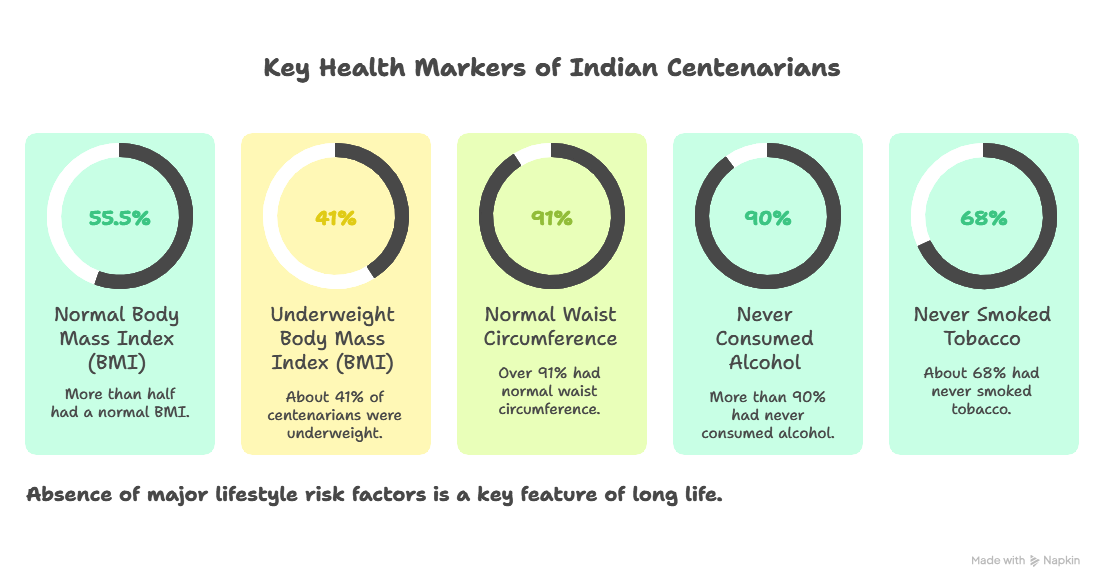
- More than half (55.5%) had a normal Body Mass Index (BMI), while about 41% were underweight.
- Over 91% had normal waist circumference, and none were overweight.
- Chronic diseases were almost absent, with no cases of heart disease or stroke and very few cases of diabetes.
- More than 90% had never consumed alcohol, and about 68% had never smoked tobacco.
- These findings show that absence of major lifestyle risk factors is a key feature of long life.
Implications for Nutrition and Public Health Policy
- The findings support a shift toward dietary moderation, physical activity, and weight management at the population level.
- Public health policies should promote low-fat, low-sugar, and low-salt diets.
- Alcohol and tobacco use must be restricted through behaviour-based interventions.
- Early preventive health action is needed to reduce the future burden of lifestyle diseases.
Policy Implications for Elderly Care
- There is a need for formal caregiving systems, community day-care services, and accessible transport for the elderly.
- Professional nursing and ambulatory services must be expanded.
- Behavioural change is required to destigmatise the use of outside help for elderly care.
- Technology such as remote monitoring and geriatric assistive devices should be promoted.
- Stronger social security systems are needed to support paid caregiving and financial independence.
Future of Longevity Research in India
- India is projected to become home to the largest number of centenarians in the world by 2050.
- There is an urgent need to build a strong national database on centenarians, their location, health, and lifestyles.
- India’s success in maternal and child health data collection should now be extended to ageing research.
- Longevity is influenced by biological, genetic, lifestyle, clinical, and socioeconomic factors.
- India’s large population and diversity offer a unique opportunity for global research on healthy ageing.
