Profile
 Settings
 Refer your friends
 Sign out




Why in News?
- The External Affairs Minister addressed a conference marking 50 years of the Biological Weapons Convention, highlighting global gaps in preparedness against bioterrorism.
DO YOU KNOW?Biological Weapons Convention (BWC)
|
Definition of Bioterrorism
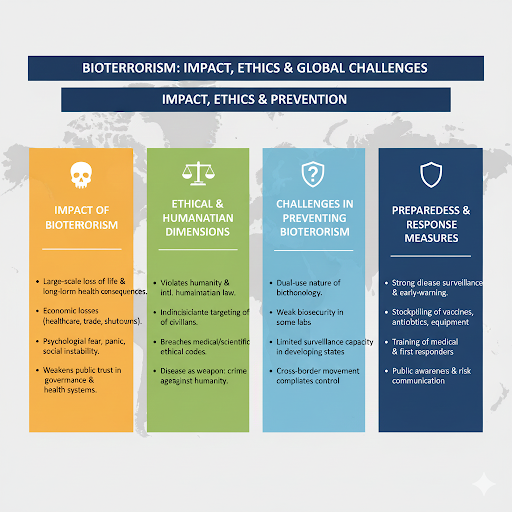
- Bioterrorism refers to the deliberate release of biological agents such as bacteria, viruses, or toxins to cause disease or death in humans, animals, or plants.
- It is a form of asymmetric warfare where small resources can cause large-scale damage.
- The objective is to create fear, economic disruption, and social instability.
- It is classified as a non-conventional security threat under internal and external security frameworks.
Nature of Biological Agents Used
- Common agents include anthrax, smallpox, plague, botulinum toxin, and viral hemorrhagic fevers.
- These agents are often highly infectious or toxic with low infectious doses.
- Some biological agents have high mortality but limited spread, while others spread rapidly with moderate mortality.
- Many biological agents can be genetically modified to increase virulence or resistance.
Characteristics That Make Bioterrorism Dangerous
- Biological agents are often invisible, odorless, and difficult to detect in real time.
- The incubation period delays detection, allowing silent spread.
- Attacks can cause mass panic and overload public health systems.
- Attribution of perpetrators is technically complex and time-consuming.
Historical Instances of Bioterrorism
- The 2001 anthrax letter attacks in the United States caused deaths and nationwide panic.
- During World War II, Japan’s Unit 731 used biological agents in China.
- Several terrorist organizations have attempted or planned biological attacks, though most failed.
- These examples highlight the long-standing and evolving nature of bioterror threats.
Global Legal and Institutional Framework
- The Biological Weapons Convention (BWC), 1972 prohibits development, production, and stockpiling of biological weapons.
- The United Nations Security Council Resolution 1540 obligates States to prevent non-state actors from acquiring WMDs.
- The World Health Organization (WHO) provides early warning and global disease surveillance mechanisms.
- International cooperation is essential due to the transnational impact of biological threats.
Bioterrorism and Internal Security
- Bioterrorism directly threatens internal security by targeting civilian populations and critical infrastructure.
- It can disrupt food security, water supply, healthcare systems, and public order.
- Urban density and mobility enhance the potential scale of attacks.
- It requires integrated response from health, security, and disaster management agencies.
India’s Biosecurity and Legal Framework
- India is a signatory to the Biological Weapons Convention and is legally bound to its provisions.
- The Disaster Management Act, 2005 provides the institutional framework for response to biological disasters.
- The Epidemic Diseases Act, 1897 and relevant provisions of Bharatiya Nyaya Sanhita support legal action.
- The National Disaster Management Authority (NDMA) has issued guidelines for biological disaster management.
Institutional Mechanisms in India
- The Ministry of Home Affairs coordinates internal security and counter-terror response.
- The Ministry of Health and Family Welfare leads disease surveillance and medical response.
- The Integrated Disease Surveillance Programme (IDSP) tracks outbreak patterns.
- The National Centre for Disease Control (NCDC) supports laboratory and epidemiological capacity.