Profile
 Settings
 Refer your friends
 Sign out




Why in News:
![]()
- The Supreme Court recently ruled that using unproven stem cell therapy to treat Autism constitutes “medical negligence” and “professional misconduct,” halting its commercial practice.
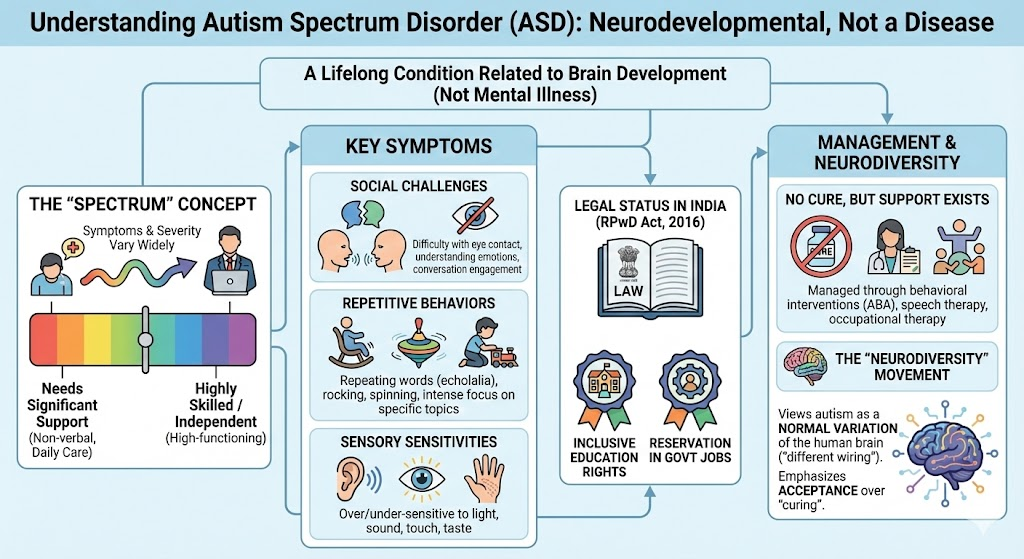
- Definition: ASD is a neurodevelopmental disorder that affects how a person communicates, interacts, and behaves. It is not a disease or a mental illness, but a lifelong condition related to brain development.
- The “Spectrum” Concept: It is called a “spectrum” because the symptoms and severity vary widely. One person might need significant daily support (non-verbal), while another might be highly skilled and live independently (“high-functioning”).
- Key Symptoms:
- Social Challenges: Difficulty in making eye contact, understanding emotions, or engaging in conversation.
- Repetitive Behaviors: Repeating words (echolalia), rocking, spinning, or having an intense focus on specific topics.
- Sensory Sensitivities: Being over-sensitive or under-sensitive to light, sound, touch, or taste.
- Legal Status in India: Autism is recognized as a specific disability under the Rights of Persons with Disabilities (RPwD) Act, 2016. This grants individuals rights to inclusive education and reservation in government jobs.
- No Known Cure: Currently, there is no medical cure for autism. It is managed through behavioral interventions (like Applied Behavior Analysis), speech therapy, and occupational therapy.
- The “Neurodiversity” Movement: This concept views autism not as a defect to be fixed, but as a normal variation of the human brain (different “wiring”), emphasizing acceptance over “curing.”