


 Profile
 Settings
 Refer your friends
 Sign out




Why in News?
- A new global study has reported early warning signs of artemisinin resistance emerging in Africa, raising concerns about the future effectiveness of the world’s most important anti-malaria drug.
Background: The Malaria Drug Crisis
- During the Vietnam War, malaria caused more deaths than combat due to chloroquine resistance in malaria parasites.
- Vietnam sought help from China, leading to the launch of Project 523 to find new anti-malarial drugs.
- This effort marked a major turning point in malaria treatment history.
Discovery of Artemisinin
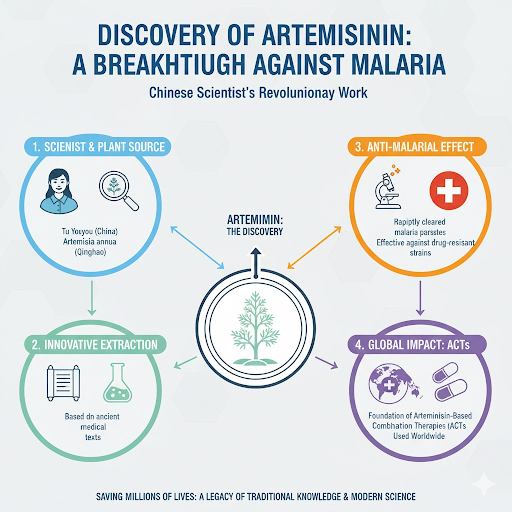
- Chinese scientist Tu Youyou identified artemisinin from the plant Artemisia annua (qinghao).
- She used low-temperature extraction, based on ancient medical texts, to preserve the active compound.
- Artemisinin proved highly effective, rapidly clearing malaria parasites, including chloroquine-resistant strains.
- It later became the foundation of artemisinin-based combination therapies (ACTs) used worldwide.
Global Impact and Recognition
- Artemisinin-based therapies became the backbone of global malaria control after the 1980s.
- The discovery saved millions of lives, especially in Africa and Southeast Asia.
- In 2015, Tu Youyou won the Nobel Prize in Medicine, highlighting the drug’s global significance.
Emergence of Artemisinin Resistance
- By the late 2000s, delayed parasite clearance was observed in Southeast Asia.
- Resistance was linked to mutations in the kelch13 gene of the malaria parasite.
- These mutations allow parasites to survive drug exposure by slowing their growth temporarily.
- Strong regional surveillance helped contain resistance in Southeast Asia, preventing global spread.
New Evidence of Resistance in Africa
- A large study published in eLife analysed 1.1 lakh parasite samples from 73 countries.
- It found rising kelch13 mutations in Northeast and East Africa, especially in Rwanda, Uganda, Tanzania, Ethiopia, and Sudan.
- Around 10% of samples in Northeast Africa showed resistance markers.
- These mutations appear to be locally emerging, not imported from Asia.
Why Africa Is at Risk
- Heavy use of artemisinin, poor treatment adherence, and weak surveillance increase resistance risk.
- Resistant parasites survive longer and spread more easily through mosquitoes.
- Once resistance becomes widespread, it is very difficult to reverse, as seen with chloroquine.
- Africa still has a window of opportunity because resistance levels remain low in most regions.
Data Gaps and Surveillance Challenges
- Malaria surveillance weakened after 2019 due to COVID-19 and funding cuts.
- Sample collection declined, especially from Southeast Asia, a historic resistance hotspot.
- Differences in genetic testing methods may have missed rare mutations.
- These gaps highlight the need for stronger and more consistent global surveillance.
Way Forward and Global Significance
- Experts call for urgent action to prevent a full-scale resistance crisis in Africa.
- Key steps include improving genetic surveillance, diversifying malaria drugs, and monitoring partner-drug resistance.
- Sustained funding and rapid policy adjustments are essential to protect ACT effectiveness.
- Artemisinin’s story shows that scientific breakthroughs must be matched with vigilance, not complacency.
