


 Profile
 Settings
 Refer your friends
 Sign out




Why in News?
- The Supreme Court of India, in its November–December 2025 judgment, accepted a uniform scientific definition of the Aravalli Hills and Ranges and paused new mining leases until a comprehensive Management Plan for Sustainable Mining (MPSM) is prepared, to safeguard the fragile Aravalli ecosystem.
Background of the Supreme Court Intervention
- The Supreme Court examined long-standing concerns over unregulated and illegal mining in the Aravalli region spanning Delhi, Haryana, Rajasthan, and Gujarat.
- It constituted a Committee led by the Ministry of Environment, Forest and Climate Change (MoEF&CC) with experts from the Forest Survey of India (FSI), Geological Survey of India (GSI) and the Central Empowered Committee (CEC).
- The Court emphasised that the Aravallis are a national ecological asset, not merely a mineral-bearing zone.
- The judgment aims to bring clarity, uniformity, and enforceability in protecting the Aravalli landscape.
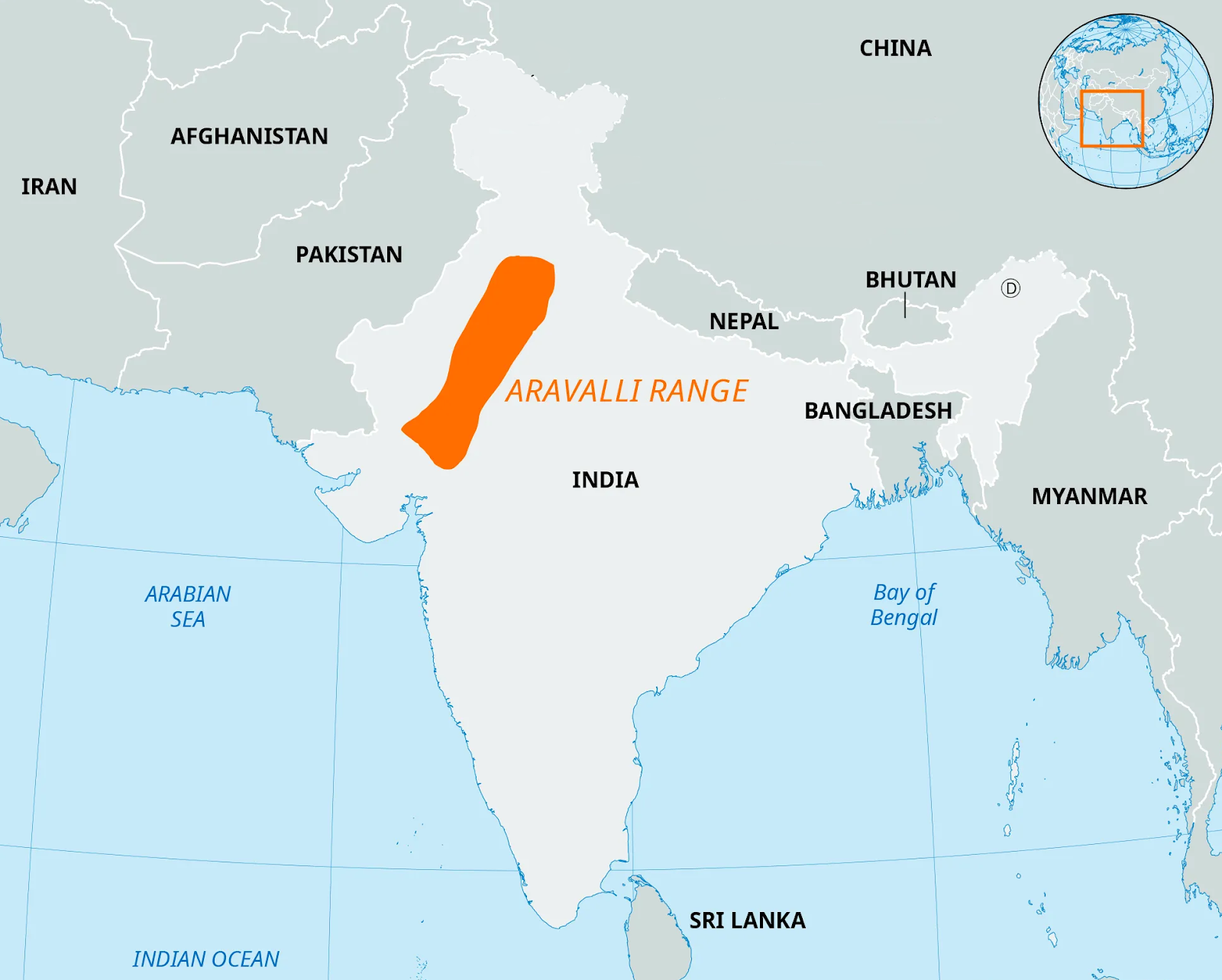
Ecological Importance of the Aravalli Hills
- The Aravallis are among the oldest mountain ranges in the world, stretching about 650 km from Delhi to Gujarat.
- They act as a natural barrier against the eastward spread of the Thar Desert, protecting the Indo-Gangetic plains.
- The range plays a crucial role in groundwater recharge, climate moderation, and air-quality regulation in the National Capital Region (NCR).
- It supports rich biodiversity, wildlife corridors, and river systems such as the Chambal, Sabarmati and Luni.
Need for a Uniform Definition
- Different States earlier used inconsistent criteria to define Aravalli hills, enabling regulatory loopholes.
- The Forest Survey of India (FSI) had proposed multiple parameters, leading to ambiguity in enforcement.
- To resolve this, the Supreme Court mandated a single, scientific, and nationally applicable definition.
- Uniformity was necessary to prevent selective mining approvals and ecological fragmentation.
Final Scientific Definition Accepted by the Court
- Aravalli Hills are defined as any landform rising 100 metres or more above local relief, including the entire enclosed hill mass and its supporting slopes.
- Aravalli Ranges consist of two or more such hills located within 500 metres of each other, along with the landforms between them.
- Importantly, all slopes, foothills, valleys and intervening landforms are included, irrespective of their height.
- This ensures that mining is not automatically permitted below 100 metres, closing a major regulatory gap.
Supreme Court Directions on Mining Regulation
- The Court accepted all recommendations of the MoEF&CC Committee.
- New mining leases are frozen until a landscape-wide Management Plan for Sustainable Mining (MPSM) is finalised.
- Existing legal mines may continue, but only under strict environmental and monitoring conditions.
- Mining is absolutely prohibited in core/inviolate areas, except in rare cases involving critical, strategic, or atomic minerals under the Mines and Minerals (Development and Regulation) Act, 1957 (MMDR Act).
DO YOU KNOW?
Mines and Minerals (Development and Regulation) Act, 1957
|
Management Plan for Sustainable Mining (MPSM)
- The Court directed the Indian Council of Forestry Research and Education (ICFRE) to prepare the MPSM for the entire Aravalli landscape.
- The plan must identify no-mining zones, highly regulated zones, and restoration-priority areas.
- It must assess cumulative environmental impacts, ecological carrying capacity, and long-term sustainability.
- Detailed post-mining restoration and rehabilitation measures are mandatory components.
DO YOU KNOW?
Indian Council of Forestry Research and Education (ICFRE)
|
Protection of Core and Ecologically Sensitive Areas
- Mining is prohibited in Protected Areas, Tiger Reserves, wildlife corridors, Eco-Sensitive Zones (ESZs) and wetlands.
- Areas afforested using Compensatory Afforestation Fund Management and Planning Authority (CAMPA) funds are fully protected.
- A minimum 1 km buffer from Protected Area boundaries applies even where ESZs are narrower.
- These safeguards ensure habitat connectivity and biodiversity conservation.
- The Court endorsed technology-based surveillance, including drones, CCTV cameras and electronic weighbridges.
- District-level task forces involving revenue, forest, mining and police departments are mandated.
- Transport oversight through e-challans and continuous monitoring by State Pollution Control Boards (SPCBs) is required.
- Repeated violations can lead to suspension of Environmental Clearance (EC) and closure of mines.
Balancing Conservation with Development
- The Court rejected a blanket mining ban, noting that such bans often fuel illegal mining mafias.
- Instead, it adopted a calibrated approach combining protection of sensitive zones with regulated economic activity.
- Sustainable mining, where permitted, must comply with Environmental Impact Assessment (EIA) and Environmental Management Plans (EMP).
- This approach aligns environmental protection with responsible development.
