


 Profile
 Settings
 Refer your friends
 Sign out




Why in News?
- The Department for Promotion of Industry and Internal Trade (DPIIT) has released a working paper proposing a new framework for the use of online content by Artificial Intelligence (AI) models and the payment of royalties to copyright holders.
Key Proposal on Access to Online Content
- The paper suggests that AI models should, by default, have access to freely available online content.
- Publishers should not be given a direct opt-out option for such publicly available content.
- This means AI developers would be legally allowed to scrape open web data.
- The objective is to remove legal uncertainty around training AI models.
Proposal for a Royalty Collection System
- The paper proposes the creation of a copyright society like a non-profit body.
- This body will collect royalties from AI developers.
- Royalties will be paid to both members and non-members whose content is used.
- The aim is to ensure that content creators are compensated for the use of their work.
Meaning of Artificial Intelligence and Copyright
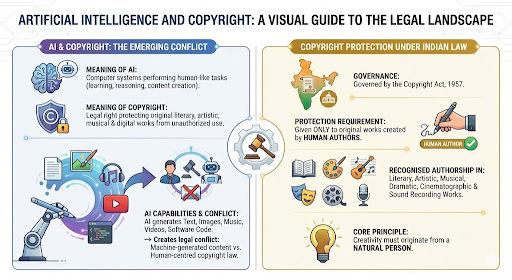
- Artificial Intelligence refers to computer systems capable of performing tasks requiring human intelligence such as learning, reasoning, and content creation.
- Copyright is a legal right that protects original literary, artistic, musical and digital works from unauthorised use.
- AI systems are now capable of generating text, images, music, videos, and software code.
- This creates a new legal conflict between machine-generated content and human-centred copyright law.
Copyright Protection under Indian Law
- Copyright in India is governed by the Copyright Act, 1957.
- Protection is given only to original works created by human authors.
- The law recognises authorship in literary, artistic, musical, dramatic, cinematographic and sound recording works.
- Indian copyright law is based on the principle that creativity must originate from a natural person.
AI Training and Use of Copyrighted Data
- AI models are trained on large datasets that often include books, articles, images and music protected by copyright.
- This raises the question of whether using copyrighted material for AI training amounts to copyright infringement.
- Many AI developers rely on exceptions such as fair use or fair dealing.
- Copyright owners argue that unauthorised data scraping harms their economic rights.
Ownership of AI-Generated Works
- A major legal issue is who owns the copyright in content generated by AI systems.
- Under Indian law, only human creators are recognised as authors, not machines.
- If a human exercises substantial control over the AI output, that person may claim authorship.
- Fully autonomous AI-generated content currently exists in a legal grey zone without clear ownership.
International Legal Developments on AI and Copyright
- The World Intellectual Property Organization (WIPO) is examining the global impact of AI on intellectual property rights.
- The European Union has proposed regulations requiring transparency on training data used by AI systems.
- Courts in several countries have held that AI cannot be recognised as a legal author.
- These developments influence India’s evolving approach to AI governance and copyright reform.
Economic and Creative Industry Implications
- AI has improved efficiency in publishing, media, advertising, and software development.
- At the same time, creators fear loss of income due to cheap AI-generated substitutes.
- Small artists and authors face difficulty in enforcing their copyright against large AI companies.
- The balance between innovation and protection of creative labour has become a major policy challenge.
Ethical and Constitutional Concerns
- Unauthorised use of protected works for AI training raises issues of fairness, consent, and economic justice.
- Creators may lose control over how their intellectual property is reused and monetised.
- This affects the Right to livelihood under Article 21 of the Constitution.
- Ethical AI governance demands transparency, credit, and compensation for original creators.
India’s Policy Approach and Way Forward
- India currently follows a technology-neutral copyright framework, without specific AI provisions.
- There is a growing need for clear legal guidelines on AI training data and authorship of AI outputs.
- India must balance digital innovation with protection of creative industries.
- Legal reforms, stakeholder consultations, and alignment with global IP norms are essential for future readiness.
