


 Profile
 Settings
 Refer your friends
 Sign out




Why in News:
- Researchers have developed a novel sensor that utilizes sound waves instead of chemical reactions to detect leaks of helium, a chemically inert and scarce resource.
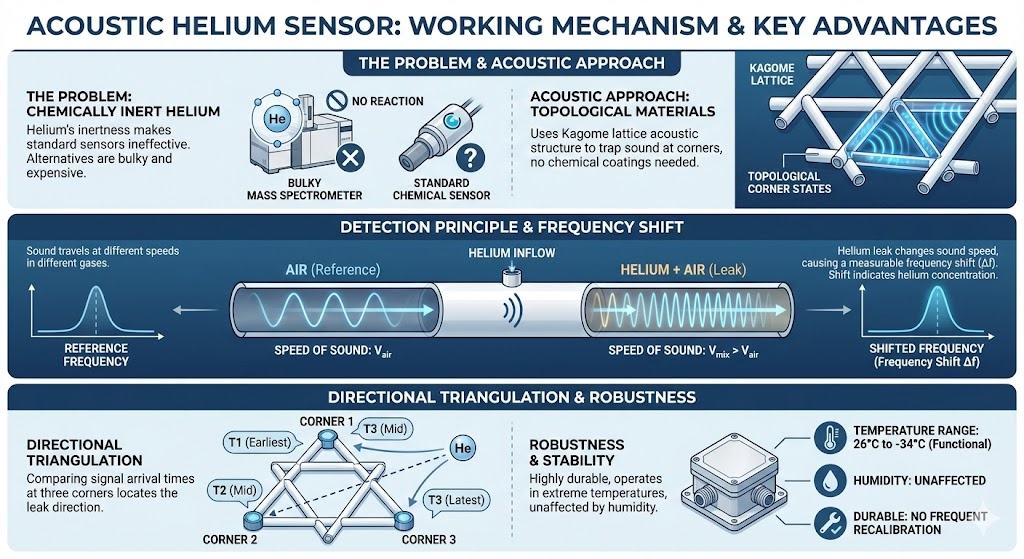
- The Problem: Helium is chemically inert (does not react easily), making standard chemical sensors ineffective. Alternative methods like mass spectrometry are often too bulky and expensive.
- Acoustic Approach: The new sensor relies on acoustic topological materials rather than chemical coatings. It uses a specific geometric structure called a Kagome lattice (interlaced triangles and hexagons).
- Topological Corner States: The sensor is designed with rigid cylinders and tubes that trap sound waves specifically at the three corners of its triangular structure, preventing them from escaping.
- Detection Principle: Sound travels at different speeds through different gases. When helium leaks into the sensor, it changes the speed of sound inside the tubes.
- Frequency Shift: This change in speed alters the frequency (pitch) of the trapped sound waves. By measuring this shift, the sensor calculates the helium concentration.
- Directional Triangulation: A unique feature is its ability to locate the leak. By comparing the timing of signals at the three distinct corners, the sensor can triangulate the direction from which the gas is originating.
- Robustness: Unlike chemical sensors, it is highly durable, functioning in temperatures from 26°C to -34°C and is unaffected by humidity changes, eliminating the need for frequent recalibration.
