


 Profile
 Settings
 Refer your friends
 Sign out




Details of the Earthquake
![]()
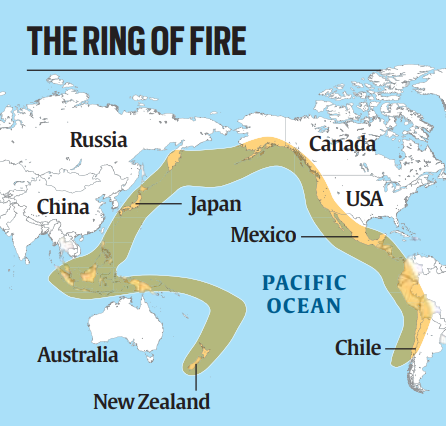
- The earthquake occurred in Russia’s Kamchatka Peninsula, 6,500 km east of Moscow.
- It generated tsunami waves: 3–4 meters in Kamchatka, ~5 feet in Hawaii, ~2 feet in Japan.
- Kamchatka lies on the “Ring of Fire”, a highly active seismic and volcanic zone around the Pacific Ocean.
- Over 80% of the world’s largest earthquakes occur here.
- The region has recorded more than 130 quakes of 7+ magnitude since 1900.
- The quake was caused by subduction, where the dense Pacific Plate moves beneath continental plates, generating pressure and causing quakes.
- The Ring of Fire has the highest number of subduction zones, explaining its high seismic activity.
- A similar process created the Himalayas, making them another major earthquake zone.
- Alpide Belt:
- Runs from Indonesia through the Himalayas to Turkey.
- Produces 15–17% of global large quakes.
- Often deadlier due to high population density.
- Mid-Atlantic Ridge:
- Underwater faultline from the Arctic to the Antarctic.
- Produces moderate quakes with minimal impact due to distance from land.
- The size of faultlines limits quake strength.
- The largest recorded quake (Chile, 1960) was 9.5 magnitude.
- Anything stronger (e.g. magnitude 10) would require a faultline nearly the length of the Earth—not geologically possible.
