Access free live classes and tests on the app
Download
+
Unacademy's Blog!
Login Join for Free
avtar
  • ProfileProfile
  • Settings Settings
  • Refer your friendsRefer your friends
  • Sign outSign out
  • Terms & conditions
  • •
  • Privacy policy
  • About
  • •
  • Careers
  • •
  • Blog

© 2023 Sorting Hat Technologies Pvt Ltd

Challenge Yourself Everyday Attempt 2023’s and previous year’s JEE Main Download Important Formulas pdf Attempt Free Test Series for JEE Main 2023

Trending Topics

  • JEE Main 2024
  • JEE Main Rank Predictor 2024
  • JEE Main Mock Test 2024
  • JEE Main 2024 Admit Card
  • JEE Advanced Syllabus
  • JEE Preparation Books
  • JEE Notes
  • JEE Advanced Toppers
  • JEE Advanced 2022 Question Paper
  • JEE Advanced 2022 Answer Key
  • JEE Main Question Paper
  • JEE Main Answer key 2022
  • JEE Main Paper Analysis 2022
  • JEE Main Result
  • JEE Exam Pattern
  • JEE Main Eligibility
  • JEE College predictor
[wp_login_wall media_id="424566" text_before_login="Download JEE Main PYQs" text_after_login="Download JEE Main 2022 Question Papers"]

JEE Coaching Centres

  • JEE Coaching in Nagpur
  • JEE Coaching in Ranchi
  • JEE Coaching in Gorakhpur
  • JEE Coaching in Bhubaneswar
  • JEE Coaching in Vijayawada
  • JEE Coaching in Dehradun
  • JEE Coaching in Indore
  • JEE Coaching in Gurugram
  • JEE Coaching in Muzaffarpur
  • JEE Coaching in Varanasi
  • JEE Coaching in Jammu
  • JEE Coaching in Kolhapur
  • JEE Coaching in Bikaner
  • JEE Coaching in Delhi Lajpat Nagar
Predict your JEE Rank . [wp_custom_style style=".side-btn-second{margin: 1px 0px;}"][wp_custom_script script="document.querySelector('.targetTopBtn').onClick = topFunction; function topFunction() { window.scrollTo({ top: 0, behavior: 'smooth' }) }"][wp_custom_style style=".side-btn-second{margin: 1px 0px;} .elementor-element.elementor-element-dcb2b31{display: none !important;}"]
Challenge Yourself Everyday Attempt 2023’s and previous year’s JEE Main Download Important Formulas pdf Attempt Free Test Series for JEE Main 2023

Trending Topics

  • JEE Main 2024
  • JEE Main Rank Predictor 2024
  • JEE Main Mock Test 2024
  • JEE Main 2024 Admit Card
  • JEE Advanced Syllabus
  • JEE Preparation Books
  • JEE Notes
  • JEE Advanced Toppers
  • JEE Advanced 2022 Question Paper
  • JEE Advanced 2022 Answer Key
  • JEE Main Question Paper
  • JEE Main Answer key 2022
  • JEE Main Paper Analysis 2022
  • JEE Main Result
  • JEE Exam Pattern
  • JEE Main Eligibility
  • JEE College predictor
[wp_login_wall media_id="424566" text_before_login="Download JEE Main PYQs" text_after_login="Download JEE Main 2022 Question Papers"]

JEE Coaching Centres

  • JEE Coaching in Nagpur
  • JEE Coaching in Ranchi
  • JEE Coaching in Gorakhpur
  • JEE Coaching in Bhubaneswar
  • JEE Coaching in Vijayawada
  • JEE Coaching in Dehradun
  • JEE Coaching in Indore
  • JEE Coaching in Gurugram
  • JEE Coaching in Muzaffarpur
  • JEE Coaching in Varanasi
  • JEE Coaching in Jammu
  • JEE Coaching in Kolhapur
  • JEE Coaching in Bikaner
  • JEE Coaching in Delhi Lajpat Nagar
Predict your JEE Rank . [wp_custom_style style=".side-btn-second{margin: 1px 0px;}"][wp_custom_script script="document.querySelector('.targetTopBtn').onClick = topFunction; function topFunction() { window.scrollTo({ top: 0, behavior: 'smooth' }) }"][wp_custom_style style=".side-btn-second{margin: 1px 0px;} .elementor-element.elementor-element-dcb2b31{display: none !important;}"]
JEE Main 2026 Preparation: Question Papers, Solutions, Mock Tests & Strategy Unacademy » JEE Study Material » Chemistry » Covalent Bonding in Carbon Atom
Challenge Yourself Everyday Attempt 2023’s and previous year’s JEE Main Download Important Formulas pdf Attempt Free Test Series for JEE Main 2023

Trending Topics

  • JEE Main 2024
  • JEE Main Rank Predictor 2024
  • JEE Main Mock Test 2024
  • JEE Main 2024 Admit Card
  • JEE Advanced Syllabus
  • JEE Preparation Books
  • JEE Notes
  • JEE Advanced Toppers
  • JEE Advanced 2022 Question Paper
  • JEE Advanced 2022 Answer Key
  • JEE Main Question Paper
  • JEE Main Answer key 2022
  • JEE Main Paper Analysis 2022
  • JEE Main Result
  • JEE Exam Pattern
  • JEE Main Eligibility
  • JEE College predictor
[wp_login_wall media_id="424566" text_before_login="Download JEE Main PYQs" text_after_login="Download JEE Main 2022 Question Papers"]

JEE Coaching Centres

  • JEE Coaching in Nagpur
  • JEE Coaching in Ranchi
  • JEE Coaching in Gorakhpur
  • JEE Coaching in Bhubaneswar
  • JEE Coaching in Vijayawada
  • JEE Coaching in Dehradun
  • JEE Coaching in Indore
  • JEE Coaching in Gurugram
  • JEE Coaching in Muzaffarpur
  • JEE Coaching in Varanasi
  • JEE Coaching in Jammu
  • JEE Coaching in Kolhapur
  • JEE Coaching in Bikaner
  • JEE Coaching in Delhi Lajpat Nagar
Predict your JEE Rank . [wp_custom_style style=".side-btn-second{margin: 1px 0px;}"][wp_custom_script script="document.querySelector('.targetTopBtn').onClick = topFunction; function topFunction() { window.scrollTo({ top: 0, behavior: 'smooth' }) }"][wp_custom_style style=".side-btn-second{margin: 1px 0px;} .elementor-element.elementor-element-dcb2b31{display: none !important;}"]

Covalent Bonding in Carbon Atom

This article covers covalent bonding in carbon atoms. It includes what covalent bonding is and how it occurs in the case of carbon atoms.

Table of Content
  •  

Covalent bonds are a class of synthetic bonds where valence electrons are divided among two molecules, ordinarily two non-metals. The arrangement of a covalent bond permits the non-metals to comply with the octet rule and, along these lines, become more steady. Covalent holding requires a particular direction between molecules to accomplish the cross-over between holding orbitals.

Tetravalency of Carbon

Carbon is a nonmetal in group 14 of the periodic table. The nuclear number of carbon is six, with an electronic arrangement of 2, 4. Along these lines, carbon has four valence electrons in its valence shell. Valence electrons are the electrons in a molecule’s external energy level associated with the synthetic bond arrangement.

Carbon needs four more valence electrons to fill its outermost energy level with eight electrons. A full outer energy level is the most steady course of action of electrons.

Carbon can form four covalent bonds. Covalent bonds are bonds that are formed between nonmetals. In a covalent bond, two molecules share a couple of electrons. By framing four covalent bonds, carbon shares four sets of electrons, filling its outer energy level and accomplishing dependability.

Different Types of Carbon Compounds

  • Saturated carbon compounds: These are compounds in which carbon atoms are linked together with a single bond only to form the aliphatic or ring-like configuration. Alkanes like methane, ethane, etc., are perfect examples.
  • Unsaturated carbon compounds: These are compounds in which carbon atoms are linked together with double bonds or triple bonds and single bonds to attain a chain-like or a ring-like configuration. Ethene, benzene, etc., belong to this category of carbon compounds.

Covalent Bonding and Covalent Compounds

A covalent bond is the interatomic bond formed by the sharing of an electron pair between two atoms. The electrostatic attraction of the nuclei of the two atoms for the identical electrons causes the bonding in covalent compounds.

A covalent compound is a molecule produced by covalent bonds in which one or more pairs of valence electrons are shared by the atoms.

Types of Covalent Bonds

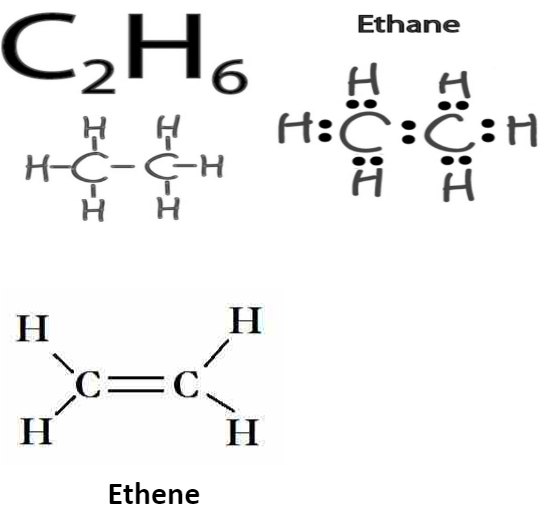
All bonds are represented as single lines in the ethane Lewis formula shown.Each bond is made up of two electrons, known as bonding electrons. It is also feasible for two atoms to share four electrons if they are bound together. This bonding structure, known as a double bond, is illustrated by two lines representing two electrons.

An example is the ethene molecule illustrated below.
i1
i2

Six electrons can be shared between two atoms. In this situation, the representation is made up of three single lines, a configuration known as a triple bond. The acetylene molecule illustrates a triple bond.

This nomenclature (single, double, or triple bond) is quite flexible and informal. However, calculations do not accurately represent the true nature of the bonds. They are, nonetheless, quite beneficial in a variety of scenarios.

Covalent Polar Bond

Covalent polar  bond is formed between the two atoms where the electrons which form the bond are distributed unequally.  Electrons will be drawn to more electronegative atoms. As a result, the common electron pair will be closer to that atom. Oxygen-hydrogen, nitrogen-hydrogen, and sulphur-oxygen are molecules that form hydrogen bonds due to an imbalanced electrostatic potential.

Non-polar Covalent Bond

This covalent connection is established when two atoms share an equal number of electrons. Non-polar covalent bonds form when the atoms combining have comparable electron affinities (diatomic elements).

Non-polar covalent bonds, for example, can be present in gas molecules such as hydrogen gas, nitrogen gas, etc.

Covalent Bond Formation

Covalent bonds arise because they provide atoms with a more stable electron configuration. An oxygen atom has six valence electrons on its own. Each oxygen atom contains eight valence electrons since it shares two pairs of valence electrons. This fills its outer energy level, resulting in the most stable electron configuration. The shared electrons are attracted to both oxygen nuclei, and this force of attraction keeps the two atoms in the oxygen molecule together.

Formation of Covalent Bonds in Carbon Compounds

A carbon atom can create covalent connections with other carbon atoms or atoms of other elements. Carbon frequently forms bonds with hydrogen. Hydrocarbons are compounds that include carbon and hydrogen. Methane (CH4) is an example of a hydrocarbon. A single carbon atom forms covalent connections with four hydrogen atoms in methane.

Carbon Compound Bonding

Carbon creates covalent bonds with other atoms in its molecules. Carbon has a valency of four in each compound, indicating that it is tetravalent. Carbon has an atomic number of six, and the first shell has just two electrons, while the outermost shell includes four electrons. The carbon atom can achieve the noble gas configuration by sharing its valence electrons with other carbon atoms or atoms of other elements and forming a covalent bond.

Properties of Covalent Bonds

  • They are extremely strong chemical bonds formed between atoms.
  • They don’t generate additional electrons. The link just connects them.
  • They seldom dissolve spontaneously after formation.
  • They are directional, meaning the linked atoms have distinct orientations relative to one another.
  • Most covalently bound chemicals have relatively low melting and boiling points.
  • Covalently bound compounds often have lower enthalpies of vaporisation and fusion.
  • Due to a lack of free electrons, covalent molecules do not conduct electricity.
  • Water does not dissolve covalent compounds.

Conclusion

A covalent bond is an attractive force that holds two atoms together that share a pair of valence electrons. Covalent bonding arises between non-metal atoms. A covalent compound is formed when atoms of different elements link together. Since the shared electrons occupy the outer energy level of each atom, covalent connections develop.

This is the most stable electron configuration. Carbon has a high degree of catenation, forming covalent connections with carbon atoms or other elements. Since carbon has four valence electrons, it may make four covalent bonds to obtain a complete outer energy level. It forms compounds known as hydrocarbons when it solely binds with hydrogen. Carbon may create covalent bonds with other carbons in single, double, or triple forms.

faq

Frequently Asked Questions

Get answers to the most common queries related to the JEE Examination Preparation.

Which of the following statements concerning carbon compounds is true? (a) They are good electrical conductors. (b)They are poor electrical conductors. (c)Their molecules have a high attraction force. (d) Their molecules do not have substantial attraction forces.

Ans. Carbon generally forms covalent bonds because absorbing and giving four electrons is difficult. Since a covalen...Read full

What is the maximum number of covalent bonds that a single carbon atom may form?

Ans. A single carbon atom may make a maximum of four covalent connections.

In ethane, ethyne and ethene compounds, how many bonds do the carbon atoms share?

Ans. The two carbon atoms in ethane share a single bond. They share a double bond in ethene and a triple bond in ethyne.

How does carbon attain a complete outer energy level?

Ans. Carbon can generate four covalent connections. Chemical bonds that occur between non-metals are known as covalent bonds. Carbon shares four pa...Read full

How many more electrons does carbon require to reach its complete outer energy level?

Ans. Carbon requires four extra valence electrons to fill its outer energy level with eight electrons. The most stable electron configuration is on...Read full

Ans. Carbon generally forms covalent bonds because absorbing and giving four electrons is difficult. Since a covalent link is weaker than an ionic bond, covalent compounds are poor conductors of electricity and do not have significant forces. As a result, options b and d are accurate.

Ans. A single carbon atom may make a maximum of four covalent connections.

Ans. The two carbon atoms in ethane share a single bond. They share a double bond in ethene and a triple bond in ethyne.

Ans. Carbon can generate four covalent connections. Chemical bonds that occur between non-metals are known as covalent bonds. Carbon shares four pairs of electrons by establishing four covalent bonds, thereby filling its outer energy level and ensuring stability.

Ans. Carbon requires four extra valence electrons to fill its outer energy level with eight electrons. The most stable electron configuration is one with a complete outer energy level.

Challenge Yourself Everyday
Attempt 2023’s and previous year’s JEE Main
Download Important Formulas pdf
Attempt Free Test Series for JEE Main 2023

Trending Topics

  • JEE Main 2024
  • JEE Main Rank Predictor 2024
  • JEE Main Mock Test 2024
  • JEE Main 2024 Admit Card
  • JEE Advanced Syllabus
  • JEE Preparation Books
  • JEE Notes
  • JEE Advanced Toppers
  • JEE Advanced 2022 Question Paper
  • JEE Advanced 2022 Answer Key
  • JEE Main Question Paper
  • JEE Main Answer key 2022
  • JEE Main Paper Analysis 2022
  • JEE Main Result
  • JEE Exam Pattern
  • JEE Main Eligibility
  • JEE College predictor

JEE Coaching Centres

  • JEE Coaching in Nagpur
  • JEE Coaching in Ranchi
  • JEE Coaching in Gorakhpur
  • JEE Coaching in Bhubaneswar
  • JEE Coaching in Vijayawada
  • JEE Coaching in Dehradun
  • JEE Coaching in Indore
  • JEE Coaching in Gurugram
  • JEE Coaching in Muzaffarpur
  • JEE Coaching in Varanasi
  • JEE Coaching in Jammu
  • JEE Coaching in Kolhapur
  • JEE Coaching in Bikaner
  • JEE Coaching in Delhi Lajpat Nagar
Predict your JEE Rank
.
Challenge Yourself Everyday
Attempt 2023’s and previous year’s JEE Main
Download Important Formulas pdf
Attempt Free Test Series for JEE Main 2023

Trending Topics

  • JEE Main 2024
  • JEE Main Rank Predictor 2024
  • JEE Main Mock Test 2024
  • JEE Main 2024 Admit Card
  • JEE Advanced Syllabus
  • JEE Preparation Books
  • JEE Notes
  • JEE Advanced Toppers
  • JEE Advanced 2022 Question Paper
  • JEE Advanced 2022 Answer Key
  • JEE Main Question Paper
  • JEE Main Answer key 2022
  • JEE Main Paper Analysis 2022
  • JEE Main Result
  • JEE Exam Pattern
  • JEE Main Eligibility
  • JEE College predictor

JEE Coaching Centres

  • JEE Coaching in Nagpur
  • JEE Coaching in Ranchi
  • JEE Coaching in Gorakhpur
  • JEE Coaching in Bhubaneswar
  • JEE Coaching in Vijayawada
  • JEE Coaching in Dehradun
  • JEE Coaching in Indore
  • JEE Coaching in Gurugram
  • JEE Coaching in Muzaffarpur
  • JEE Coaching in Varanasi
  • JEE Coaching in Jammu
  • JEE Coaching in Kolhapur
  • JEE Coaching in Bikaner
  • JEE Coaching in Delhi Lajpat Nagar
Predict your JEE Rank
.
Company Logo

Unacademy is India’s largest online learning platform. Download our apps to start learning


Starting your preparation?

Call us and we will answer all your questions about learning on Unacademy

Call +91 8585858585

Company
About usShikshodayaCareers
we're hiring
BlogsPrivacy PolicyTerms and Conditions
Help & support
User GuidelinesSite MapRefund PolicyTakedown PolicyGrievance Redressal
Products
Learner appLearner appEducator appEducator appParent appParent app
Popular goals
IIT JEEUPSCSSCCSIR UGC NETNEET UG
Trending exams
GATECATCANTA UGC NETBank Exams
Study material
UPSC Study MaterialNEET UG Study MaterialCA Foundation Study MaterialJEE Study MaterialSSC Study Material

© 2026 Sorting Hat Technologies Pvt Ltd

Unacademy's Blog!

Share via

COPY