Wave FormulaElectromagnetic wave equations are given as below | ||
| Description | Formula | |
| Gauss’s Law for electricity | ∮ E.da=Q/ϵ_0 | |
| Gauss’s Law for Magnetism | B.dA=0 | |
| Faraday’s Law | E.dl=-dϕdt | |
| Ampere-Maxwell Law | ∮ B.dl=μ_0 ϵ_0 (dϕ_E)/dt | |
| Speed of Light in Vacuum | c=1/√(μ_0 ϵ_o ) | |
| Speed of light in medium | v=1/√μϵ | |
| Relation between Electric and Magnetic field | E_0/B_0 =c | |
Wave FormulaThe formula for wave are as stated below | ||
| Description | Formula | |
| General Equation of Wave Motion | (∂^2 y)/(∂t^2 )=v^2 (∂^2 y)/(∂x^2 ) | |
| Wave number | 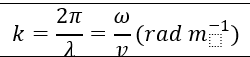 | |
| Phase of a Wave | It is the difference in phases of two particles at any time t. ∆ϕ=2π/λ∆x | |
| Speed of Transverse Wave Along a String / Wire | v=√(T/μ) where T=Tension(-1) μ=mass per unit length | |
| Power Transmitted Along The String By a Sine Wave | Average Power (P) P=2π^2 f^2 A^2 μv v =velocityIntensity I=P/S=2π^2 f^2 A^2 ρv | |
| Longitudinal Displacement of Sound Wave | ϵ=A sin(ωt-kx) | |
| Pressure Excess during travelling sound wave | P_ex=-B ∂ϵ/∂x=(B) Cos (ωt-kx) Where B is the Bulk Modulus Pex is the excess pressure | |
| Speed of Sound | C=√(E/ρ) Here, E is elastic modulus ρ is the density of medium | |
| Loudness of Sound | 10 ( I/I_0 ) dB | |
| Intensity at a distance r from a point Source | I=P/(4πr^2 ) | |
| Interference of Sound Wave | P_1=P_m1 Sin(ωt-kx_1+θ_1 ) P_2=P_m2 Sin(ωt-kx_2+θ_2)The Result is the sum of all the pressure. P_0=√(p_(m_1)^2+p_(m_2)^2+2p_(m_1 ) P_m2 cosϕ) | |
| For constructive Interference | ϕ=2πn then,=>P_o=P_(m_1 )+P_(m_2 ) | |
| For destructive interference | ϕ=(2n+1)π and=>P_o=|P_(m_1 )-P_(m_2 ) | | |
| Close Organ Pipe | f=v/4l,3v/4l,5v/4l,….((2n+1)v)/4l | |
| Open organ pipe | f=v/2l,2v/2l,…nV/2l | |
| Beats | Beats Frequency=f1–f2 | |
| Doppler’s Law | The Observed Frequency, f^'=f((v-v_0)/(v-v_s ))Apparent Wavelength, λ^'=λ((v-v_s)/v) | |
Wave Optics FormulaThe formula for wave optics are as stated below | ||
| Description | Formulas | |
| The path difference of two coherent Waves | ∆d=d2–d1 ∆d is the path difference | |
| The Path difference of two coherent waves: Interference Maximum | ∆d=k.λ ∆d is path difference λ is the wavelength | |
| The path difference of two coherent waves: Interference Minimum | ∆d=((2.k+1).λ)/2 ∆d is path difference λ is the wave length | |
| Thin-film interference: Constructive (maximum) | 2ntcos r =(n+1/2)λ t is film thickness n is refractive index r is refraction angle λ is wave length | |
| Thin-Film interference: destructive (minimum) | 2ntcosr =nλ t is film thickness n is refractive index r is refraction angle λ is wave length | |
| Radii of Newton’s Ring | r=√(k.R.λ) or r=√(((2.k+1).R.λ) )/2 r is the radius R is the radius of curvature λ is the wavelength | |
| Light Diffraction | l=d^2/(4.λ) I is the distance from obstacle d is the obstacle size λ is wavelength | |
| Diffraction grating: maximum (bright stripes) | dsinθ =kλ d is the lattice constant is the diffraction angle λ is the wavelength | |
| Diffraction grating (dark stripes) | dsinθ =(K+1/2)λ d is the lattice constant is the diffraction angle λ is the wavelength | |
Work Power and Energy FormulaThe formula for work power energy are as stated below | ||
| Description | Formulas | |
| Work done is given by | W=F×d F is the force d is the displacement | |
| Kinetic Energy | K.E=1/2 mv^2 m is the mass of the body. v is the velocity of the body | |
| Potential Energy | P.E=mgh m is the mass of the body in kg h is the height of the body in meters g is the acceleration due to gravity | |
| Power | P=W/t W is the work done by the body t is the time P=(F ⃗.(ds) ⃗)/dt=F ⃗.V ⃗ | |
| Conservative Forces | F=-du/dr | |
| Work-Energy theorem | W_net=∆K Where Wnet is the sum of all forces acting on the object K is the change of kinetic energy | |
Kinetic Theory FormulaThe formula for kinetic theory are as stated below | ||
| Description | Formula | |
| Boltzmann’s Constant | k_B= nR/N kB = Boltzmann’s constant R = gas constant n = number of moles N = number of particles in one mole | |
| Total translational Kinetic Energy of Gas | K.E = 3/2 (nRT) R = gas constant n = number of moles T = absolute temperature | |
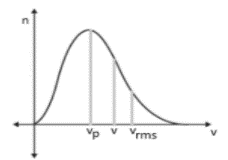
| Maxwell distribution law | V_rms Vp = most probable speed V = average speed | |
| RMS Speed | V_rms= √(3kt/m) = √(3Rt/M) R = universal gas constant T = absolute temperature M = molar mass | |
| Average Speed | v ⃗=√(8kt/πm) = √(8Rt/πM) | |
| Most probable speed | v_p=√(2kt/m) = √(2Rt/M) | |
| Pressure of ideal gas | p = 1/3 ρ〖v^2〗_rms | |
| Equipartition of energy | For each degree of freedom K=1/2 k_B TFor f degree of freedom K=f/2 k_B TkB = Boltzmann’s constant T = temperature of gas | |
| Internal Energy | For n moles of an ideal gas, internal energy is given as U=f/2 (nRT) | |
Kinetic Theory of Gases FormulaThe formula for kinetic theory of gases are as stated below | ||
| Description | Formulas | |
| Boltzmann’s Constant | k_B=nR/N
| |
| Total Translational K.E of Gas | K.E=(3/2)nRT
| |
| Maxwell Distribution Law | V_rms>V>Vp
| |
| RMS Speed (Vrms) | V_rms=√(8kt/m)=√(3RT/M)
| |
| Average Speed | v ⃗=√(8kt/πm)=√(8RT/πM) | |
| Most Probable Speed (Vp ) | V_p=√(2kt/m)=√(2RT/M) | |
| The Pressure of Ideal Gas | P=1/3 V_rms^2
| |
| Equipartition of Energy | K=1/2 K_B T for each degree of freedom K=(f/2) K_B T
| |
| Internal Energy | U=(f/2)nRT
| |



 Profile
 Settings
 Refer your friends
 Sign out