Centre of mass formula
The formula for centre of mass are as stated below |
| Description |
Formula |
| Centre of mass of a system with n number of masses situated on a line at different positions |
![]() |
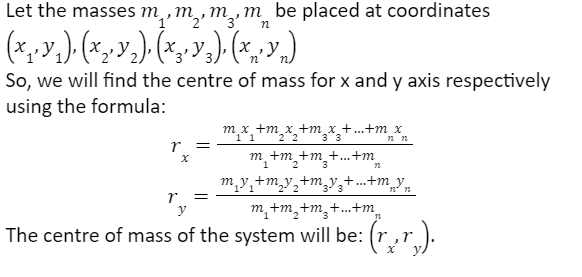
| Centre of mass of a system with n number of masses situated on a 2D plane |
![]() |
| Centre of mass of a rectangular plate |
The centre of mass of a uniform rectangular plate of length L and breadth B is given as:
r_x=B/2
r_y=L/2 |
| Centre of mass of a triangular plate |
The centre of mass of a uniform triangular plate is given by the formula:
r_c=h/3
Where, h is the height of the plate. |
| Centre of mass of a semi-circular ring |
The centre of mass of a semi-circular ring is given as:
r_y=2R/π
r_x=O
Here, R is the radius of the semi- Circle. |
| Centre of mass of a semi-circular disc |
The centre of mass of a semi-circular disc is given as:
r_y=4R/3π
r_x=O
Here, R is the radius of the semi- Circle. |
| Centre of mass of a hemispherical shell |
The centre of mass of a hemispherical shell is given as:
r_y=R/2
r_x=O
Here, R is the radius of the semi- Circle. |
| Centre of mass of a solid hemisphere |
The centre of mass of a solid hemisphere is given as:
r_y=3R/8
r_x=O
Here, R is the radius of the hemisphere. |
| Centre of mass of a circular cone |
The centre of mass of a circular cone is given as:
r_y=h/4
Here, h is the height of the cone. |
| Centre of mass of a hollow circular cone |
The centre of mass of a hollow circular cone is given as:
r_y=h/3
Here, h is the height of the cone. |
Circular motion
The formula for circular motion are as stated below |
| Description |
Formula |
| Average angular velocity |
ω_average=(θ_2-θ_1)/(t_2-t_1 )
![]() |
| Average angular acceleration |
![]() |
| Tangential acceleration |
a_t=dV/dt
Here dV is the change in velocity over time dt.
a_t=r dω/dt
Here, r is the radius, dω is the change in angular frequency over time dt. |
| Centripetal acceleration |
a_c=v^2/r
or a_c=ω^2 r
Here, v is the linear velocity, r is the radius and ω is the angular frequency. |
| Normal reaction on a body moving on a concave bridge |
N=mg□cos cos θ +(mv^2)/r
Here, m is the mass, g is the gravitational acceleration, θ is the angle, v is the linear velocity and r is the radius of the bridge. |
| Normal reaction on a convex bridge |
N=mg□cos cos θ -(mv^2)/r
Here, m is the mass, g is the gravitational acceleration, θ is the angle, v is the linear velocity and r is the radius. |
| Safe velocity of a vehicle on a level road |
v_safe≤√μgr
Here, v safe is the safe velocity, is the coefficient of friction, g is the gravitational acceleration and r is the radius. |
| Banking angle |
tan θ =v^2/rg
Here, θ is the banking angle, v is the linear velocity, r is the radius of the curve and g is the gravitational acceleration. |
| Centrifugal force |
f=mω^2 r
Here, f is the centrifugal force, m is the mass, is the angular velocity and r is the radius. |
| Conical pendulum |
T=2π√((L cos θ )/g)
Here, L is the length of the pendulum, θ is the angle made by the string with the vertical and g is the gravitational acceleration. |
De Broglie wavelength formula
The formula for de broglie wavelength are as stated below |
| Description |
Formula |
| De Broglie wavelength |
![]() |
| Radius of electron in hydrogen like atoms |
r_n=n^2/Z a_0
Here, rn is the radius of nth orbit, a0 is a constant whose value is0.529×10^(-10) m m and z is the atomic number. |
| Speed of electron in hydrogen like atoms |
v_n=Z/n v_0
Here, Z is the atomic number, n is the orbit and v0 is a constant whose value is 2.19×10⁶m/s. |
| Energy in nth orbit |
E_n=E_1⋅Z^2/n^2
Here,
En is energy of the nth orbit, E1 is the energy of the 1st orbit and its value is -13.6 eV, Z is the atomic number and n is the number orbit |
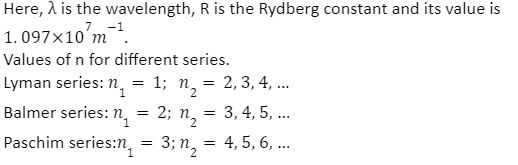
| Wavelength corresponding to spectral lines |
1/λ=R[1/(n_1^2 )-1/(n_2^2 )]
![]() |
| Minimum wavelength for x rays |
λ_min=hc/(eV_0 )
Or λ_min=12400/V_0 ×10^(-10) m
here, min is the minimum wavelength, h is the plank’s constant, c is the speed of light, e is the charge of an electron and V0 is the accelerating voltage. |
| Radius of nucleus |
R=R_0 A^(1/3)
Here, R is the radius of the atom, R_0 is a constant whose value is 1.1×10^(-15)m, A is the mass number of the atom. |
| Number of nuclei during a radioactive decay |
N=N_0 e^(-λt)here, N is the number of nuclei at time t, N_0 is the initial number of nucleus and λ is the decay constant. |
| Half-life of a radioactive sample |
T_(1/2)=0.693/λ
Here, T1/2 is the half-life period and λ is the decay constant. |
| Average life |
T_av=T_(1/2)/0.693here, T_avis the average life and T1/2 is the half- life period. |






 Profile
 Settings
 Refer your friends
 Sign out


