Vectors FormulaThe formula for vectors are as stated below |
| Description | Formula |
| Position Vector of a Point | If a and b are positive vectors of two points A and B, then AB =b- a - Distance Formula: Distance between the two points A( a ) and B( b) is
AB= |( a ) ⃗-b ⃗ |∣(a)⃗−b⃗∣ - Section Formula: r ⃗=(n ( a ) ⃗+m b ⃗ )/(m+n)r⃗=(n(a)⃗+mb⃗)/(m+n) Midpoint of AB=(( a ) ⃗+b ⃗)/2((a)⃗+b⃗)/2
|
| Scalar Product of Two vectors | a .b= a b cosθ , where a , b are the magnitude of a and b respectively and θ is the angle between a and b - i.i=j.j=k.k=1; i.j=j.k=k.i=0 , projection of a on b= a . b /b
- If ( a ) ⃗=a_1 i+a_2 j+a_3 k & ( b ) ⃗=b_1 i+b_2 j+b_3 k then a ⃗.( b ) ⃗=a_1 b_1+a_2 b_2+a_3 b_3
- The angle ∅ between a & b is given by ∅ =〖cos〗^(-1) (a ⃗.( b ) ⃗)/| ( a ) ⃗ || ( b ) ⃗ | ,0≤∅≤π.∅=〖cos〗(−1)(a⃗.(b)⃗)/∣(a)⃗∣∣(b)⃗∣,0≤∅≤π
- a . b =0 a Perpendicular to b (a≠0, b ≠0)
|
| Vector Product of Two vectors | - If a & b are two vectors and is the angle between them then
- a. b =absinθ n , where n is the unit vector perpendicular to both a & b such that a,b& n form a right handed screw system
- Geometrically a b=area of the parallelogram whose two adjacents sides are represented by a & b
- i.i=j.j=k.k=0; i.j=k, j.k=i, k.i=j
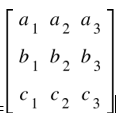
- a ⃗=a_1 i ̂+a_2 j ̂+a_3 k ̂ & b ⃗=b_1 i ̂+b_2 j ̂+b_3 k ̂ then a ⃗× b ⃗= =
![]() ![]() b= o↔ a and b are parallel (collinear) (a≠0, b≠0) i.e. a=K b where K is a scalar. ±( a ⃗× b ⃗)/| a ⃗× b ⃗ |±(a⃗×b⃗)/∣a⃗×b⃗∣ b= o↔ a and b are parallel (collinear) (a≠0, b≠0) i.e. a=K b where K is a scalar. ±( a ⃗× b ⃗)/| a ⃗× b ⃗ |±(a⃗×b⃗)/∣a⃗×b⃗∣
- Unit vector perpendicular to the plane of a & b is n= ABC=1/2 [a ⃗×b ⃗+b ⃗×c ⃗+c ⃗×a ⃗ ]ABC=1/2[a⃗×b⃗+b⃗×c⃗+c⃗×a⃗]
- If a,b & c are the position vectors of 3 points A, B & C then the vector area of triangle ABC=1/2ab+bc+ca. The points A, B & C are collinear if
- a ⃗×b ⃗+b ⃗×c ⃗+c ⃗×a ⃗=0 ⃗a⃗×b⃗+b⃗×c⃗+c⃗×a⃗=0⃗
- Area of any quadrilateral whose diagonal vectors are (d_1 ) ⃗ & (d_2 ) ⃗ is given by 1/2 |(d_1 ) ⃗×(d_2 ) ⃗ |1/2∣(d1)⃗×(d2)⃗∣
- Lagrange’sIdentity:(a ⃗×b ⃗ )^2=|a ⃗ |^2 |b ⃗ |^2-(a ⃗.b ⃗ )^2=[((a) ⃗×a ⃗ ) (a ⃗×(b)) ⃗ ( b ⃗×(a)) ⃗ ( b ⃗×(b)) ⃗](a⃗×b⃗)2=∣a⃗∣2∣b⃗∣2−(a⃗.b⃗)2=[((a)⃗×a⃗)(a⃗×(b))⃗(b⃗×(a))⃗(b⃗×(b))⃗]
|
| Scalar Triple Product | - The scalar triple product of three vectors a,b & c is defined as:
a ⃗×b ⃗.c ⃗=|a ⃗ ||b ⃗ ||c ⃗ | □sin sin θ □cos cos ∅a⃗×b⃗.c⃗=∣a⃗∣∣b⃗∣∣c⃗∣□sinsinθ□coscos∅ - Volume of tetrahedron V=[a ⃗.b ⃗.c ⃗ ]V=[a⃗.b⃗.c⃗]
- In a scalar triple product the position of dot and cross can be interchanged i.e.
a ⃗.(b ⃗×c ⃗ )=(a ⃗×b ⃗ ).c ⃗ Or [a ⃗ b ⃗ c ⃗ ]=[b ⃗ c ⃗ a ⃗ ]=[c ⃗ a ⃗ b ⃗ ] a ⃗.(b ⃗×c ⃗ )=-a ⃗.(c ⃗×b ⃗) i.e. [a ⃗ b ⃗ c ⃗ ]=-[a ⃗ c ⃗ b ⃗]a⃗.(b⃗×c⃗)=(a⃗×b⃗).c⃗Or[a⃗b⃗c⃗]=[b⃗c⃗a⃗]=[c⃗a⃗b⃗]a⃗.(b⃗×c⃗)=−a⃗.(c⃗×b⃗)i.e.[a⃗b⃗c⃗]=−[a⃗c⃗b⃗] - If a ⃗=a_1 i+a_2 j+a_3 k; b ⃗=b_1 i+b_2 j+b_3 k & c ⃗=c_1 i+c_2 j+c_3 k then
a.b.c= ![]() - If a,b,c are coplanar
[a ⃗ b ⃗ c ⃗ ][a⃗b⃗c⃗]
- Volume of tetrahedron OABC with O as origin & A(a), B(b) and C(c) be the vertices = |1/6[a ⃗ b ⃗ c ⃗]|∣1/6[a⃗b⃗c⃗]∣
- The position vector of the centroid of a tetrahedron if the pv’s of its vertices are a,b,c & d are given by 1/4[a ⃗+b ⃗+c ⃗+d ⃗]1/4[a⃗+b⃗+c⃗+d⃗]
|
| Vector Triple Product | a ⃗×(b ⃗×c ⃗ )=(a ⃗.c ⃗ ) b ⃗-(a ⃗.b ⃗ ) c ⃗, (a ⃗×b ⃗ )×c ⃗=(a ⃗.c ⃗ ) b ⃗-(b ⃗.c ⃗)a ⃗a⃗×(b⃗×c⃗)=(a⃗.c⃗)b⃗−(a⃗.b⃗)c⃗,(a⃗×b⃗)×c⃗=(a⃗.c⃗)b⃗−(b⃗.c⃗)a⃗ In general: (a ⃗×b ⃗ )×c ⃗≠a ⃗×(b ⃗×c ⃗ )(a⃗×b⃗)×c⃗=a⃗×(b⃗×c⃗) |
Parabola formulaThe formula for parabola are as stated below |
| Description | Formula |
| Equation of standard parabola: | The equation of parabola with focus at (a,0), a>0 and directrix x = -a is given as y^2=4axy2=4ax When vertex is (0, 0) then axis is given as y = 0 Length of latus rectum is equals to 4a Ends of the latus rectum are L(a, 2a) and L’(a, -2a). |
| Parametric representation | The point (x,y1) lies outside, on or inside the parabola which is given as y = 4ax Therefore, equation of parabola now becomes, 〖y_1〗^2-4ax≥0〖y1〗2−4ax≥0 Or 〖y_1〗^2-4ax<0〖y1〗2−4ax<0 |
| Line and a parabola | Length of the chord intercepted by the parabolay^2=4axy2=4ax on the line y = mx+c is given as 4/m^2 (√(a(1+m^2 )(a-mc) )4/m2(√(a(1+m2)(a−mc)) |
| Tangents to the parabola | Tangent of the parabola y^2=4axy2=4axis given as T = 0 y=mx+am , m≠0 is the tangent of parabola y^2=4ax at (a/m^2 ,2a/m)y2=4axat(a/m2,2a/m) |
| Normal to the parabola y2=4ax | Normal to the paraboly^2=4axy2=4ax is given as y-y_1=(-y_1)/2a (x-x_1 )y−y1=(−y1)/2a(x−x1) |
| A chord with a given middle point | The equation of the chord of parabola y^2=4axy2=4axwith midpoint (x1, y1) is given as T = S1. Here, S_1=y_1-4axS1=y1−4ax |
Definite Integration FormulaThe formula for definite integration are as stated below |
| Description | Formula |
| Definite Integral as Limit Sum | ∫_a^b f(x)dx=∑_(r=1)^n hf(a+rh)∫abf(x)dx=∑(r=1)nhf(a+rh) Here h=(b-a)/nh=(b−a)/n is the length of each subinterval |
| Definite Integral Formula Using the Fundamental theorem of calculus | ∫_a^b f(x)dx=F(b)-F(a), where F^’ (x)=f(x)∫abf(x)dx=F(b)−F(a),whereF’(x)=f(x) |
| Properties of Definite Integral | ∫_a^b f(x).dx=∫_a^b f(t).dt∫abf(x).dx=∫abf(t).dt ∫_a^b f(x).dx=-∫_b^a f(x).dx∫_a^b cf(x).dx=c∫_a^b f(x).dx∫_a^b f(x)±g(x).dx=∫_a^b f(x).dx±∫_a^b g(x).dx∫_a^b f(x).dx=∫_a^c f(x).dx+∫_c^b f(x).dx∫_a^b f(x).dx=∫_a^b f(a+b-x).dx∫_0^a f(x).dx=∫_0^a f(a-x).dt∫_0^2a f(x).dx=2∫_0^a f(x).dx f(2a-x)=f(x) ∫_0^2a f(x).dx=0∫_(-a)^a f(x).dx=2∫_0^a f(x).dxf(-x)=f(x) |
| Definite Integrals involving Rational or irrational Expression | ∫_a^∞ dx/(x^2+a^2 )=π/2a∫a∞dx/(x2+a2)=π/2a - ∫_a^∞ (x^m dx)/(x^n+a^n )=(πa^(m-n+1))/(n ((m+1)π)/n) ),0<m+1<n∫a∞(xmdx)/(xn+an)=(πa(m−n+1))/(n((m+1)π)/n)),0<m+1<n
- ∫_a^∞ (x^(p-1) dx)/(1+x)=π/(□sin sin (pπ) ),0<p<1∫a∞(x(p−1)dx)/(1+x)=π/(□sinsin(pπ)),0<p<1
- ∫_a^∞ dx/√(a^2-x^2 )=π/2∫a∞dx/√(a2−x2)=π/2
- ∫_a^∞ √(a^2-x^2 ) dx=(πa^2)/4∫a∞√(a2−x2)dx=(πa2)/4
|
| Definite Integrals involving Trigonometric Functions | - ∫_0^π mx )nx )dx={0 if m≠n π/2 if m=n m,n positive integers
- ∫_0^π mx )nx )dx={ 0 if m≠n π/2 if m=n m,n positive integers
- ∫_0^π mx )nx )dx={ 0 if m+n even 2m/(m^2-n^2 ) if m=n odd m,n integers
- ∫_0^(π/2) x dx=∫_0^(π/2) x dx=π/4∫0(π/2)xdx=∫0(π/2)xdx=π/4
- ∫_0^(π/2) x dx =∫_0^(π/2) dx =(1.3.5…….2m-1)/(2.4.6……2m).π/2,m=1,2,…∫0(π/2)xdx=∫0(π/2)dx=(1.3.5…….2m−1)/(2.4.6……2m).π/2,m=1,2,…
- ∫_0^(π/2) x dx =∫_0^(π/2) dx =(2.4.6….2m)/(1.3.5…2m+1),m=1,2,…∫0(π/2)xdx=∫0(π/2)dx=(2.4.6….2m)/(1.3.5…2m+1),m=1,2,…
|
| If f(x) is a periodic function with period T | - ∫_0^nT f(x)dx=n∫_0^T f(x)dx,n∈z,∫_a^(a+nT) f(x)dx=n∫_0^T f(x)dx,n∈z, a∈R∫0nTf(x)dx=n∫0Tf(x)dx,n∈z,∫a(a+nT)f(x)dx=n∫0Tf(x)dx,n∈z,a∈R
- ∫_mT^nT f(x)dx=(n-m)∫_0^T f(x)dx,m,n∈z,∫_nT^(a+nT) f(x)dx=∫_0^a f(x)dx,n∈z, a∈R∫mTnTf(x)dx=(n−m)∫0Tf(x)dx,m,n∈z,∫nT(a+nT)f(x)dx=∫0af(x)dx,n∈z,a∈R
- ∫_(a+nT)^(b+nT) f(x)dx=∫_a^a f(x)dx,n∈z, a,b∈R∫(a+nT)(b+nT)f(x)dx=∫aaf(x)dx,n∈z,a,b∈R
|
| Leibnitz Theorem | If F(x)=∫_(g(x))^(h(x)) f(t)dt, then (dF(x))/dx=h^’ (x)f(h(x))-g^’ (x)f(g(x))IfF(x)=∫(g(x))(h(x))f(t)dt,then(dF(x))/dx=h’(x)f(h(x))−g’(x)f(g(x)) |
Ellipse FormulaThe formula for ellipse are as stated below |
| Description | Formula |
| Standard Equation | x^2/a^2 +y^2/b^2 =1, where ![]() - Eccentricity: e=√(1-b^2/a^2 ) (0<e<1) Directrices: x=±a/e
- Foci: S=±a e,0. Length of major axes =2a and minor axes =2b
- Vertices: A’=-a,0 & A=a,0.
- Latus Rectum: = (2b^2)/a=2a(1-e^2)
|
Auxiliary circle | x^2+y^2 = a^2 |
Parametric Representation | x=a cos θ & y=b sin θ |
Position of a Point w.r.t. an Ellipse | The point P(x_1,y_1) lies outside, inside or on the ellipse according as; (x_1^2)/a^2 + (y_1^2)/b^2 -1><or=0 |
Line and an Ellipse | The line y=mx+c meets the ellipse
x^2/a^2 +y^2/b^2 =1in two points real, coincident or imaginary according as c^2is < =or > a^2 m^2+b^2 |
Tangents | - Slope form: y=mx±√(a^2 m^2+b^2 )
, point form: 〖xx〗_(1 )/a^2 +〖yy〗_1/b^2 =1
- Parametric form: xcosθ/a+ysinθ/b=1
|
Normal | (a^2 x)/x_1 – (b^2 y)/y_1 =a^2-b^2, ax.secθ-by.cosecθ=(a^2-b^2 ),
y=mx-(〖(a〗^2-b^2)m)/(√(a^2+b^2 ) m^2 ) |
Director Circle | x^2+y^2=a^2+b^2 |



 Profile
 Settings
 Refer your friends
 Sign out