Linear Equation is defined as an algebraic expression that can be written in the form of x+b = 0, having a variable with exponent (power) of 1. There are 2 types of the linear equation – Linear equation in one variable and linear equation in two variables. The graphical representation of a linear equation in one variable is always a straight line horizontally or vertically and the graphical representation of a linear equation in two variables is also a straight line.
An equation with the highest exponent 1 of the variable and that equation when presented graphically, forms a straight line is called a linear equation.
A linear equation in one variable is defined as an equation that is used to represent and solve for an unknown quantity. A linear equation in one variable is always in the form “ax+b=0” Where a and b are two integers and x is a variable. For example,
If x+5 = 15.
We need to find “y” from this equation i.e. only one variable is present in this equation. This equation has the highest exponent of 1 and there is only one solution of this equation. So this type of equation is known as a linear equation in one variable. Therefore, we can recognize a linear equation by seeing that only one variable is present with an exponent one on it.
Linear equation in two variables is defined as an equation that is used to represent and solve for 2 unknown quantities. A linear equation in two variables is generally in the form “ax+by+c=0”. Where a, b and c are three integers, both a and b are not equal to 0 and x and y are the two variables in it.
A pair of linear equations in two variables can be solved by using different methods like the elimination method, substitution method, graphical method, and cross-multiplication method. The geometrical or graphical representation of a pair of linear equations in two variables is always a straight line. The general form of pair of linear equations in two variables are given as
p1x + q1y + r1 = 0
p2x + q2y + r2 = 0
In the above equations, p1, p2, q1, q2, r1 and r2 are the integers and p1² + q1² ≠ 0 and p2² + q2² ≠ 0. Here, p1, p2, q1, q2 are known as coefficients of the variables x and y respectively.
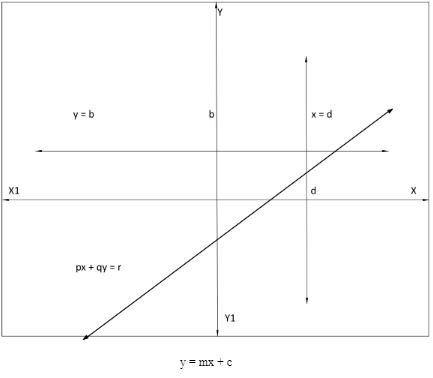
There are several formulas for linear equations in one variable and linear equations in two variables where a line can be defined in an (x,y) plane. The common formulas are:-
(px + qy = r)
Where,
x = d
(y = mx + c)
Where,
The value of y when x is 0 is called the y-intercept because (0,y) is the point at which the line crosses the y-axis. Henceforth, the linear equation formula is given as: (y = mx + c)
y = b
{y – y1 )= m(x-x1)}
Where,
x/x0 + y/y0 = 1
Where,
The graphical representation of these linear equation formulas are given below


 Profile
 Settings
 Refer your friends
 Sign out