Access free live classes and tests on the app
Download
+
Unacademy
  • Goals
    • AFCAT
    • AP EAMCET
    • Bank Exam
    • BPSC
    • CA Foundation
    • CAPF
    • CAT
    • CBSE Class 11
    • CBSE Class 12
    • CDS
    • CLAT
    • CSIR UGC
    • GATE
    • IIT JAM
    • JEE
    • Karnataka CET
    • Karnataka PSC
    • Kerala PSC
    • MHT CET
    • MPPSC
    • NDA
    • NEET PG
    • NEET UG
    • NTA UGC
    • Railway Exam
    • SSC
    • TS EAMCET
    • UPSC
    • WBPSC
    • CFA
Login Join for Free
avtar
  • ProfileProfile
  • Settings Settings
  • Refer your friendsRefer your friends
  • Sign outSign out
  • Terms & conditions
  • •
  • Privacy policy
  • About
  • •
  • Careers
  • •
  • Blog

© 2023 Sorting Hat Technologies Pvt Ltd

Watch Free Classes
    • Free courses
    • JEE Main 2024
    • JEE Main 2024 Live Paper Discussion
    • JEE Main Rank Predictor 2024
    • JEE Main College Predictor 2024
    • Stream Predictor
    • JEE Main 2024 Free Mock Test
    • Study Materials
    • Notifications
    • JEE Advanced Syllabus
    • JEE Books
    • JEE Main Question Paper
    • JEE Coaching
    • Downloads
    • JEE Notes & Lectures
    • JEE Daily Videos
    • Difference Between
    • Full Forms
    • Important Formulas
    • Exam Tips
JEE Main 2026 Preparation: Question Papers, Solutions, Mock Tests & Strategy Unacademy » JEE Study Material » Mathematics » Area of Equilateral Triangle

Area of Equilateral Triangle

Area of equilateral triangle is the length of any side squared and multiplied by the cosine of each angle. A proof, derivation and formula for it is given in this video.

Table of Content
  •  

The area of an equilateral triangle refers to the amount of space it occupies in a two-dimensional plane. A triangle with all sides equal and all angles measuring 60 degrees is called an equilateral triangle. The number of unit squares that would fit into any two-dimensional shape is known as its area. The term “unit” refers to one (1), and a unit square is defined as a square having a side length of one unit. The area of an equilateral triangle, on the other hand, is the entire amount of space it encloses in a two-dimensional plane.

Table of content

  1. Area of Equilateral triangle
  2. Derivation of the formula
  3. The area of an equilateral triangle can be calculated using the method above in the following ways
  4. Conclusion
  5. FAQs

Area of Equilateral triangle:

The area of an equilateral triangle is defined as the area enclosed by the triangle’s three sides. It’s calculated in square units. in², m², cm², yd² and other key units are used to express the area of an equilateral triangle. In the sections below, we’ll look at the formula for calculating the area of an equilateral triangle and its derivation.

Formula: –

The area occupied between the sides of an equilateral triangle in a 2D plane is calculated using the equilateral triangle area formula. Many people use the ability to calculate the areas of any geometrical shape in their job. We have the formula for the area of an equilateral triangle. Finding the area of a triangle in a general triangle might be difficult for a variety of reasons. Finding the area of an equilateral triangle, on the other hand, is a simple computation.

The general formula for determining the area of a triangle whose base and height is known is given by:

Area = ½ × base × height

The area of an equilateral triangle is calculated using the following formula:   
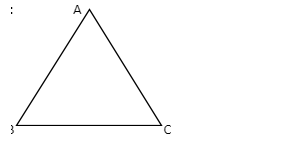
Area = √3/4 × (side)² sq. units

In the adjacent figure, AB = AC = BC = a cm.

So the area of the given equilateral triangle is given by:

A = √3/4 × (side)² sq. units                                                     

= √3/4 × a² cm²

Derivation of the formula

All of the sides of an equilateral triangle are equal, and all of the interior angles are 60 degrees. As a result, the area of an equilateral triangle can be calculated if one of the sides’ lengths is known. Using the formula, get the area of an equilateral triangle as,

Area = √3/4 × a² sq. units

Where, a = length of each side of the equilateral triangle.

The area of an equilateral triangle can be calculated using the method above in the following ways:

  • Using the triangle’s general area:

The general area of the triangle formula can be used to generate the formula for calculating the area of an equilateral triangle. To accomplish so, we’ll need the lengths of each side and the equilateral triangle’s height. As a result, we’ll calculate an equilateral triangle’s height in terms of its side length.

The generic formula for the area of a triangle, which is equal to (½ × base × height), yields the formula for the area of an equilateral triangle. The formula for an equilateral triangle is deduced as follows.

Area of triangle = ½ × base × height

The Pythagoras theorem (hypotenuse² = base² + height²) is used 

to find the height of the equilateral triangle.

Here, a/2 is the base, h is the height, and an is the hypotenuse.                              

(Refer to the figure aside)

Apply Pythagoras’ theorem to the triangle now.
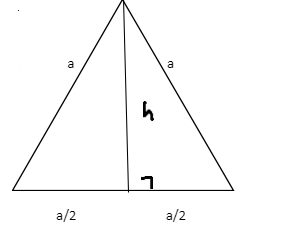
a² = h² + (a/2)²

⇒ h² = a² – (a²/4)

⇒ h² = (3a²)/4.                                                                       

Or, h = (√3a)/2

So the area of the triangle is given by ,

A = ½ × base × height

= ½ × a × (√3a)/2

= (√3/4)a²

Thus, the area of the equilateral triangle is given by (√3/4)a² .

  • Using Heron’s formula 

When the lengths of the triangle’s three sides are determined, Heron’s formula is used to calculate its area. Heron’s formula is named after Hero of Alexandria, a mathematician who can calculate the area of any triangle given the lengths of all three sides. When utilizing Heron’s formula to calculate the area of a triangle, we do not use angles or other distances.

The steps for calculating the area of a triangle are as follows:

Consider the ABC triangle, which has a, b, and c sides. The area of a triangle can be calculated using Heron’s formula, i.e., given by 

A = √{S (S – a) (S – b) (S – c)}

Where, S is the semi-perimeter, which is calculated as follows:

 S = (a+b+c)/2

But in case of equilateral triangle, a = b = c

So, S = (a + a + a)/2 = 3a/2

Hence the area is given by,

A = √{S (S – a) (S – a) (S – a)}

= √{3a/2(3a/2-a)³}

 = √{3a/2 × a³/8}

= √(3a⁴/16)

 = (√3/4)a² sq. units

Thus the area of the equilateral triangle is given by (√3/4)a² sq. units.

Conclusion:

The area of an equilateral triangle is defined as the area contained by the three sides of the triangle. It’s calculated in square units. The area of an equilateral triangle is commonly expressed in in², m², cm², and yd². The area of an equilateral triangle, the height of an equilateral triangle, the perimeter of an equilateral triangle, and the semi-perimeter of an equilateral triangle are all addressed here.

Important Pages

JEE Full Form

LCD Full Form

ABS Full Form

EPC Full Form

IIT Full Form

CFL Full Form

SCR Full Form

TFT Full Form

IELTS Full Form

SONAR Full Form

LED Full Form

mAh Full Form

faq

Frequently asked questions

Get answers to the most common queries related to the IIT JEE Examination Preparation.

What is the definition of an equilateral triangle?

Ans : An equilateral triangle is a sort of triangle in which all of the sides and internal angles a...Read full

What does an equilateral triangle’s area mean?

Ans : The area of an equilateral triangle is defined as the amount of two-dimensional space occupie...Read full

What is the area of an equilateral triangle formula?

Ans : The following formula is used to compute the area of an equilateral triangle: ...Read full

What is the equilateral triangle's perimeter formula?

Ans : The perimeter of an equilateral triangle can be calculated using the following formula:...Read full

Is it possible to have an obtuse angle in an equilateral triangle?

Ans : It is not possible because an equilateral triangle has equal sides and angles, each angle is ...Read full

Ans : An equilateral triangle is a sort of triangle in which all of the sides and internal angles are the same. The measure of each angle of an equilateral triangle is equal to 60°.


Ans : The area of an equilateral triangle is defined as the amount of two-dimensional space occupied by the equilateral triangle.

Ans : The following formula is used to compute the area of an equilateral triangle:

                       A = (√3/4)a²

Ans : The perimeter of an equilateral triangle can be calculated using the following formula:

P = 3a

Ans : It is not possible because an equilateral triangle has equal sides and angles, each angle is acute and measures 60°, it cannot be obtuse. As a result, an obtuse angle cannot exist in an equilateral angle.


Crack IIT JEE with Unacademy

Get subscription and access unlimited live and recorded courses from India’s best educators

  • Structured syllabus
  • Daily live classes
  • Ask doubts
  • Tests & practice
Learn more

Notifications

Get all the important information related to the JEE Exam including the process of application, important calendar dates, eligibility criteria, exam centers etc.

Allotment of Examination Centre
JEE Advanced Eligibility Criteria
JEE Advanced Exam Dates
JEE Advanced Exam Pattern 2023
JEE Advanced Syllabus
JEE Application Fee
JEE Application Process
JEE Eligibility Criteria 2023
JEE Exam Language and Centres
JEE Exam Pattern – Check JEE Paper Pattern 2024
JEE Examination Scheme
JEE Main 2024 Admit Card (OUT) – Steps to Download Session 1 Hall Ticket
JEE Main Application Form
JEE Main Eligibility Criteria 2024
JEE Main Exam Dates
JEE Main Exam Pattern
JEE Main Highlights
JEE Main Paper Analysis
JEE Main Question Paper with Solutions and Answer Keys
JEE Main Result 2022 (Out)
JEE Main Revised Dates
JEE Marking Scheme
JEE Preparation Books 2024 – JEE Best Books (Mains and Advanced)
Online Applications for JEE (Main)-2022 Session 2
Reserved Seats
See all

Related articles

Learn more topics related to Mathematics
Zero Vector

A zero vector is defined as a line segment coincident with its beginning and ending points. Primary Keyword: Zero Vector

ZERO MATRIX

In this article, we will discuss about the zero matrix and it’s properties.

YARDS TO FEET

In this article we will discuss the conversion of yards into feet and feets to yard.

XVI Roman Numeral

In this article we are going to discuss XVI Roman Numerals and its origin.

See all
Access more than

10,505+ courses for IIT JEE

Get subscription
Challenge Yourself Everyday
Attempt 2023’s and previous year’s JEE Main
Download Important Formulas pdf
Attempt Free Test Series for JEE Main 2023

Trending Topics

  • JEE Main 2024
  • JEE Main Rank Predictor 2024
  • JEE Main Mock Test 2024
  • JEE Main 2024 Admit Card
  • JEE Advanced Syllabus
  • JEE Preparation Books
  • JEE Notes
  • JEE Advanced Toppers
  • JEE Advanced 2022 Question Paper
  • JEE Advanced 2022 Answer Key
  • JEE Main Question Paper
  • JEE Main Answer key 2022
  • JEE Main Paper Analysis 2022
  • JEE Main Result
  • JEE Exam Pattern
  • JEE Main Eligibility
  • JEE College predictor

JEE Coaching Centres

  • JEE Coaching in Nagpur
  • JEE Coaching in Ranchi
  • JEE Coaching in Gorakhpur
  • JEE Coaching in Bhubaneswar
  • JEE Coaching in Vijayawada
  • JEE Coaching in Dehradun
  • JEE Coaching in Indore
  • JEE Coaching in Gurugram
  • JEE Coaching in Muzaffarpur
  • JEE Coaching in Varanasi
  • JEE Coaching in Jammu
  • JEE Coaching in Kolhapur
  • JEE Coaching in Bikaner
  • JEE Coaching in Delhi Lajpat Nagar
Predict your JEE Rank
.
Company Logo

Unacademy is India’s largest online learning platform. Download our apps to start learning


Starting your preparation?

Call us and we will answer all your questions about learning on Unacademy

Call +91 8585858585

Company
About usShikshodayaCareers
we're hiring
BlogsPrivacy PolicyTerms and Conditions
Help & support
User GuidelinesSite MapRefund PolicyTakedown PolicyGrievance Redressal
Products
Learner appLearner appEducator appEducator appParent appParent app
Popular goals
IIT JEEUPSCSSCCSIR UGC NETNEET UG
Trending exams
GATECATCANTA UGC NETBank Exams
Study material
UPSC Study MaterialNEET UG Study MaterialCA Foundation Study MaterialJEE Study MaterialSSC Study Material

© 2026 Sorting Hat Technologies Pvt Ltd

Unacademy
  • Goals
    • AFCAT
    • AP EAMCET
    • Bank Exam
    • BPSC
    • CA Foundation
    • CAPF
    • CAT
    • CBSE Class 11
    • CBSE Class 12
    • CDS
    • CLAT
    • CSIR UGC
    • GATE
    • IIT JAM
    • JEE
    • Karnataka CET
    • Karnataka PSC
    • Kerala PSC
    • MHT CET
    • MPPSC
    • NDA
    • NEET PG
    • NEET UG
    • NTA UGC
    • Railway Exam
    • SSC
    • TS EAMCET
    • UPSC
    • WBPSC
    • CFA

Share via

COPY