Access free live classes and tests on the app
Download
+
Unacademy
  • Goals
    • AFCAT
    • AP EAMCET
    • Bank Exam
    • BPSC
    • CA Foundation
    • CAPF
    • CAT
    • CBSE Class 11
    • CBSE Class 12
    • CDS
    • CLAT
    • CSIR UGC
    • GATE
    • IIT JAM
    • JEE
    • Karnataka CET
    • Karnataka PSC
    • Kerala PSC
    • MHT CET
    • MPPSC
    • NDA
    • NEET PG
    • NEET UG
    • NTA UGC
    • Railway Exam
    • SSC
    • TS EAMCET
    • UPSC
    • WBPSC
    • CFA
Login Join for Free
avtar
  • ProfileProfile
  • Settings Settings
  • Refer your friendsRefer your friends
  • Sign outSign out
  • Terms & conditions
  • •
  • Privacy policy
  • About
  • •
  • Careers
  • •
  • Blog

© 2023 Sorting Hat Technologies Pvt Ltd

JEE Main 2026 Preparation: Question Papers, Solutions, Mock Tests & Strategy Unacademy » JEE Study Material » Physics » AC Circuit Containing Capacitor Only

AC Circuit Containing Capacitor Only

Circuits using alternate currents are known as AC circuits. AC circuits are typical in domestic and industrial settings.

Table of Content
  •  

Some circuits are powered by an alternating current or alternating voltage. Such circuits are known as alternating current (AC) circuits. Voltage or current that is alternately altered about a mean value and reversed in direction is known as alternating voltage or current.

Capacitance is charge stored on its plate. On applying AC current a capacitor will charge alternately and discharge at a frequency of the AC current supplied. During the transition from the positive to the negative half cycle of the supply voltage or vice versa at points 0o and 180o along the sine wave, the proportionality of charging current is directly proportional to the amount of change in voltage across the plates.

DC vs AC

  • The continuous flow of electrons in a certain direction or forward occurs in DC. AC is the discontinuous flow of electrons that changes direction periodically. When it goes from negative to positive, this power switch also changes voltage values.
  • DC and AC are different from generation to generation and distribution in many ways, the most important being the direction of the flow of electrical energy.
  • Owing to the absence of sinusoidal waveform function for the supply, the voltage and current are constant over time in DC circuits. AC circuits, however, consistently change their current, voltage, and power output.
  • As a result, power cannot be calculated in AC circuits in the same way as before. Nonetheless, we can assume that power equals amperes (i) multiplied by voltage (v).

Passive components in AC circuits

  • A resistor’s resistance (R) remains the same whether it is in a DC or AC circuit; capacitance is written as “C”. Inductance is another term for volume, depicted by “L”. Zero inductance is written as L = 0, and infinite capacitance as C = ∞. Such traits are always an indication of a pure resistor.
  • The resistance level of all the resistors in an AC/DC circuit is the same.
  • The phase and current voltages of a full-resistive circuit are always the same, so we can add voltage to current power to get the power consumed at any given time.
  • In contrast, capacitors and inductors have a reaction resistance, referred to as XL and XC. In addition to inhibiting the flow of current, this reaction has a variable value, unlike a resistor with a fixed resistance value.
  • An inductor’s reaction value depends on the amount of power it receives as well as its DC value.

AC circuit containing only a capacitor

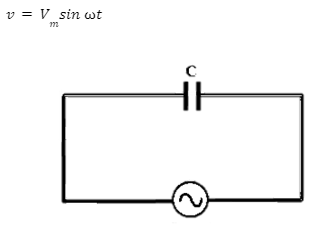
An alternating voltage source is connected across a capacitance C capacitor. An alternating voltage is given by the following:

xx1

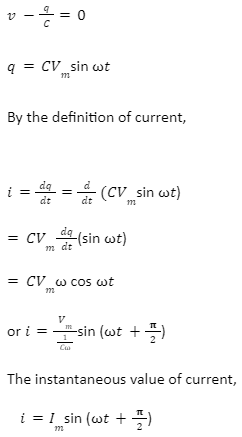
In Kirchoff’s loop rule, if “q” is the charge on the capacitor at that instant, the electromotive force across the capacitor is q/C.

xx2

where [Vm] / [1/Cω] = Im ,which is alternating current’s peak value. According to equations 4.49 and 4.50, current leads to applied voltage by π/2 in capacitive circuits. 

Capacitive reactance XC

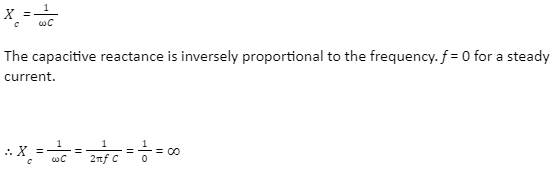
The peak value of current Im is given by Im = [Vm] / [1/Cω]. Comparing the equation with Im = Vm/R from the resistive circuit, the quantity 1/ Cω plays the same role as the resistance R in the resistive circuit. This is called capacitive reactance (XC), or the reactance offered by the capacitor. It is measured in ohm.

xx3

Hence, a capacitive circuit provides a constant resistance to the steady current, which is why the constant current cannot flow through the capacitor.

Conclusion

Capacitance is charge stored on its plate. On applying AC current a capacitor will charge alternately and discharge at a frequency of the AC current supplied. The peak value of current Im is given by Im = [Vm] / [1/Cω]. Comparing the equation with Im = Vm/R from the resistive circuit, the quantity 1/ Cω plays the same role as the resistance R in the resistive circuit. This is called capacitive reactance (XC), or the reactance offered by the capacitor. It is measured in ohm. The expression for the reactance of a capacitor is  Xc = 1C. The phase and current voltages of a full-resistive circuit are always the same, so we can add voltage to current power to get the power consumed at any given time.

xx4

Phasor diagram and wave diagram for AC circuit containing capacitor only

faq

Frequently asked questions

Get answers to the most common queries related to the IIT JEE Examination Preparation.

What is an alternating current?

Ans. Circuits that use alternating currents are called AC circuits. ...Read full

What are the differences between an AC and a DC current?

Ans. The continuous flow of electrons in a certain direction or forward is what happens in DC. AC i...Read full

What are the passive components of an AC circuit?

Ans. A resistor’s resistance (R) remains the same whether it is in a DC or AC circuit. Inductance is anoth...Read full

How does the charging current change with respect to the supply voltage?

Ans. On applying AC current a capacitor will charge alternately and discharge at a frequency of the...Read full

What is capacitive reactance?

Ans. The resistance or the reactance offered by the capacitor is called the Capacitive reactance. I...Read full

Ans. Circuits that use alternating currents are called AC circuits. Voltage or current that is alternately altered about a mean value and reversed in direction is known as alternating voltage or current.

Ans. The continuous flow of electrons in a certain direction or forward is what happens in DC. AC is the discontinuous flow of electrons that changes direction periodically. When it goes from negative to positive, this power switch also changes voltage values. Owing to the absence of sinusoidal waveform function for the supply, the voltage and current are constant over time in DC circuits. AC circuits, however, consistently change their current, voltage, and power output.

Ans. A resistor’s resistance (R) remains the same whether it is in a DC or AC circuit. Inductance is another term for volume, and we can refer to it as L. Zero inductance, which is L = 0, and infinite capacitance, which is C = ∞, indicate a pure resistor. Hence, the passive components of an AC circuit are an inductor, resistor, and capacitor.

Ans. On applying AC current a capacitor will charge alternately and discharge at a frequency of the AC current supplied. During the transition from the positive to the negative half cycle of the supply voltage or vice versa at points 0o and 180o along the sine wave, the proportionality of charging current is directly proportional to the amount of change in voltage across the plates.

Ans. The resistance or the reactance offered by the capacitor is called the Capacitive reactance. It

Crack IIT JEE with Unacademy

Get subscription and access unlimited live and recorded courses from India’s best educators

  • Structured syllabus
  • Daily live classes
  • Ask doubts
  • Tests & practice
Learn more

Notifications

Get all the important information related to the JEE Exam including the process of application, important calendar dates, eligibility criteria, exam centers etc.

Allotment of Examination Centre
JEE Advanced Eligibility Criteria
JEE Advanced Exam Dates
JEE Advanced Exam Pattern 2023
JEE Advanced Syllabus
JEE Application Fee
JEE Application Process
JEE Eligibility Criteria 2023
JEE Exam Language and Centres
JEE Exam Pattern – Check JEE Paper Pattern 2024
JEE Examination Scheme
JEE Main 2024 Admit Card (OUT) – Steps to Download Session 1 Hall Ticket
JEE Main Application Form
JEE Main Eligibility Criteria 2024
JEE Main Exam Dates
JEE Main Exam Pattern
JEE Main Highlights
JEE Main Paper Analysis
JEE Main Question Paper with Solutions and Answer Keys
JEE Main Result 2022 (Out)
JEE Main Revised Dates
JEE Marking Scheme
JEE Preparation Books 2024 – JEE Best Books (Mains and Advanced)
Online Applications for JEE (Main)-2022 Session 2
Reserved Seats
See all

Related articles

Learn more topics related to Physics
Zinc-Carbon Cell

The battery you use every day in your TV remote or torch is made up of cells and is also known as a zinc-carbon cell. Read on to know more.

ZEROTH LAW OF THERMODYNAMICS

Read about the Zeroth law of thermodynamics. Learn about the zeroth law definitions and their examples.

Zener Diode As A Voltage Regulator

Understand the concepts of Zener diodes. Also, learn about the efficiency and limitations of Zener Diode as a Voltage Regulator.

Zener diode as a voltage regulator

zener diode is a very versatile semiconductor that is used for a variety of industrial processes and allows the flow of current in both directions.It can be used as a voltage regulator.

See all
Access more than

10,505+ courses for IIT JEE

Get subscription
Company Logo

Unacademy is India’s largest online learning platform. Download our apps to start learning


Starting your preparation?

Call us and we will answer all your questions about learning on Unacademy

Call +91 8585858585

Company
About usShikshodayaCareers
we're hiring
BlogsPrivacy PolicyTerms and Conditions
Help & support
User GuidelinesSite MapRefund PolicyTakedown PolicyGrievance Redressal
Products
Learner appLearner appEducator appEducator appParent appParent app
Popular goals
IIT JEEUPSCSSCCSIR UGC NETNEET UG
Trending exams
GATECATCANTA UGC NETBank Exams
Study material
UPSC Study MaterialNEET UG Study MaterialCA Foundation Study MaterialJEE Study MaterialSSC Study Material

© 2026 Sorting Hat Technologies Pvt Ltd

Unacademy
  • Goals
    • AFCAT
    • AP EAMCET
    • Bank Exam
    • BPSC
    • CA Foundation
    • CAPF
    • CAT
    • CBSE Class 11
    • CBSE Class 12
    • CDS
    • CLAT
    • CSIR UGC
    • GATE
    • IIT JAM
    • JEE
    • Karnataka CET
    • Karnataka PSC
    • Kerala PSC
    • MHT CET
    • MPPSC
    • NDA
    • NEET PG
    • NEET UG
    • NTA UGC
    • Railway Exam
    • SSC
    • TS EAMCET
    • UPSC
    • WBPSC
    • CFA

Share via

COPY