Access free live classes and tests on the app
Download
+
Unacademy
  • Goals
    • AFCAT
    • AP EAMCET
    • Bank Exam
    • BPSC
    • CA Foundation
    • CAPF
    • CAT
    • CBSE Class 11
    • CBSE Class 12
    • CDS
    • CLAT
    • CSIR UGC
    • GATE
    • IIT JAM
    • JEE
    • Karnataka CET
    • Karnataka PSC
    • Kerala PSC
    • MHT CET
    • MPPSC
    • NDA
    • NEET PG
    • NEET UG
    • NTA UGC
    • Railway Exam
    • SSC
    • TS EAMCET
    • UPSC
    • WBPSC
    • CFA
Login Join for Free
avtar
  • ProfileProfile
  • Settings Settings
  • Refer your friendsRefer your friends
  • Sign outSign out
  • Terms & conditions
  • •
  • Privacy policy
  • About
  • •
  • Careers
  • •
  • Blog

© 2023 Sorting Hat Technologies Pvt Ltd

Watch Free Classes
    • Free courses
    • JEE Main 2024
    • JEE Main 2024 Live Paper Discussion
    • JEE Main Rank Predictor 2024
    • JEE Main College Predictor 2024
    • Stream Predictor
    • JEE Main 2024 Free Mock Test
    • Study Materials
    • Notifications
    • JEE Advanced Syllabus
    • JEE Books
    • JEE Main Question Paper
    • JEE Coaching
    • Downloads
    • JEE Notes & Lectures
    • JEE Daily Videos
    • Difference Between
    • Full Forms
    • Important Formulas
    • Exam Tips
JEE Main 2026 Preparation: Question Papers, Solutions, Mock Tests & Strategy Unacademy » JEE Study Material » Mathematics » Trigonometric Ratios of Compound Angles

Trigonometric Ratios of Compound Angles

Trigonometric The values of all the trigonometric functions are based on the value of the ratio of sides in a right-angled triangle. Ratios are defined as the values of these functions.

Table of Content
  •  

Trigonometry is the area of mathematics that examines angles and the various ways in which they can be measured. The usage of trigonometric functions, such as trigonometric ratios, compound angles, and multiple angles, is necessary in order to obtain conclusions that are consistent. This page is a discussion on the trigonometric ratios of compound angles, complete with cases that have been solved.

A ray that is rotated about an initial point is an example of an angle. The side that faces away from where the rotation begins is known as the initial side, while the side that faces toward where it ends is known as the terminal side. When a ray is turned in the anticlockwise direction, the resulting angle is positive, whereas the angle produced by rotating the ray in the clockwise direction is negative. Both degrees and radians are valid units for measuring angles.

Compound Angles

A compound angle is a name given to the angle that is the algebraic sum of two or more angles. Compound angles can be represented by their corresponding trigonometric identities. Using the idea of compound angles, it is possible to compute the fundamental arithmetic operations of calculating the sum and difference of functions.

List of Trigonometric Ratios of Compound Angles

The following are the formulas for calculating the trigonometric ratios of compound angles:

  • sin (A + B) = sin A cos B + cos A sin B
  • sin (A – B) = sin A cos B – cos A sin B
  • cos (A + B) = cos A cos B – sin A cos B
  • cos (A – B) = cos A cos B + sin A cos B
  • tan (A + B) = [tan A + tanB] / [1 – tan A tan B]
  • tan (A – B) = [tan A – tan B] / [1 + tan A tan B]
  • sin (A + B) sin (A – B) = sin2 A – sin2 B = cos2 B – cos2 A
  • cos (A + B) cos (A – B) = cos2 A – sin2 A – sin2 B = cos2 B – sin2 A

Transformation of Products into Sum or Difference of Sines and Cosines:

  •  2 sin A cos B = sin (A+B) + sin (A-B)
  •  2 cos A cos B = cos (A+B) + cos (A-B)
  •  2 cos A sin B = sin (A+B) – sin (A-B)
  •  2 sin A sin B = cos (A-B) – cos (A+B)

Multiple and submultiple Angles

(a) sin 2A = 2 sin A cos A = 2 tan A/(1+tan2A)

(b) cos 2A = cos2A – sin2A  = 2cos2A-1 = 1-2 sin2A

(c) tan 2A = 2 tan A/(1-tan2A)

(d) sin 3A = 3 sinA – 4 sin3A

(e) cos 3A = 4 cos3A – 3 cos A

(f) tan 3A = (3 tan A- tan3A)/(1-3tan2A)

Proofs for sin(A+B), cos(A+B), and tan(A+B)

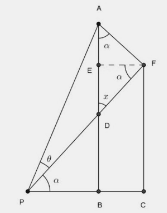
The process of finding a solution will be aided by the following figure.

Throughout the course of the explanation, we will be utilising and correspondingly in place of ‘A and ‘B wherever appropriate.

The following diagram depicts five right triangles: △APB, △PFC, △AFD, △DEF and △AEF . Within each of these triangles, EF||PBC, EF=BC, and CF=BE.

AS EF||PB, ∠CPF=∠EFD=α. Once more, in the right EFD, ∠α+∠x=900, and in the right AFD, ∠x+∠DAF=900, ∠DAF=∠α.

With this background, we may deduce sin(+).

Proof of sin(A+B)

sin(α+θ)=ABAP

=AE+BEAP

=CFAP+AEAP

=CFPF.PFAP+AEAF.AFAP

=sinα.cosθ+cosα.sinθ.

Proof of cos(A+B)

Using the same figure, we have,

cos(α+θ)=PBAP

=PC−BCAP

=PCAP−EFAP

=PCPF.PFAP−EFAF.AFAP

=cosα.cosθ−sinα.sinθ.

Proof of tan(A+B)

We’ll prove tan(+α+θ) using sin(+α+θ) and cos(+α+θ) instead of deriving it.

tan(α+θ)=tanα+tanθ/1−tanα.tanθ.

tan(α+θ)=sin(α+θ)/cos(α+θ)

=sinα.cosθ+cosα.sinθ/cosα.cosθ−sinα.sinθ.

After removing the factorcosα.cosθ from both the numerator and the denominator of the right-hand side of the preceding relation, we have the following:

tan(α+θ)=tanα+tanθ/1−tanα.tanθ.

The derivation of cos(A+B) follows the same pattern as the derivation of sin(A+B), and the expression for tan(A+B) may be simply derived from sin(A+B) and cos(A+B). Therefore, it is important for us to grasp the derivation of sin(A+B).

Conclusion

Trigonometry is an extremely helpful tool for determining which side of a particular triangle is unknown. The idea of the right triangle, which is employed in trigonometry, is put to excellent use in this particular fieldwork exercise. We are able to become proficient in reading the vertical angle using the theodolite, which enables us to accurately determine the height of the Mapuaadmin building.

Students who have a solid grasp of trigonometry ratios are able to calculate out complicated angles and dimensions in a comparatively short amount of time. Trigonometry is one of the most useful subfields of mathematics due to its widespread application in the fields of engineering, architecture, and a variety of other scientific disciplines.


faq

Frequently asked questions

Get answers to the most common queries related to the JEE Examination Preparation.

What is meant by the term "complex cut"?

Ans. A compound cut consists of two different angles being sliced together. The bevel angle and the mitre angle are ...Read full

What exactly are the formulas for compound angles?

Ans. A trigonometric identity is essentially a formula that represents a trigonometric function of (A+B) or (AB) in ...Read full

In an acute-angled triangle, cot B . cot C + cot A . cot C + cot A . cot B=?

Ans. Since A+B+C=π so, A+B=π−...Read full

Show that θ=18∘ satisfies the equation cos3θ=sin2θ.

Ans. We know that cos(3×18∘...Read full

If sin A = 1 / √10 and sin B = 1 / √5, where A and B are positive acute angles, then what is A + B?

Ans. We know that sin (A + B) = sin A cos B + cos A sin B = [1 / √10...Read full

Ans. A compound cut consists of two different angles being sliced together. The bevel angle and the mitre angle are their respective names. The bevel angle, also known as the blade tilt, refers to the degree to which the saw blade is tilted from a vertical position on the saw table. In a similar manner, the mitre angle of the table saw is adjusted using the mitre gauge. In addition, a cut that is perpendicular has a mitre angle of zero degrees.

Ans. A trigonometric identity is essentially a formula that represents a trigonometric function of (A+B) or (AB) in terms of expressions of trigonometric functions of A and B. A compound angle formula, also known as an addition formula, is another name for this type of formula.

Ans. Since A+B+C=π

so, A+B=π−C

⇒cot(A+B) = cot(π−C)

⇒cotA cotB − 1cotB + cotA = − cotC

⇒cotA . cotB + cotB . cotC + cotA . cotC = 1

Ans. We know that

cos(3×18∘)=cos54∘=sin(90∘−54∘)=sin36∘=sin(2×18∘).

So θ=18∘ satisfies

cos3θ=sin2θ.

Ans. We know that sin (A + B) = sin A cos B + cos A sin B

= [1 / √10] [√(1 − 1 / 5)] + [1 / √5] √(1 − 1 / 10)

= [1 / √10] [√4 / 5] + [1 / √5] [√9 / 10]

= [1 / √50] * (2 + 3)

= 5 / √50 = 1 / √2

⇒ sin (A + B) = sin π / 4

Hence, A + B = π / 4

Crack IIT JEE with Unacademy

Get subscription and access unlimited live and recorded courses from India’s best educators

  • Structured syllabus
  • Daily live classes
  • Ask doubts
  • Tests & practice
Learn more

Notifications

Get all the important information related to the JEE Exam including the process of application, important calendar dates, eligibility criteria, exam centers etc.

Allotment of Examination Centre
JEE Advanced Eligibility Criteria
JEE Advanced Exam Dates
JEE Advanced Exam Pattern 2023
JEE Advanced Syllabus
JEE Application Fee
JEE Application Process
JEE Eligibility Criteria 2023
JEE Exam Language and Centres
JEE Exam Pattern – Check JEE Paper Pattern 2024
JEE Examination Scheme
JEE Main 2024 Admit Card (OUT) – Steps to Download Session 1 Hall Ticket
JEE Main Application Form
JEE Main Eligibility Criteria 2024
JEE Main Exam Dates
JEE Main Exam Pattern
JEE Main Highlights
JEE Main Paper Analysis
JEE Main Question Paper with Solutions and Answer Keys
JEE Main Result 2022 (Out)
JEE Main Revised Dates
JEE Marking Scheme
JEE Preparation Books 2024 – JEE Best Books (Mains and Advanced)
Online Applications for JEE (Main)-2022 Session 2
Reserved Seats
See all

Related articles

Learn more topics related to Mathematics
Zero Vector

A zero vector is defined as a line segment coincident with its beginning and ending points. Primary Keyword: Zero Vector

ZERO MATRIX

In this article, we will discuss about the zero matrix and it’s properties.

YARDS TO FEET

In this article we will discuss the conversion of yards into feet and feets to yard.

XVI Roman Numeral

In this article we are going to discuss XVI Roman Numerals and its origin.

See all
Access more than

10,505+ courses for IIT JEE

Get subscription

Trending Topics

  • JEE Main 2024
  • JEE Main Rank Predictor 2024
  • JEE Main Mock Test 2024
  • JEE Main 2024 Admit Card
  • JEE Advanced Syllabus
  • JEE Preparation Books
  • JEE Notes
  • JEE Advanced Toppers
  • JEE Advanced 2022 Question Paper
  • JEE Advanced 2022 Answer Key
  • JEE Main Question Paper
  • JEE Main Answer key 2022
  • JEE Main Paper Analysis 2022
  • JEE Main Result
  • JEE Exam Pattern
  • JEE Main Eligibility
  • JEE College predictor
combat_iitjee

Related links

  • JEE Study Materials
  • CNG Full Form
  • Dimensional Formula of Pressure
  • Reimer Tiemann Reaction
  • Vector Triple Product
  • Swarts Reaction
  • Focal length of Convex Lens
  • Root mean square velocities
  • Fehling’s solution
testseries_iitjee
Predict your JEE Rank
.
Company Logo

Unacademy is India’s largest online learning platform. Download our apps to start learning


Starting your preparation?

Call us and we will answer all your questions about learning on Unacademy

Call +91 8585858585

Company
About usShikshodayaCareers
we're hiring
BlogsPrivacy PolicyTerms and Conditions
Help & support
User GuidelinesSite MapRefund PolicyTakedown PolicyGrievance Redressal
Products
Learner appLearner appEducator appEducator appParent appParent app
Popular goals
IIT JEEUPSCSSCCSIR UGC NETNEET UG
Trending exams
GATECATCANTA UGC NETBank Exams
Study material
UPSC Study MaterialNEET UG Study MaterialCA Foundation Study MaterialJEE Study MaterialSSC Study Material

© 2026 Sorting Hat Technologies Pvt Ltd

Unacademy
  • Goals
    • AFCAT
    • AP EAMCET
    • Bank Exam
    • BPSC
    • CA Foundation
    • CAPF
    • CAT
    • CBSE Class 11
    • CBSE Class 12
    • CDS
    • CLAT
    • CSIR UGC
    • GATE
    • IIT JAM
    • JEE
    • Karnataka CET
    • Karnataka PSC
    • Kerala PSC
    • MHT CET
    • MPPSC
    • NDA
    • NEET PG
    • NEET UG
    • NTA UGC
    • Railway Exam
    • SSC
    • TS EAMCET
    • UPSC
    • WBPSC
    • CFA

Share via

COPY