Access free live classes and tests on the app
Download
+
Unacademy
  • Goals
    • AFCAT
    • AP EAMCET
    • Bank Exam
    • BPSC
    • CA Foundation
    • CAPF
    • CAT
    • CBSE Class 11
    • CBSE Class 12
    • CDS
    • CLAT
    • CSIR UGC
    • GATE
    • IIT JAM
    • JEE
    • Karnataka CET
    • Karnataka PSC
    • Kerala PSC
    • MHT CET
    • MPPSC
    • NDA
    • NEET PG
    • NEET UG
    • NTA UGC
    • Railway Exam
    • SSC
    • TS EAMCET
    • UPSC
    • WBPSC
    • CFA
Login Join for Free
avtar
  • ProfileProfile
  • Settings Settings
  • Refer your friendsRefer your friends
  • Sign outSign out
  • Terms & conditions
  • •
  • Privacy policy
  • About
  • •
  • Careers
  • •
  • Blog

© 2023 Sorting Hat Technologies Pvt Ltd

Watch Free Classes
    • Free courses
    • JEE Main 2024
    • JEE Main 2024 Live Paper Discussion
    • JEE Main Rank Predictor 2024
    • JEE Main College Predictor 2024
    • Stream Predictor
    • JEE Main 2024 Free Mock Test
    • Study Materials
    • Notifications
    • JEE Advanced Syllabus
    • JEE Books
    • JEE Main Question Paper
    • JEE Coaching
    • Downloads
    • JEE Notes & Lectures
    • JEE Daily Videos
    • Difference Between
    • Full Forms
    • Important Formulas
    • Exam Tips
JEE Main 2026 Preparation: Question Papers, Solutions, Mock Tests & Strategy Unacademy » JEE Study Material » Mathematics » Qualitative and Quantitative Research

Qualitative and Quantitative Research

Quantitative research is concerned with numbers and figures, whereas qualitative research is concerned with words and their interpretations. Quantitative methods make it possible to measure variables and test hypotheses in a systematic manner. Qualitative research methods enable you to explore deeper into concepts and experiences.

Table of Content
  •  

Research is defined as the generation of new concepts, methodologies, and understandings through the development of new knowledge and/or the creative application of existing knowledge. This could include synthesizing and analyzing past research to the point where it produces fresh and innovative results.

The two most common forms of research methodologies are qualitative and quantitative research methods.

The most generally used instrument for increasing and brushing up on one’s stock of information about something or someone is research. There are two traditional approaches of conducting research in the fields of marketing, technology, economics, and so on: qualitative research and quantitative research. While qualitative research depends on verbal narratives such as spoken or written material to form conclusions, quantitative research relies on logical or statistical findings.

  • Qualitative research

Words are used to describe qualitative research. It’s a tool for analyzing concepts, ideas. This type of research allows you to discover more about a little-known subject. And written descriptions of observations, and literature reviews that examine concepts and theories are all common qualitative methods.

Qualitative data is information about a subject that cannot be expressed numerically. Quantitative data is information that defines a subject and is expressed as a number that can be analysed. Quantitative data can be divided into two categories: continuous and discrete.

Qualitative research Types:

There are six different forms of qualitative research.

  1. Phenomenological
  2. Ethnographic
  3. Grounded theory
  4. Historical, 
  5. Case study
  6. Action research

Qualitative data graph: For qualitative data, there are a variety of graphs to choose from. Bar graphs, Pareto charts, and pie charts are examples of these graphics. The most frequent techniques of displaying qualitative data are pie charts and bar graphs. Both can be created using a spreadsheet tool such as Excel.

  1. Quantitative research

Numbers and graphs are used in quantitative research. It’s utilized to put hypotheses and assumptions to the test or confirm them. This type of research can be used to generate generalizable facts about a topic.

Quantitative approaches include things like experiments, numerical observations, and surveys with questionnaire items.

Quantitative data is defined as the value of data expressed as counts or numbers, with each data set having a distinct numerical value. This data can be verified, and mathematical tools can be used to assess it quickly.

Qualitative graphs are used to show circumstances that may not always have numerical values. Qualitative graphs are graphical representations of the key features of a situation. Graph A, for example, might represent an automobile that accelerates at a constant rate.

Quantitative research Types

Quantitative research is divided into four categories:

  1. Descriptive
  2. Correlational
  3. Causal-Comparative/Quasi-Experimental
  4. Experimental Research

Quantitative data graph

Quantitative graphs are used to display and summarize numerical data from a categorical The research of a quantitative variable. The most common types of quantitative graphs are bar charts and pie charts. Pictogram.

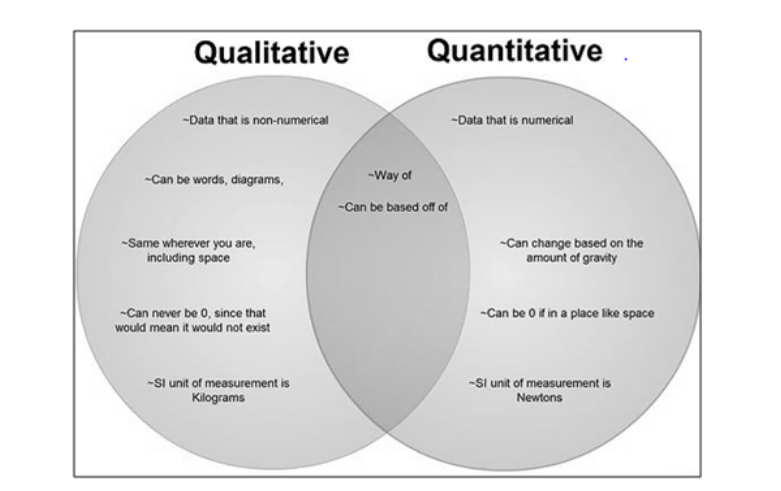
Qualitative vs quantitative research Venn diagram

The qualitative and quantitative techniques are depicted in this Venn diagram. Qualitative research approaches that require first-hand observation. Quantitative research tools like surveys and questionnaires will provide researchers with information about the current condition.
Give 3 similarities of qualitative and quantitative research

 Similarities of qualitative and quantitative research are given below:

  1. When conducting research, both qualitative and quantitative researchers employ similar techniques.
  2. A plan for conducting an investigation is required for both qualitative and quantitative research.
  3. Quantitative research is mostly used to test theories, but it can also be used to develop hypotheses and theories. Qualitative theory can be used to test hypotheses and theories, in addition to producing them.

Conclusion

Understanding the fundamental distinctions and similarities between qualitative and quantitative research is critical since it aids in selecting the optimal data type to work with. It also aids in correct identification, preventing data from being miscategorized.

These two study types have distinct benefits over one another, which is why researchers employ one data type for one research and the other for another. Quantitative data, on the other hand, continues to be the more prevalent data type when compared to qualitative data.

faq

Frequently Asked Questions

Get answers to the most common queries related to the JEE Examination Preparation.

Why is qualitative analysis superior to quantitative analysis?

Ans. Quantitative research data, such as market size, demographics, and user preferences, is useful for making busin...Read full

What is the significance of qualitative and quantitative research?

Ans. Quantitative research excels at establishing cause-and-effect correlations, testing hypotheses, and determining...Read full

In research technique, what is qualitative research?

Ans.  “Qualitative research refers to any study that employs data that does not have ordinal values.” Q...Read full

What is the relationship between qualitative and quantitative research?

Ans. Given that both qualitative and quantitative market research contribute to the understanding you seek, integrat...Read full

What does it mean to conduct quantitative research?

Ans. Quantitative research is a technique for learning about a small group of people called a sample population. Qua...Read full

Ans. Quantitative research data, such as market size, demographics, and user preferences, is useful for making business decisions. Qualitative research yields useful information for product design, such as information on user needs, behavior patterns, and use cases.

Ans. Quantitative research excels at establishing cause-and-effect correlations, testing hypotheses, and determining a large population’s beliefs, attitudes, and practices, whereas qualitative research excels at developing hypotheses and theories, as well as describing processes.

Ans.  “Qualitative research refers to any study that employs data that does not have ordinal values.” Qualitative research is to explore phenomena in their natural setting in order to understand the interpretations people give to them.

Ans. Given that both qualitative and quantitative market research contribute to the understanding you seek, integrating the two should yield considerable benefits, allowing you to compare and contrast data and acquire far deeper insights.

Ans. Quantitative research is a technique for learning about a small group of people called a sample population. Quantitative research, which is based on scientific inquiry, uses data that is observed or measured to investigate questions about a sample population.

Crack IIT JEE with Unacademy

Get subscription and access unlimited live and recorded courses from India’s best educators

  • Structured syllabus
  • Daily live classes
  • Ask doubts
  • Tests & practice
Learn more

Notifications

Get all the important information related to the JEE Exam including the process of application, important calendar dates, eligibility criteria, exam centers etc.

Allotment of Examination Centre
JEE Advanced Eligibility Criteria
JEE Advanced Exam Dates
JEE Advanced Exam Pattern 2023
JEE Advanced Syllabus
JEE Application Fee
JEE Application Process
JEE Eligibility Criteria 2023
JEE Exam Language and Centres
JEE Exam Pattern – Check JEE Paper Pattern 2024
JEE Examination Scheme
JEE Main 2024 Admit Card (OUT) – Steps to Download Session 1 Hall Ticket
JEE Main Application Form
JEE Main Eligibility Criteria 2024
JEE Main Exam Dates
JEE Main Exam Pattern
JEE Main Highlights
JEE Main Paper Analysis
JEE Main Question Paper with Solutions and Answer Keys
JEE Main Result 2022 (Out)
JEE Main Revised Dates
JEE Marking Scheme
JEE Preparation Books 2024 – JEE Best Books (Mains and Advanced)
Online Applications for JEE (Main)-2022 Session 2
Reserved Seats
See all

Related articles

Learn more topics related to Mathematics
Zero Vector

A zero vector is defined as a line segment coincident with its beginning and ending points. Primary Keyword: Zero Vector

ZERO MATRIX

In this article, we will discuss about the zero matrix and it’s properties.

YARDS TO FEET

In this article we will discuss the conversion of yards into feet and feets to yard.

XVI Roman Numeral

In this article we are going to discuss XVI Roman Numerals and its origin.

See all
Access more than

10,505+ courses for IIT JEE

Get subscription

Trending Topics

  • JEE Main 2024
  • JEE Main Rank Predictor 2024
  • JEE Main Mock Test 2024
  • JEE Main 2024 Admit Card
  • JEE Advanced Syllabus
  • JEE Preparation Books
  • JEE Notes
  • JEE Advanced Toppers
  • JEE Advanced 2022 Question Paper
  • JEE Advanced 2022 Answer Key
  • JEE Main Question Paper
  • JEE Main Answer key 2022
  • JEE Main Paper Analysis 2022
  • JEE Main Result
  • JEE Exam Pattern
  • JEE Main Eligibility
  • JEE College predictor
combat_iitjee

Related links

  • JEE Study Materials
  • CNG Full Form
  • Dimensional Formula of Pressure
  • Reimer Tiemann Reaction
  • Vector Triple Product
  • Swarts Reaction
  • Focal length of Convex Lens
  • Root mean square velocities
  • Fehling’s solution
testseries_iitjee
Predict your JEE Rank
.
Company Logo

Unacademy is India’s largest online learning platform. Download our apps to start learning


Starting your preparation?

Call us and we will answer all your questions about learning on Unacademy

Call +91 8585858585

Company
About usShikshodayaCareers
we're hiring
BlogsPrivacy PolicyTerms and Conditions
Help & support
User GuidelinesSite MapRefund PolicyTakedown PolicyGrievance Redressal
Products
Learner appLearner appEducator appEducator appParent appParent app
Popular goals
IIT JEEUPSCSSCCSIR UGC NETNEET UG
Trending exams
GATECATCANTA UGC NETBank Exams
Study material
UPSC Study MaterialNEET UG Study MaterialCA Foundation Study MaterialJEE Study MaterialSSC Study Material

© 2026 Sorting Hat Technologies Pvt Ltd

Unacademy
  • Goals
    • AFCAT
    • AP EAMCET
    • Bank Exam
    • BPSC
    • CA Foundation
    • CAPF
    • CAT
    • CBSE Class 11
    • CBSE Class 12
    • CDS
    • CLAT
    • CSIR UGC
    • GATE
    • IIT JAM
    • JEE
    • Karnataka CET
    • Karnataka PSC
    • Kerala PSC
    • MHT CET
    • MPPSC
    • NDA
    • NEET PG
    • NEET UG
    • NTA UGC
    • Railway Exam
    • SSC
    • TS EAMCET
    • UPSC
    • WBPSC
    • CFA

Share via

COPY