Access free live classes and tests on the app
Download
+
Unacademy
  • Goals
    • AFCAT
    • AP EAMCET
    • Bank Exam
    • BPSC
    • CA Foundation
    • CAPF
    • CAT
    • CBSE Class 11
    • CBSE Class 12
    • CDS
    • CLAT
    • CSIR UGC
    • GATE
    • IIT JAM
    • JEE
    • Karnataka CET
    • Karnataka PSC
    • Kerala PSC
    • MHT CET
    • MPPSC
    • NDA
    • NEET PG
    • NEET UG
    • NTA UGC
    • Railway Exam
    • SSC
    • TS EAMCET
    • UPSC
    • WBPSC
    • CFA
Login Join for Free
avtar
  • ProfileProfile
  • Settings Settings
  • Refer your friendsRefer your friends
  • Sign outSign out
  • Terms & conditions
  • •
  • Privacy policy
  • About
  • •
  • Careers
  • •
  • Blog

© 2023 Sorting Hat Technologies Pvt Ltd

JEE Main 2026 Preparation: Question Papers, Solutions, Mock Tests & Strategy Unacademy » JEE Study Material » Mathematics »  Interior Angles of a Polygon

 Interior Angles of a Polygon

Polygons are the closed figures made by joining line segments end to end. It is a two-dimensional figure (only has length and breadth). The line segments which form a Polygon are called sides or edges. A polygon can have infinite sides.

Table of Content
  •  

Introduction

Polygons are the closed figures made by joining line segments end to end. It is a two-dimensional figure (only has length and breadth). The line segments which form a Polygon are called sides or edges. A polygon can have infinite sides. As you read above a polygon can have infinite sides, here are some examples of polygons that will clear your understanding of polygons. Examples- Triangle, Square, Rectangle, Heptagon, etc. 

On the end, where sides are joined, there are the angles of the polygon.

TYPES OF POLYGON

There are basically four types of polygon

  1. Regular 
  2. Irregular
  3. Convex
  4. Concave

Here is the basic understanding of these types of a polygon.

Regular Polygon: Regular Polygons are those which have all sides with interior angles equal. For example- Square, Rhombus, Regular Pentagon, Equilateral Triangle, etc. 

Irregular Polygon: In the case of Irregular Polygons, Interior angles, Sides, are different. For example- Scalene Triangle, A kite, etc.

Convex Polygon: All convex polygons have all interior angles less than 180◦ and this is a necessary condition that will apply to all angles of a polygon. These are called convex because their vertex comes outward from the center of the shape.

Concave Polygon: In Concave Polygon, at least an interior angle of a polygon is greater than 180◦ . And these polygons have at least four sides. Now, why are they called Concave Polygons- it is because their vertex goes inward towards the center of the shape.

Do you know anything about Interior angles of Polygon?

Above we talked a little about the introduction of Interior Angles. Here, we will discuss them in detail. 

The angle formed by adjacent sides is known as the Interior Angle of the Polygon. As the name suggests, interior angles so this angle will form inside of adjacent sides of Polygon. 

Sum of Interior Angles of A Polygon

As you may know, the sum of Interior angles of a triangle is 180◦. So, same as triangles we have a formula for finding the sum of interior angles of a polygon.

Sum of Interior angles = (s-2)x 180 degrees

s = Number of sides of polygons

For  example, for a polygon having 7 sides the sum is, n = 7

Sum = (7 -2 ) × 180

sum = 900 degree

Polygon

No. of sides of a polygon

Sum Of Interior angles (in degrees)

Triangle

3

180 

Quadrilateral

4

360

Heptagon

7

900

Nonagon

9

1260

Decagon

10

1440

Interior Angles Theorem

Statement: The sum of interior angles of a polygon is (2n-4) × 90 degrees. where n is the number of sides of a polygon.

Proof: Consider an n side polygon ABCDEF, and any point O within the polygon such that OA, OB, OC are joined together.

An n-sided polygon will form n triangles in it. As we know, the sum of interior angles of a triangle is 180 degrees, so n triangle will give n * 180 degrees sum.

So, Total Angles in the interior + sum of angles in the interior = 2 – n*90

———–eqn (1)

At Point O, the sum of all angles is 360 degrees.

On substituting the above values in Eqn 1 we get,

360 degrees + 2n * 90 degrees = total interior angles of a polygon

Therefore, the Sum of interior angles = (2n*90) – 360 degrees

take 90 as common, 

Sum of all inner angles = (2n – 4) * 90 degrees

Interior Angles Formula

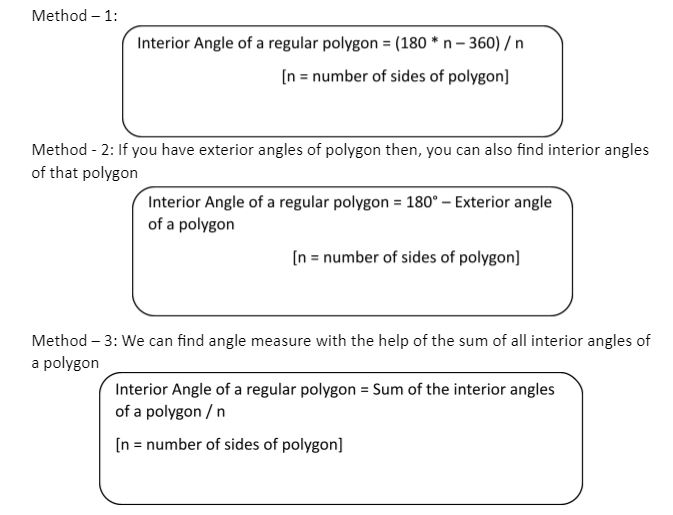
We have three methods to calculate the formula of interior angles

Some regular polygons with their interior angles

Regular Polygon

A measure of interior angles (in degrees)

Triangle

60

Quadrilateral

90

Pentagon

108

Heptagon

128.57

Octagon

135

Decagon

144

Interior angles of a convex polygon

As mentioned above, the Convex polygon has all angles less than 180 degrees.

So, all interior angles of a polygon are less than 180 degrees.

The formula for finding the sum of interior angles,

Sum = (n – 2) × 180 degrees

where n is the number of vertices present in a convex polygon.

Conclusion

You get to know about the interior angles of polygons in detail. Interior angles are used in higher mathematics in many places. Interior angle is the angle formed between adjacent sides of a polygon. We have also seen what is the interior angle theorem and what is the interior angle formulas.


faq

Frequently asked questions

Get answers to the most common queries related to the JEE Examination Preparation.

Will you consider Circle as a polygon?

Ans. So, the answer is simply No. As Polygon contains sides, Circle Is a curved surface. That’s why Circle ...Read full

What are the interior angles of Nonagon, if you have a sum of all interior angles is 1260 degrees?

Ans: Interior Angle of a regular polygon = Sum of the interio...Read full

Can you find the sum of interior angles of a kite?

Ans: As a kite is an irregular polygon, all angles measured are not the same. But, the sum of all i...Read full

Ans. So, the answer is simply No. As Polygon contains sides, Circle Is a curved surface. That’s why Circle is not a Polygon.


Ans: Interior Angle of a regular polygon = Sum of the interior angles of a polygon / n = 1260 / 9

= 140 degrees


Ans: As a kite is an irregular polygon, all angles measured are not the same. But, the sum of all interior angles is 360 degrees, as a kite is a quadrilateral. 


Trending Topics

  • JEE Main 2024
  • JEE Main Rank Predictor 2024
  • JEE Main Mock Test 2024
  • JEE Main 2024 Admit Card
  • JEE Advanced Syllabus
  • JEE Preparation Books
  • JEE Notes
  • JEE Advanced Toppers
  • JEE Advanced 2022 Question Paper
  • JEE Advanced 2022 Answer Key
  • JEE Main Question Paper
  • JEE Main Answer key 2022
  • JEE Main Paper Analysis 2022
  • JEE Main Result
  • JEE Exam Pattern
  • JEE Main Eligibility
  • JEE College predictor
combat_iitjee

Related links

  • JEE Study Materials
  • CNG Full Form
  • Dimensional Formula of Pressure
  • Reimer Tiemann Reaction
  • Vector Triple Product
  • Swarts Reaction
  • Focal length of Convex Lens
  • Root mean square velocities
  • Fehling’s solution
testseries_iitjee
Predict your JEE Rank
.
Company Logo

Unacademy is India’s largest online learning platform. Download our apps to start learning


Starting your preparation?

Call us and we will answer all your questions about learning on Unacademy

Call +91 8585858585

Company
About usShikshodayaCareers
we're hiring
BlogsPrivacy PolicyTerms and Conditions
Help & support
User GuidelinesSite MapRefund PolicyTakedown PolicyGrievance Redressal
Products
Learner appLearner appEducator appEducator appParent appParent app
Popular goals
IIT JEEUPSCSSCCSIR UGC NETNEET UG
Trending exams
GATECATCANTA UGC NETBank Exams
Study material
UPSC Study MaterialNEET UG Study MaterialCA Foundation Study MaterialJEE Study MaterialSSC Study Material

© 2026 Sorting Hat Technologies Pvt Ltd

Unacademy
  • Goals
    • AFCAT
    • AP EAMCET
    • Bank Exam
    • BPSC
    • CA Foundation
    • CAPF
    • CAT
    • CBSE Class 11
    • CBSE Class 12
    • CDS
    • CLAT
    • CSIR UGC
    • GATE
    • IIT JAM
    • JEE
    • Karnataka CET
    • Karnataka PSC
    • Kerala PSC
    • MHT CET
    • MPPSC
    • NDA
    • NEET PG
    • NEET UG
    • NTA UGC
    • Railway Exam
    • SSC
    • TS EAMCET
    • UPSC
    • WBPSC
    • CFA

Share via

COPY