Access free live classes and tests on the app
Download
+
Unacademy
  • Goals
    • AFCAT
    • AP EAMCET
    • Bank Exam
    • BPSC
    • CA Foundation
    • CAPF
    • CAT
    • CBSE Class 11
    • CBSE Class 12
    • CDS
    • CLAT
    • CSIR UGC
    • GATE
    • IIT JAM
    • JEE
    • Karnataka CET
    • Karnataka PSC
    • Kerala PSC
    • MHT CET
    • MPPSC
    • NDA
    • NEET PG
    • NEET UG
    • NTA UGC
    • Railway Exam
    • SSC
    • TS EAMCET
    • UPSC
    • WBPSC
    • CFA
Login Join for Free
avtar
  • ProfileProfile
  • Settings Settings
  • Refer your friendsRefer your friends
  • Sign outSign out
  • Terms & conditions
  • •
  • Privacy policy
  • About
  • •
  • Careers
  • •
  • Blog

© 2023 Sorting Hat Technologies Pvt Ltd

JEE Main 2026 Preparation: Question Papers, Solutions, Mock Tests & Strategy Unacademy » JEE Study Material » Mathematics » Cube root 1 to 20

Cube root 1 to 20

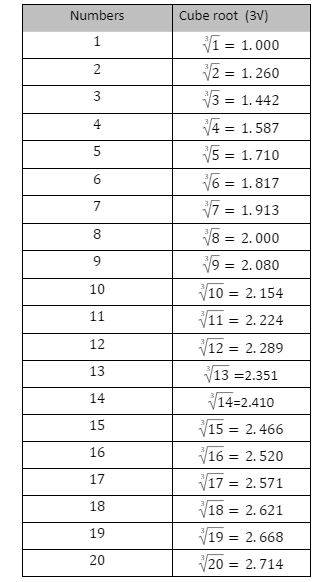
The list of cube roots of all the numbers from 1 to 20 is called Cube Root 1 to 20. For both negative and positive values, cube roots can be found. From 1 to 20, the values of cube roots range from 1 to 2.71441. We will learn about cube roots from 1 to 20in this article.

Table of Content
  •  

Introduction

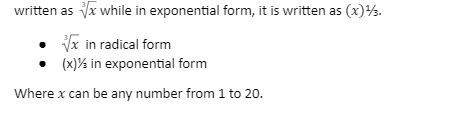
The cube root of a number is a specific value that delivers that number when multiplied three times. The numbers 1 and 8 are perfect cubes in cube roots from 1 to 20, but the remaining numbers are non-perfect cubes, meaning their cube root will be illogical.  In radical form, the cube root 1 to 20 is

How to find cube root of numbers

Prime factorization method

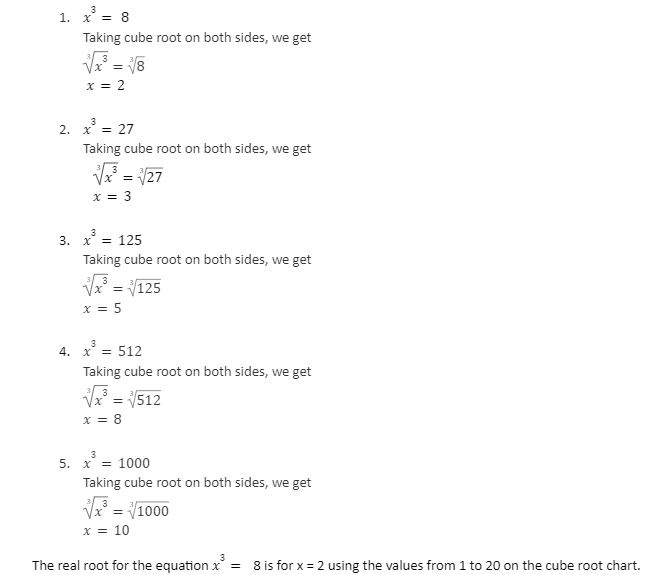
The prime factorization method can be used to find the cube root of a number that is a perfect cube. The procedure is known as the prime factorization method because it entails resolving the integer whose cube root must be sought into its prime factors. 

Follow the these step to find out the cube root of numbers

Step 1: Using the prime factorization method, find the prime factors of the number x.

Step 2 : Divide the collected factors into three groups, each holding the same amount of factors.

List of cube root 1 to 20


Remembering the cube roots 1 to 20 will assist you in efficiently simplifying time-consuming long equations. In the table below, the values of cube roots 1 to 20 are presented to three decimal places.

Conclusion

In this article we study about 1 to 20 cube roots. The term “root” refers to the origin or basic source. So all we have to do is consider “which number’s cube should be taken to obtain the given number.” Cube root is a number that must be multiplied three times to produce the original number, according to mathematics. Now consider the cube root formula:x. ∛x = y.

When solving cubic equations, the cube root is frequently used. It can be used to find the dimensions of a three-dimensional object of a given volume.


faq

Frequently asked questions

Get answers to the most common queries related to the JEE Examination Preparation.

What is the Cube Root 1 to 20 value?

Ans. When the value of cube root 1 to 20 is multiplied three times, the result is the original number  (x⅓). It i...Read full

What are the methods for calculating cube roots in the range of 1 to 20?

Ans. There are two ways for calculating the value of cube roots from 1 to 20 that are regularly used. We can use the...Read full

What is 3 plus 2 Cube Root 3's value?

...Read full

Define a number's cube root?

Ans.  The factor that we multiply by itself three times to create a number is called the cube root. Three cube root...Read full

Ans. When the value of cube root 1 to 20 is multiplied three times, the result is the original number  (x⅓). It is possible for it to have both negative and positive values. The cube roots of 1 and 8 are whole numbers (rational) in the range of 1 to 20, whereas the cube roots of 2, 3, 4, 5, 6, 7, 9, 10, 11, 12, 13, 14, 15, 16, 17, 18, 19, 20 are decimal numbers that are neither ending nor recurring (irrational).


Ans. There are two ways for calculating the value of cube roots from 1 to 20 that are regularly used. We can use the prime factorization method for perfect cubes (1, and 8), and the long division method (2, 3, 4, 5, 6, 7, 9, 10, 11, 12, 13, 14, 15, 16, 17, 18, 19, 20).


Ans.  The factor that we multiply by itself three times to create a number is called the cube root. Three cube root of, end cubic root is the symbol for cube root. Determining a number’s cube root is the inverse of cubing a number.

Company Logo

Unacademy is India’s largest online learning platform. Download our apps to start learning


Starting your preparation?

Call us and we will answer all your questions about learning on Unacademy

Call +91 8585858585

Company
About usShikshodayaCareers
we're hiring
BlogsPrivacy PolicyTerms and Conditions
Help & support
User GuidelinesSite MapRefund PolicyTakedown PolicyGrievance Redressal
Products
Learner appLearner appEducator appEducator appParent appParent app
Popular goals
IIT JEEUPSCSSCCSIR UGC NETNEET UG
Trending exams
GATECATCANTA UGC NETBank Exams
Study material
UPSC Study MaterialNEET UG Study MaterialCA Foundation Study MaterialJEE Study MaterialSSC Study Material

© 2026 Sorting Hat Technologies Pvt Ltd

Unacademy
  • Goals
    • AFCAT
    • AP EAMCET
    • Bank Exam
    • BPSC
    • CA Foundation
    • CAPF
    • CAT
    • CBSE Class 11
    • CBSE Class 12
    • CDS
    • CLAT
    • CSIR UGC
    • GATE
    • IIT JAM
    • JEE
    • Karnataka CET
    • Karnataka PSC
    • Kerala PSC
    • MHT CET
    • MPPSC
    • NDA
    • NEET PG
    • NEET UG
    • NTA UGC
    • Railway Exam
    • SSC
    • TS EAMCET
    • UPSC
    • WBPSC
    • CFA

Share via

COPY