Access free live classes and tests on the app
Download
+
Unacademy
  • Goals
    • AFCAT
    • AP EAMCET
    • Bank Exam
    • BPSC
    • CA Foundation
    • CAPF
    • CAT
    • CBSE Class 11
    • CBSE Class 12
    • CDS
    • CLAT
    • CSIR UGC
    • GATE
    • IIT JAM
    • JEE
    • Karnataka CET
    • Karnataka PSC
    • Kerala PSC
    • MHT CET
    • MPPSC
    • NDA
    • NEET PG
    • NEET UG
    • NTA UGC
    • Railway Exam
    • SSC
    • TS EAMCET
    • UPSC
    • WBPSC
    • CFA
Login Join for Free
avtar
  • ProfileProfile
  • Settings Settings
  • Refer your friendsRefer your friends
  • Sign outSign out
  • Terms & conditions
  • •
  • Privacy policy
  • About
  • •
  • Careers
  • •
  • Blog

© 2023 Sorting Hat Technologies Pvt Ltd

Watch Free Classes
    • Free courses
    • JEE Main 2024
    • JEE Main 2024 Live Paper Discussion
    • JEE Main Rank Predictor 2024
    • JEE Main College Predictor 2024
    • Stream Predictor
    • JEE Main 2024 Free Mock Test
    • Study Materials
    • Notifications
    • JEE Advanced Syllabus
    • JEE Books
    • JEE Main Question Paper
    • JEE Coaching
    • Downloads
    • JEE Notes & Lectures
    • JEE Daily Videos
    • Difference Between
    • Full Forms
    • Important Formulas
    • Exam Tips
JEE Main 2026 Preparation: Question Papers, Solutions, Mock Tests & Strategy Unacademy » JEE Study Material » Mathematics » Addition Formulae of Vectors

Addition Formulae of Vectors

In this topic we will discuss addition formulae of vectors and various methods like the parallelogram method and adding vectors graphically in the article below.

Table of Content
  •  

The term “addition” refers to the joining of two or more vectors. We add two or more vectors together by utilising the addition operation to create a new vector that is equal to the sum of the two or more vectors that were previously added. Vector addition has applications in the physical sciences, where vectors are used to express physical quantities such as velocity, displacement, and acceleration.

This article will discuss vector addition, addition formulae, their characteristics, and numerous rules, provided with solved examples.

What is Vector Addition? 

A vector represents direction and magnitude. So, it is usually represented with an arrow above the quantity. For example, Vector a is written as a and so on. When you add two vectors, the resultant is written as a+b

There are some basic principles to keep in mind for the addition of vectors:

  • Vector addition is only possible when the vectors are of the same nature. For instance, you can add acceleration only with acceleration and not any other quantity.
  • Scalars and vectors cannot be added.

Basic Properties for Addition of Vectors

Whether you are adding vectors graphically or using any other method, you must remember that algebraic addition is quite different from vector addition. Some basic properties will come in handy to help you arrive at the correct answer.

The first aspect that you would have to consider about adding two vectors together is to remember a few rules related to the addition and subtraction of vectors. The following tips will enable you to do it graphically as well.

  • You have to use geometry to add two vectors and not algebra
  • The calculation may be about finding the sum of each vector, but the vectors behave independently and follow specific laws individually
  • The final result equals the count of vectors acting on a particular body at any given point in time
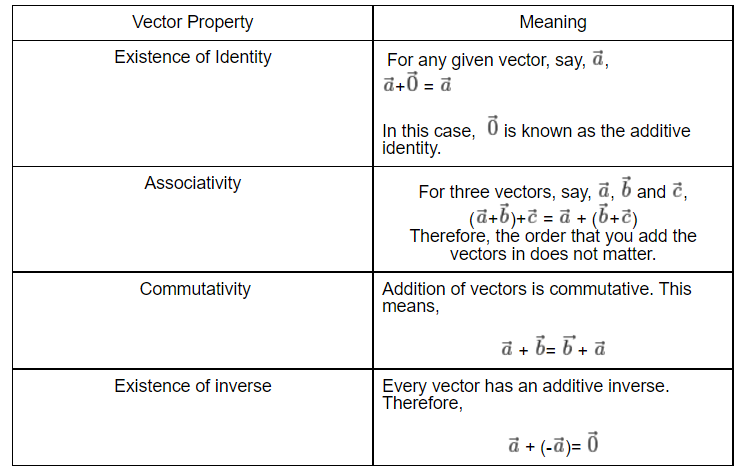
  • The result of vector addition is cumulative. In other words, the resultant number/direction is not dependent on the order of the vectors that are being calculated.

You may illustrate the process of summation of two or multiple vectors by providing vector addition and subtraction examples.

Some of the other laws to consider before attempting addition and subtraction of vectors are:-

Triangle Law

Adding two vectors represented by a  and b can be done by drawing a line AB where A forms the tail and B is the head.

  • Draw a second line BC where B forms the tail and C its head
  • Join the points A and C by another line. The resulting line AC will give you the sum of the two vectors.

Parallelogram Law

The addition and subtraction of vectors, particularly the addition procedure, can be explained with a parallelogram. The law elaborates the process in the following manner:-

  • P and Q represent two sides of a parallelogram that are adjacent to each other. Each side points in an external direction
  • A diagonal line drawn from the intersecting point of P and Q will give the result, one diagonal will be addition of two vectors, while the other one will be their subtraction.

Polygon Law

This particular law considers multiple counts of vectors. When their magnitude, along with the direction of each is considered in an order of the sides of a polygon, the result is evident by the magnitude and the direction considered in the opposite direction of its sides. The addition and subtraction of vectors by using a polygon can be depicted by the following method:-

Name the four vectors as A, B, C, and D consecutively. You now need to obtain the results by adding all four-vectors. You may want to segregate the sides A and B and form a triangle. The opposite direction of both vectors will provide you with the result of adding these two vectors. Now consider the opposite triangle created out of the polygon in the same manner. You will be able to figure out the total of A through D by tracing the direction and taking the total displacement into account.

Conclusion:

The addition of vectors becomes simpler when you understand addition formulae. As a revision, here are some principles that you should remember when adding vectors:


  • You can only add vectors that represent the same quantity. For instance, you can add two vectors that represent acceleration. But not when one vector represents acceleration, and the other represents force.
  • Vector addition is both associative and commutative in nature.
  • You cannot add vectors and scalars.
  • The triangle law of vector addition is considered the first rule of vector addition.

Crack IIT JEE with Unacademy

Get subscription and access unlimited live and recorded courses from India’s best educators

  • Structured syllabus
  • Daily live classes
  • Ask doubts
  • Tests & practice
Learn more

Notifications

Get all the important information related to the JEE Exam including the process of application, important calendar dates, eligibility criteria, exam centers etc.

Allotment of Examination Centre
JEE Advanced Eligibility Criteria
JEE Advanced Exam Dates
JEE Advanced Exam Pattern 2023
JEE Advanced Syllabus
JEE Application Fee
JEE Application Process
JEE Eligibility Criteria 2023
JEE Exam Language and Centres
JEE Exam Pattern – Check JEE Paper Pattern 2024
JEE Examination Scheme
JEE Main 2024 Admit Card (OUT) – Steps to Download Session 1 Hall Ticket
JEE Main Application Form
JEE Main Eligibility Criteria 2024
JEE Main Exam Dates
JEE Main Exam Pattern
JEE Main Highlights
JEE Main Paper Analysis
JEE Main Question Paper with Solutions and Answer Keys
JEE Main Result 2022 (Out)
JEE Main Revised Dates
JEE Marking Scheme
JEE Preparation Books 2024 – JEE Best Books (Mains and Advanced)
Online Applications for JEE (Main)-2022 Session 2
Reserved Seats
See all

Related articles

Learn more topics related to Mathematics
Zero Vector

A zero vector is defined as a line segment coincident with its beginning and ending points. Primary Keyword: Zero Vector

ZERO MATRIX

In this article, we will discuss about the zero matrix and it’s properties.

YARDS TO FEET

In this article we will discuss the conversion of yards into feet and feets to yard.

XVI Roman Numeral

In this article we are going to discuss XVI Roman Numerals and its origin.

See all
Access more than

10,505+ courses for IIT JEE

Get subscription

Trending Topics

  • JEE Main 2024
  • JEE Main Rank Predictor 2024
  • JEE Main Mock Test 2024
  • JEE Main 2024 Admit Card
  • JEE Advanced Syllabus
  • JEE Preparation Books
  • JEE Notes
  • JEE Advanced Toppers
  • JEE Advanced 2022 Question Paper
  • JEE Advanced 2022 Answer Key
  • JEE Main Question Paper
  • JEE Main Answer key 2022
  • JEE Main Paper Analysis 2022
  • JEE Main Result
  • JEE Exam Pattern
  • JEE Main Eligibility
  • JEE College predictor
combat_iitjee

Related links

  • JEE Study Materials
  • CNG Full Form
  • Dimensional Formula of Pressure
  • Reimer Tiemann Reaction
  • Vector Triple Product
  • Swarts Reaction
  • Focal length of Convex Lens
  • Root mean square velocities
  • Fehling’s solution
testseries_iitjee
Predict your JEE Rank
.
Company Logo

Unacademy is India’s largest online learning platform. Download our apps to start learning


Starting your preparation?

Call us and we will answer all your questions about learning on Unacademy

Call +91 8585858585

Company
About usShikshodayaCareers
we're hiring
BlogsPrivacy PolicyTerms and Conditions
Help & support
User GuidelinesSite MapRefund PolicyTakedown PolicyGrievance Redressal
Products
Learner appLearner appEducator appEducator appParent appParent app
Popular goals
IIT JEEUPSCSSCCSIR UGC NETNEET UG
Trending exams
GATECATCANTA UGC NETBank Exams
Study material
UPSC Study MaterialNEET UG Study MaterialCA Foundation Study MaterialJEE Study MaterialSSC Study Material

© 2026 Sorting Hat Technologies Pvt Ltd

Unacademy
  • Goals
    • AFCAT
    • AP EAMCET
    • Bank Exam
    • BPSC
    • CA Foundation
    • CAPF
    • CAT
    • CBSE Class 11
    • CBSE Class 12
    • CDS
    • CLAT
    • CSIR UGC
    • GATE
    • IIT JAM
    • JEE
    • Karnataka CET
    • Karnataka PSC
    • Kerala PSC
    • MHT CET
    • MPPSC
    • NDA
    • NEET PG
    • NEET UG
    • NTA UGC
    • Railway Exam
    • SSC
    • TS EAMCET
    • UPSC
    • WBPSC
    • CFA

Share via

COPY