Unacademy's Blog!
Login Join for Free
avtar
  • ProfileProfile
  • Settings Settings
  • Refer your friendsRefer your friends
  • Sign outSign out
  • Terms & conditions
  • •
  • Privacy policy
  • About
  • •
  • Careers
  • •
  • Blog

© 2023 Sorting Hat Technologies Pvt Ltd

CBSE Class 11 » CBSE Class 11 Study Materials » Mathematics » Mean Value Theorem
CBSE

Mean Value Theorem

Get a detailed understanding of the definition of mean value theorem, Rolle’s theorem, and other related topics in maths.

Table of Content
  •  

Definition of mean value theorem

The mean value theorem is a key theorem in calculus. In the 14th century, Parmeshwara, a mathematician from the state of Kerala established the oldest version of the mean value theorem. In the 17th century, Rolle presented a simpler model of this theorem. This theorem was established for polynomials and was not to be considered in calculus. The latest iteration of the mean value theorem was presented by Augustin Louis Cauchy in 1823.

According to the mean value theorem, there is one point on a curve that runs between two points in which the tangent is parallel to the secant that runs between the two points. Rolle’s theorem is based on this mean value theorem. Here, we shall discuss Rolle’s Theorem and Lagrange’s mean value theorem. What are these theorems, the statements, the conditions, how to use them to solve problems will be covered in this concept.

Rolle’s theorem

Let f be a real-valued function referred to as the closed interval a,b such that

  • It is continuous in closed interval represented as [a, b]
  • It is differentiable in open interval represented as a, b and 
  • fa=fb, then there exist at least real number ‘c’∈a, b such thatf’c=0.

Geometrical Meaning:

If fx be a real-valued function defined on a, b such that y=f(x) is continuous curve between points Aa, f(a), Bb,fb, there exists a unique tangent at every point on the curve y=fx between points A and B. Also, the ordinate points at the end of interval a,b are equal. There exists at least one point c, f(c) between A & B on the curve where tangents are parallel to x-axis.
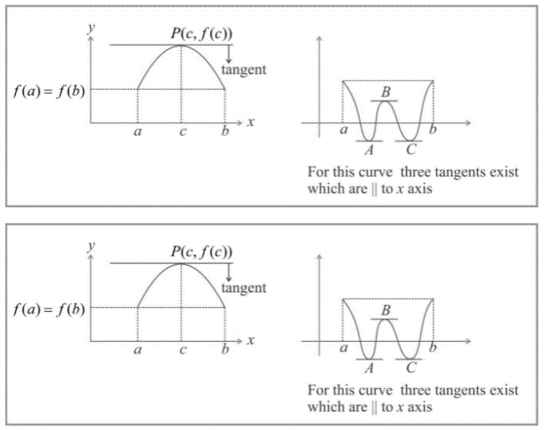
fff

Lagrange’s Mean Value Theorem

If a function of mean value theorem fx is

(i) Continuous in the close interval a, b, i.e., continuous at each point in the interval a,b

(Ii) Differentiable in the open interval a,b, i.e., differentiable at each point in the interval a,b
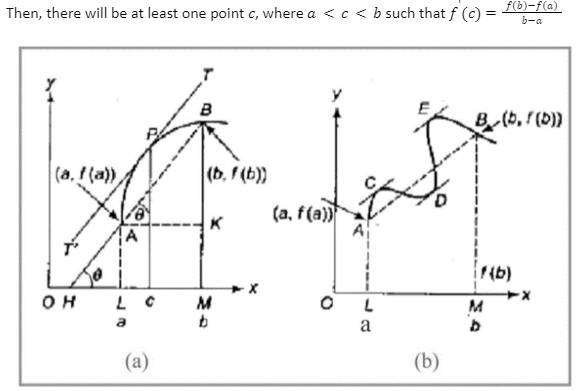
fff1

Proof of mean value theorem

To prove the mean value theorem, the function h(x) = f(x) – g(x) can be considered. Here, g(x) is referred to as the function which represents the secant line denoted as AB. Here, Rolle’s theorem is applied to the continuous function denoted as h(x), proving that the point c in (a, b) co-exists in a way that h'(c) = 0. The given equation will appear as the result of the mean value theorem. 

Let g(x) be the secant line to f(x) passing through (a, f(a)) and (b, f(b)). We know that the equation of the secant line is y-y1 = m (x- x1).

y – f(a) = {f(b) – f(a)}/(b-a) . (x – a)

or y = f(a)+ {f(b) – f(a)}/(b-a) . (x – a)

Imagine h is the function that defines the difference between the above line and any function f.

Therefore, h(x) = f(x) – f(a) – {f(b)-f(a)}/(b-a) . (x – a)

When applying the Rolle’s theorem, we have

h(a)=0 and h(b)=0

h'(x) = f'(x) – {f(b)-f(a)}/(b-a)

Or f(b) – f(a) = f'(x) (b – a). Hence proved

Differences between mean value theorem and Rolle’s theorem

The distinction between Rolle’s theorem and the mean value theorem aids in comprehending these two theorems. Both these theorems speak about the f(x) as an ongoing function in and around the interval [a, b] and also the differentiable function in and around the interval [a, b] . In the mean value theorem, both these locations (a, f(a)), (b, f(b)) are different. In comparison, the points in Rolle’s theorem are expressed as f(a) = f (b).

Conclusion

In the 14th century, Parmeshwara, a mathematician from the state of Kerala established the oldest version of the mean value theorem. The latest iteration of the Mean Value Theorem was presented by Augustin Louis Cauchy in 1823. The mean value theorem is closely related to Rolle’s theorem, which we discussed here. Both the theorems have significant differences such as, in the examples of mean value theorem, both these locations (a, f(a)), (b, f(b)) are different from one another. However, in the case of Rolle’s theorem, these locations are expressed as f(a) = f(b).


faq

Frequently asked questions

Get answers to the most common queries related to the CBSE Class 11th Examination Preparation.

State Rolle’s Theorem.

Ans. If f is a real-va...Read full

State Lagrange’s Mean Value Theorem

Ans. If a function f(x)...Read full

Who presented the latest iteration of the mean value theorem?

Ans. The latest iteration of the Mean Value Theorem was presented by Augustin Louis Cauchy in 1823....Read full

List one difference between the mean value theorem and the Rolle’s theorem

Ans. In the mean value theorem, both these locations (a, f(a)), (b, f(b)) are different from one another. Ho...Read full

What is the equation of the mean value theorem?

Ans. The mean value theorem is described for a function f(x): [a, b]â†...Read full

Check whether the following function satisfies rolle’s theorem in interval [-1,1]. f(x)=1/x

Ans. f(x)=1/x will not satisfy Rolle’s theorem in interval [-1,1] as it is not continuous at x=0....Read full

Ans. If f is a real-valued function referred to as the closed interval a,b, such that:

  • It is continuous in closed interval represented as a,b
  • It is differentiable in open interval represented as a,b
  • fa=f(b), there exists a real number c, where c∈a,b such that f‘c=0

Ans. If a function f(x) is such that:

  • It is continuous in a,b
  • Differentiable in a, b

There will be at least one point c, where a<c<b, such that:

Ans. The latest iteration of the Mean Value Theorem was presented by Augustin Louis Cauchy in 1823.

Ans. In the mean value theorem, both these locations (a, f(a)), (b, f(b)) are different from one another. However, in the case of Rolle’s theorem, these are expressed as f(a) = f(b).

Ans. The mean value theorem is described for a function f(x): [a, b]→ R. The equation of the mean value theorem is f'(c) = (f(b)−f(a))/(b−a).

Ans. f(x)=1/x will not satisfy Rolle’s theorem in interval [-1,1] as it is not continuous at x=0.

Crack K-12 with Unacademy

Get subscription and access unlimited live and recorded courses from India’s best educators

  • Structured syllabus
  • Daily live classes
  • Ask doubts
  • Tests & practice
Learn more

Notifications

Get all the important information related to the CBSE Class 11 Exam including the process of application, important calendar dates, eligibility criteria, exam centers etc.

Data Correction
Exam Pattern for Class 11th
Registration Process
Syllabus
See all

Related articles

Learn more topics related to Mathematics
Word Problems Based On Linear Inequalities In One Variable

These notes are a comprehensive overview of the topic of linear inequalities in one variable. The concept of linear equalities is crucial in solving inequalities in one variable and preparing for entrance exams.

What Is The Inverse Function Graph Like?

The inverse function of a function ‘f’ is a function that reverses the action. The inverse of f is represented by f-1. Find out more details about an inverse function graph here.

What is the fundamental counting principle

In this article, we have to learn about the fundamental principle of counting, the law of multiplication, law of addition.

Weighted Arithmetic Mean

Confused about how to calculate the weighted average . Read along to understand the weighted arithmetic mean, its applicability, formula, and advantages.

See all
Access more than

5,130+ courses for CBSE Class 11

Get subscription

Trending Topics

  • Withdrawal Slip
  • Wildlife Conservation
  • Moving Coil Galvanometer
  • Ogive Curves
  • PPT Full Form
  • Reordering Of Sentences
  • Central Problems Of An Economy
  • Transcription In Eukaryotes
combat_iitjee

Important Links

  • NCERT Solutions
  • NCERT Books
  • Physics Formulas
  • Maths Formulas
  • Chemistry Formulas
testseries_iitjee
Download NEET 2022 question paper
.
Company Logo

Unacademy is India’s largest online learning platform. Download our apps to start learning


Starting your preparation?

Call us and we will answer all your questions about learning on Unacademy

Call +91 8585858585

Company
About usShikshodayaCareers
we're hiring
BlogsPrivacy PolicyTerms and Conditions
Help & support
User GuidelinesSite MapRefund PolicyTakedown PolicyGrievance Redressal
Products
Learner appLearner appEducator appEducator appParent appParent app
Popular goals
IIT JEEUPSCSSCCSIR UGC NETNEET UG
Trending exams
GATECATCANTA UGC NETBank Exams
Study material
UPSC Study MaterialNEET UG Study MaterialCA Foundation Study MaterialJEE Study MaterialSSC Study Material

© 2026 Sorting Hat Technologies Pvt Ltd

Unacademy's Blog!

Share via

COPY