| Title | Download PDF |
| Mrunal’s Model Answer for Eco Qs in CSM26 | Download PDF |
| Title | Download PDF |
| Economy Mains Essential Datasets by Dr. Mrunal Patel | Download PDF |
| History Mains how to deal with bouncer questions by Pratik Nayak Sir | Download PDF |
Preparing for the Civil Services Mains Examination is not just about reading standard books. The real challenge begins when aspirants try to revise the huge syllabus multiple times while also preparing for answer writing. That is where well-structured UPSC Mains Notes become important.
Good UPSC Mains notes reduce revision time, improve retention, and help aspirants write more relevant and analytical answers in the examination hall. Whether you are searching for concise GS notes, current affairs compilations, or UPSC Mains Notes PDF, it is important to choose the right material that can make preparation not as easy but at least manageable.
Unacademy UPSC Mains notes are designed in a way that preparation remains closely aligned with the actual demand of the examination. Along with covering the complete syllabus in a concise format, the notes also focus on PYQ-based themes that UPSC repeatedly asks over the years. The short-note format makes revision quicker while also helping aspirants understand how static concepts, current affairs, examples, and previous year trends connect with each other in the exam.
At Unacademy, aspirants can access structured classes, answer writing guidance, and very good UPSC Mains study material designed specifically for the demands of the Mains examination. Many candidates also rely on Unacademy UPSC Mains Notes for quick revision and topic-wise preparation, as the time after Prelims for Mains 2026 is quite limited.
Unacademy UPSC Mains Notes PDF covers the complete 2026 syllabus in a structured, revision-friendly format. Below is a summary of what is available for download.
GS Paper 1 Notes PDF: Modern and Ancient History, World History, Indian Society, Art and Culture, Geography - topic-wise summaries with timelines, maps, and key themes.
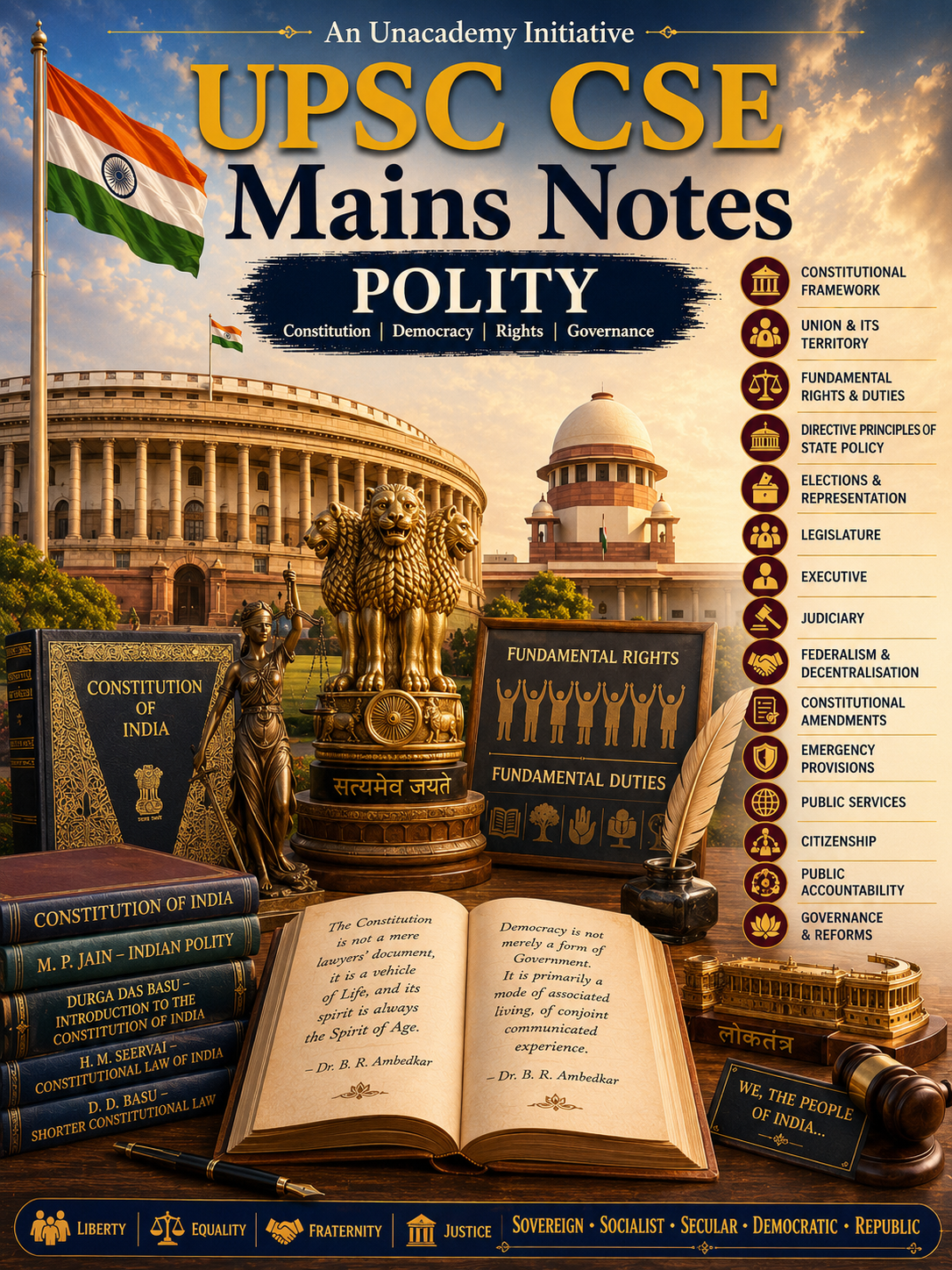
GS Paper 2 Notes PDF: Polity, Constitution, Governance, Social Justice, International Relations - with important Articles, Supreme Court judgments, committee recommendations, and scheme highlights.
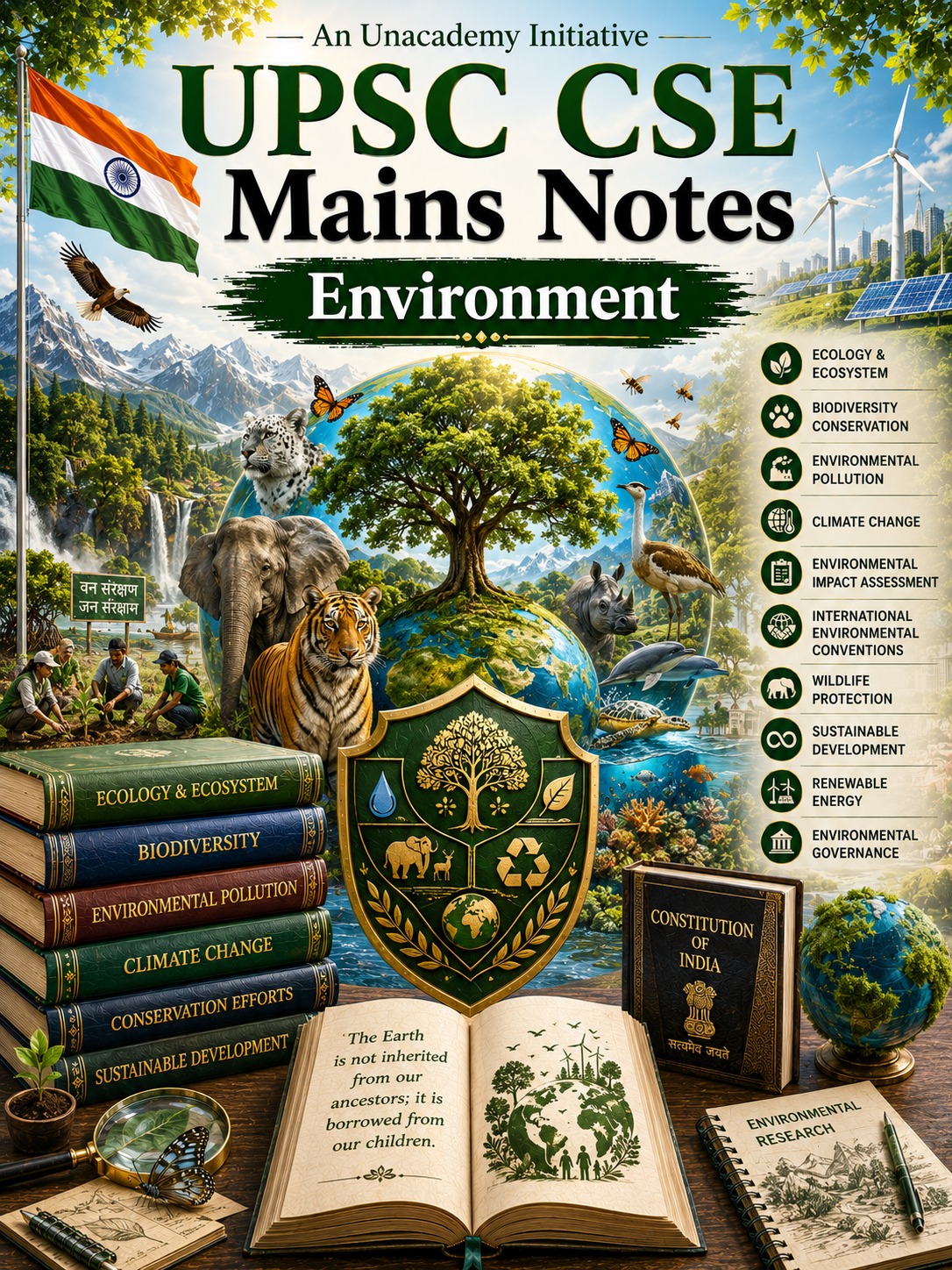
GS Paper 3 Notes PDF: Economy, Agriculture, Environment, Internal Security, Science and Technology, Disaster Management - with Economic Survey data, environmental reports, and recent policy highlights.
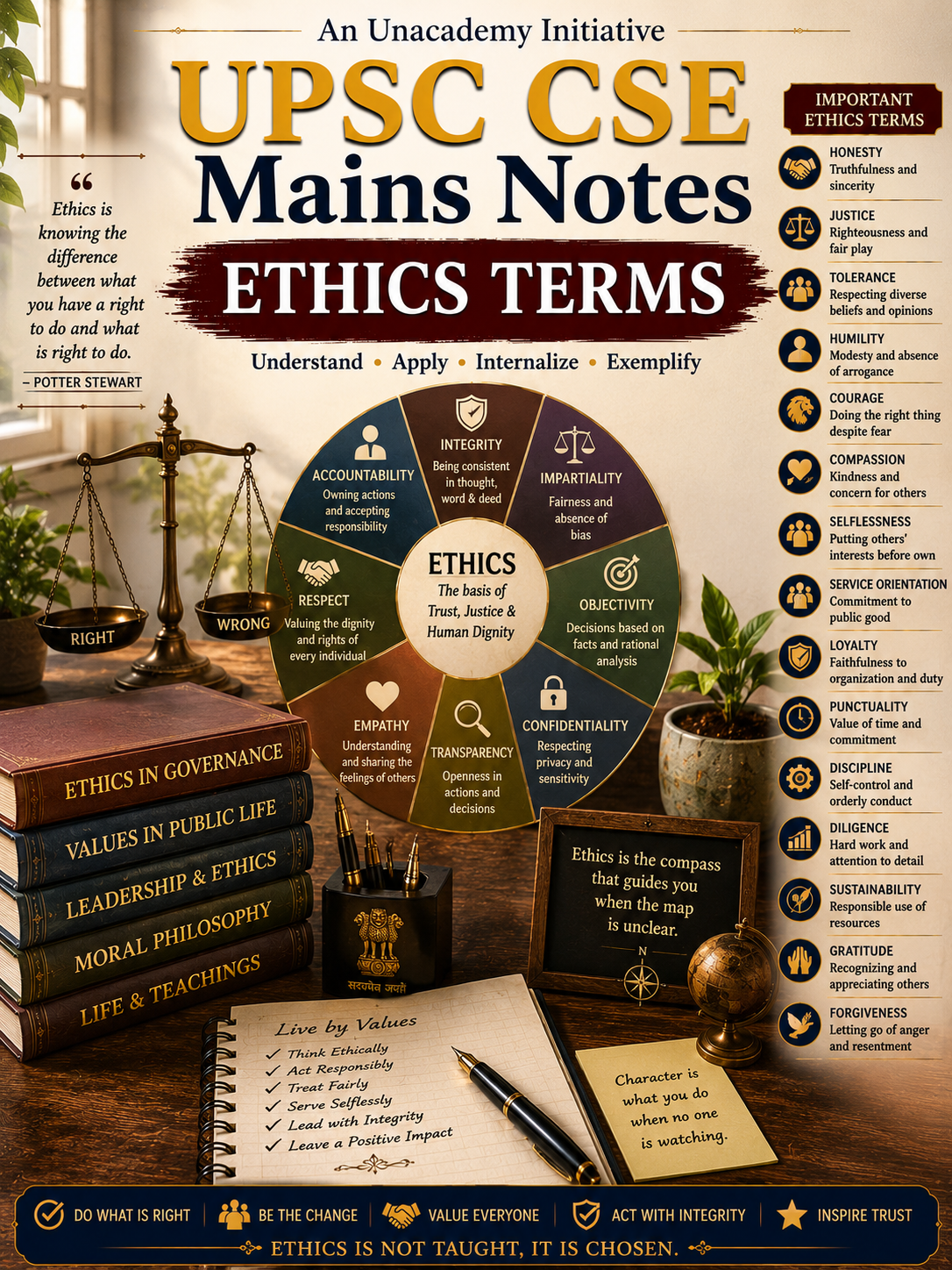
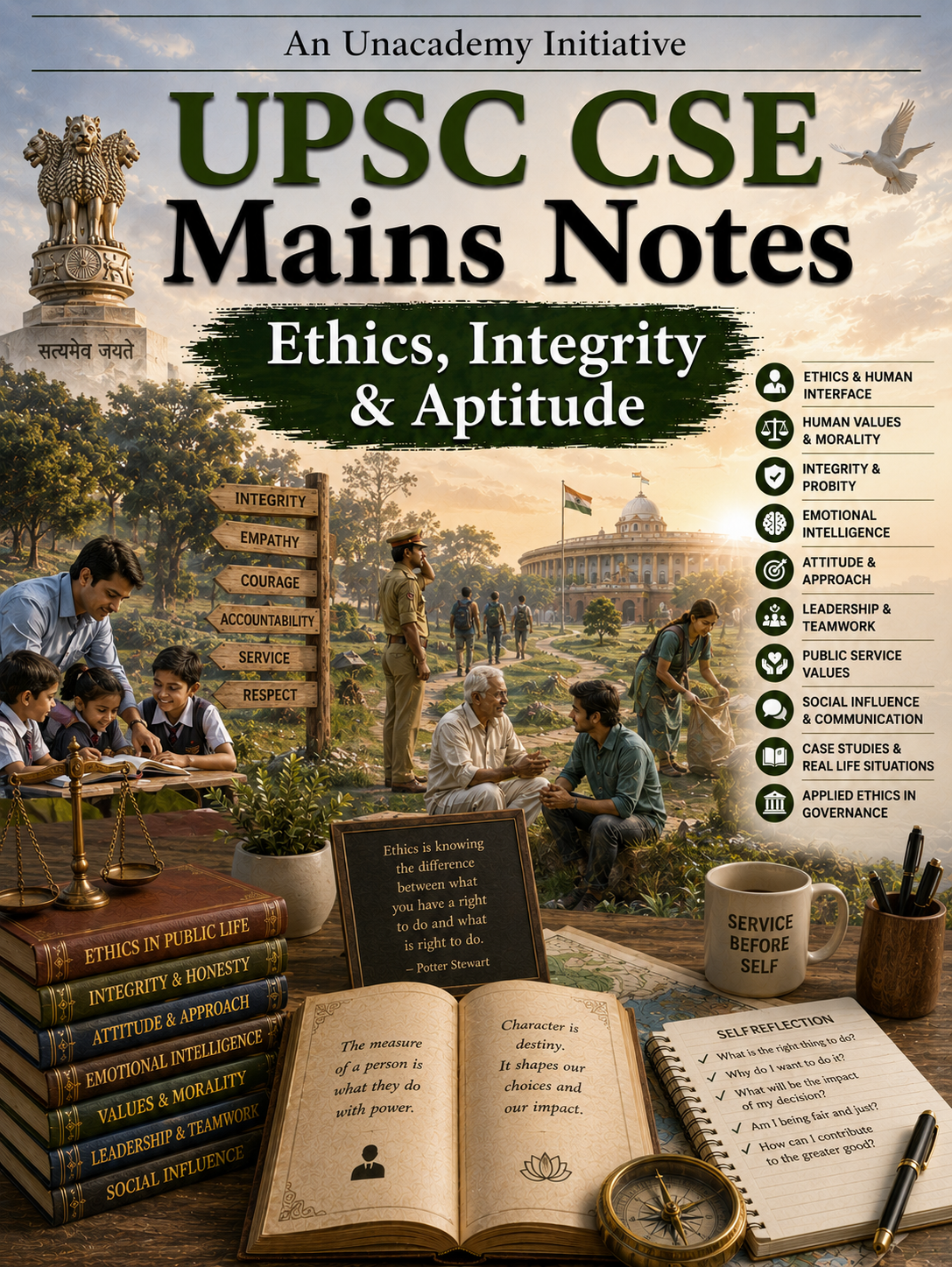
GS Paper 4 Notes PDF (Ethics): Ethical thinkers, definitions, case study frameworks, stakeholder analysis templates, and real-life governance examples.
Essay Notes PDF: Philosophy themes, social issues, governance examples, constitutional values, quotes, and international references - organized by theme.
Current Affairs Notes PDF: Issue-based current affairs linked to GS paper syllabus, updated for Mains 2026.
Always verify that the notes you download:
Avoid downloading notes from multiple sources. Revising one good set of notes four times is significantly more effective than revising four different sets of notes once each.
The UPSC Mains syllabus is quite elaborate. Reading books alone is never enough because it is important to revise content multiple times and write answers with all the information you have within strict time limits. In such a situation, well-prepared notes help aspirants:
Revise faster during the final months: In the final phase of UPSC preparation, time becomes extremely important. Most aspirants do not get enough time to go back to full textbooks or lengthy coaching material again and again. This is where proper notes become useful. Short and well-organized notes make revision quicker and less stressful. Instead of searching through different books, candidates can revise important facts, examples, reports, and concepts from one place. Multiple revisions in the last few months also improve recall during the examination.
Organize scattered information in one place: UPSC preparation usually involves studying from many different sources such as NCERTs, newspapers, standard reference books, magazines, government reports, and current affairs compilations. Over time, information starts becoming scattered, and revision becomes difficult. Notes help bring everything together topic-wise. For example, under a topic like women empowerment, aspirants can keep constitutional provisions, government schemes, committee recommendations, data, and current affairs examples together. This makes preparation more systematic and easier to revise later.
Integrate current affairs into static subjects: UPSC Mains answers cannot rely only on textbook knowledge. The exam expects candidates to connect static subjects with current developments. Good notes make this process easier. While preparing Polity, aspirants can add recent Supreme Court judgments or debates related to federalism. Environment notes can include recent climate reports or biodiversity conferences. Linking current affairs with static topics makes answers more relevant, updated, and analytical.
Improve answer structure and presentation: Good notes also help in developing better answer-writing habits. When notes are prepared with headings, sub-headings, keywords, diagrams, and short summaries, candidates naturally begin thinking in a structured way. This improves answer presentation in the exam hall. Instead of writing random points, aspirants learn how to present arguments logically with a proper introduction, organized body, and balanced conclusion. Clear presentation also makes answers easier for the examiner to read.
Add value through examples, data, and diagrams: Only basic content is often not enough in UPSC Mains. Your answers can become stronger when they include relevant examples, committee recommendations, reports, constitutional references, and data.
Every UPSC cycle, successful candidates share insights about their note-making approach. Studying these patterns reveals consistent habits that distinguish effective notes from ineffective ones.
WHAT TOPPERS' NOTES CONSISTENTLY HAVE IN COMMON:
1. Single-Source Discipline:
Most toppers maintain notes from one primary source per subject - not a compilation from 8 different books. The reasoning: depth in one source produces better answers than surface coverage of many. Toppers who used multiple sources consistently report that consolidation was their biggest challenge.
2. Issue-Based Organisation (Not Chapter-Based):
Toppers do not organise notes by textbook chapter - they organise by issue or theme that UPSC tests. For example, instead of "Chapter 5: Federalism in Laxmikanth," their notes are titled "Federalism - Challenges, Reforms, Key Judgments, Way Forward." This issue-based structure maps directly to how questions are asked.
3. Running Updates Throughout Preparation:
Topper notes are not one-time creations - they are living documents. Whenever a current event, new Supreme Court judgment, new data point, or committee recommendation becomes relevant to a topic, it is added to the relevant note. This ensures notes remain updated for the actual exam date.
4. Answer-Writing Orientation:
Toppers write notes with answer writing in mind - not just information recording. Each note includes not just what the topic is, but how to introduce it, what dimensions to cover, what examples to use, and how to conclude. Some toppers maintain a "ready-to-use" section in each note with their best introduction line and best conclusion for that topic.
5. Revision-Tested Length:
Notes that are too long do not get revised enough. Most toppers report that a good topic note should be readable in 5–7 minutes. Notes that take 20+ minutes to read once are typically revised once - which is not enough for UPSC Mains.
WHAT UNACADEMY MAINS NOTES ARE MODELLED ON:
Unacademy’s UPSC Mains Notes are designed by expert educators who have studied UPSC patterns, topper answer copies, and PYQ trends to build notes that are syllabus-aligned, revision-efficient, and answer-writing oriented - incorporating the same principles that toppers use in their own preparation.
Beginners often make one of two mistakes with notes: they either make notes too late (only after completing a source fully) or too elaborately (copying entire pages into a notebook). Both approaches waste time. Here is a better approach.
PHASE 1 - START WITH TOPIC SUMMARIES (Month 1–2):
In the early phase, notes should be simple topic summaries - not comprehensive compilations. After reading a chapter or a topic from your source, write 10–12 key points about it in your own words. Do not copy sentences. Writing in your own words forces understanding, not just transcription.
Format for beginner topic summaries:
PHASE 2 - ADD CURRENT AFFAIRS AND VALUE ADDITION (Month 3–4):
Once the topic summary exists, start enriching it. When you read an editorial, find a government report, or encounter a Supreme Court judgment related to a topic you have already noted, add it to the relevant topic note immediately - not to a separate "current affairs notebook."
This integration approach is how current affairs become part of your answer preparation - not a separate, disconnected exercise.
PHASE 3 - CONVERT TO ANSWER FRAMEWORKS (Month 5–6):
In the final phase, review your notes and convert them into answer frameworks for high-frequency topics. An answer framework includes: the best introduction angle for this topic, the 3–4 body dimensions UPSC is most likely to test, the strongest example or data point to use, and a closing direction.
This is the stage where notes stop being "study notes" and become "answer preparation notes."
SHORT NOTES VS COMPREHENSIVE NOTES - WHICH IS BETTER FOR BEGINNERS:
Short notes are better for beginners for one reason: revision frequency. A short note on a topic gets revised 4–5 times before the exam. A comprehensive note on the same topic might get revised once or twice. In UPSC Mains, revision frequency is more important than note detail.
Start short. Add depth gradually. Revise consistently.
RECOMMENDED SOURCES FOR BEGINNER MAINS NOTES:
This is one of the most commonly debated questions in UPSC preparation communities. The honest answer: both have genuine advantages, and the best approach for most aspirants is a combination.
1. Better Retention:
Research consistently shows that handwriting engages more cognitive processing than typing. When you write by hand, you are forced to summarise and paraphrase - which deepens understanding and improves recall.
2. Diagram Integration:
Handwritten notes make it easier to draw quick diagrams, flowcharts, timelines, and maps directly into the note. Since UPSC Mains rewards diagram use in certain GS papers, practising with diagrams in your notes also prepares you for the exam.
3. No Distractions:
Writing by hand removes the temptation of browser tabs, notifications, and internet rabbit holes that slow down digital note-making.
1. Easy to Update:
Current affairs integration happens regularly throughout UPSC preparation. Adding a new Supreme Court judgment, a new scheme, or updated data to a typed note is significantly easier than managing additions in handwritten notebooks.
2. Searchable and Portable:
A PDF can be searched instantly. A handwritten notebook cannot. During rapid revision, finding "all notes related to federalism" in a PDF takes seconds.
3. Easy to Revise Anywhere:
PDF notes can be accessed on a phone during commute, between classes, or in any environment. Physical notebooks require carrying them everywhere.
THE BEST APPROACH - A COMBINATION:
Unacademy UPSC Mains Notes PDF works best as a structured foundation that you supplement with your own handwritten additions during preparation.
WHO SHOULD PREFER HANDWRITTEN NOTES:
Aspirants in early stages of preparation, those who find screens tiring for long sessions, and anyone who struggles with retention when typing.
WHO SHOULD PREFER DIGITAL NOTES:
Working professionals with limited study time who need quick updates and portable access, aspirants in the consolidation/revision phase, and anyone using notes primarily for rapid pre-exam revision.
The most important point is that the UPSC Mains GS Notes should cover all four General Studies papers along with answer enrichment and integrated current affairs.
Static concepts: Good GS notes should first develop clarity on core static concepts from subjects like Polity, History, Geography, Economy, and Society. Strong conceptual understanding helps aspirants write balanced and analytical answers instead of just rote learned content.
Interlinking of Current Affairs: Current affairs interlinkage makes notes more relevant for UPSC Mains as the exam is very dynamic and it is important to cover current affairs. Important news events, government initiatives, international developments, and policy debates should be connected with static topics to improve answer quality.
Diagrams and maps: Diagrams, maps, and flowcharts can make your revision easier and also improve your answers in the exam hall. By using them, you can explain complex topics quickly and make answers more organised and visually clear for the examiner. They also help save time.
Government reports: Government reports such as the Economic Survey, NITI Aayog reports, NFHS, NCRB data, and Census findings add factual support to answers. Using such references makes arguments stronger and more credible.
Supreme Court judgments: Important Supreme Court judgments are especially useful in topics related to governance, rights, federalism, social justice, and constitutional issues. Mentioning relevant judgments shows a better understanding of contemporary legal and constitutional developments.
Committee recommendations: Committee and commission recommendations help enrich answers with practical suggestions and expert viewpoints. References to committees like Sarkaria Commission, Punchhi Commission, or ARC reports often add depth and maturity to Mains answers.
The purpose of notes is not just information overload but also clarity and retention. Hence, focus on revision.
GS Paper 1 preparation requires both factual clarity and analytical understanding. Notes for this paper should cover subjects like Modern Indian History, World History, Indian Society, Art and Culture, Geography, and basic concepts of Disaster Management. Since the syllabus is wide, concise and topic-wise notes help in faster revision before the examination.
Maps, timelines, and flowcharts are especially useful in GS1 because they improve presentation and help explain concepts more clearly. For example, timelines can simplify historical events, while maps can be used in Geography and international issues.
MODERN HISTORY NOTES:
Modern History notes should be organized chronologically and thematically. Key themes include: the Revolt of 1857 and its causes/consequences, social reform movements (Brahmo Samaj, Arya Samaj), the Indian National Movement (phases, key leaders, mass movements), and post-independence consolidation. Notes should highlight causes, key figures, consequences, and UPSC's recurring angle on each event - not just the event itself.
WORLD HISTORY NOTES:
UPSC's World History focus is specific - Industrial Revolution, French Revolution, World Wars, Decolonisation, Cold War, and the events that shaped the post-war international order. Notes should link global events to India where possible (e.g., Decolonisation and India's foreign policy, Cold War and India's Non-Alignment).
INDIAN SOCIETY NOTES:
Society notes are most effective when organized by issue - caste, gender, religion, minorities, tribals, regionalism. Each issue should include: constitutional provisions, government schemes, recent data, Supreme Court judgments, and analytical dimensions (causes, manifestations, challenges, way forward).
GEOGRAPHY NOTES:
Geography notes should prioritise Indian physical geography (rivers, mountains, climate, soil types) and economic geography (agricultural patterns, industrial locations, resource distribution). Maps and diagrams are not optional here - they are essential for both retention and exam presentation.
DISASTER MANAGEMENT NOTES:
Often underserved in GS1 preparation. Notes should cover NDMA, SDRF/NDRF frameworks, Sendai Framework, and recent disaster case studies from India.
GS2 mainly focuses on Polity, Governance, Constitution, Social Justice, and International Relations. Important topics include the Indian Constitution, Parliament, Judiciary, Federalism, Governance reforms, Welfare schemes, and India’s relations with other countries.
Answer writing in GS2 becomes stronger when notes include constitutional Articles, Supreme Court judgments, committee recommendations, and government initiatives. Such references make answers more balanced, practical, and relevant to contemporary issues.
POLITY AND CONSTITUTION NOTES:
GS2 notes should contain a dedicated reference section for important Articles. Priority Articles to note: Part III (Fundamental Rights), Part IV (DPSPs), Articles 356, 370, 51A, and the amendment procedure. Every constitutional topic should have a "Recent Developments" sub-section where current affairs are added - for example, recent Supreme Court judgments on federalism or rights.
GOVERNANCE NOTES:
Governance notes work best in a problem-solution format: What is the governance challenge? What has the government done? What do experts recommend? This framework directly maps to how UPSC asks GS2 questions.
SOCIAL JUSTICE NOTES:
Social justice topics - women, children, SC/ST, minorities, disabilities - should be prepared with: constitutional provision, key government scheme, key data point, key challenge, and way forward. A 5-element template for each topic makes revision faster and answer writing more systematic.
INTERNATIONAL RELATIONS NOTES:
India's bilateral relations (China, Pakistan, USA, Russia, neighbours) should each have a dedicated note covering: history, current status, areas of cooperation, areas of tension, and India's strategic interest. Multilateral groupings (UN, BRICS, SCO, SAARC, G20, QUAD) should have objective, India's role, and recent developments.
GS3 requires analytical preparation along with updated examples and current affairs integration. Important themes include the Indian Economy, Agriculture, Internal Security, Science and Technology, Environment and Biodiversity, and Disaster Management.
Since many GS3 questions demand factual support, data-driven answers often score better. Notes should therefore include important reports, government data, economic surveys, environmental reports, and recent technological developments for answer enrichment.
ECONOMY NOTES:
Economy notes should cover macroeconomic fundamentals (GDP, inflation, fiscal policy, monetary policy), Indian economic structure (agriculture, industry, services), and government economic initiatives. For each major economic issue, notes should include: current data, government response, and the key analytical angle UPSC tests. Economic Survey highlights and Union Budget announcements should be added to relevant economy topics as they are released.
ENVIRONMENT NOTES:
Environment notes require both static content (biodiversity concepts, ecosystems, environmental laws) and dynamic current affairs (COP summits, IPCC reports, conservation initiatives). The most effective format is issue-based: Climate Change, Biodiversity Loss, Water Crisis, Plastic Pollution - each with causes, impact on India, international agreements, India's actions, and way forward.
AGRICULTURE NOTES:
Agriculture is consistently tested in GS3. Notes should cover: land reforms, irrigation systems, agricultural credit, food security schemes (PM-KISAN, MSP), agricultural marketing reforms, challenges (fragmented land holdings, monsoon dependency, price volatility), and recent policy debates.
INTERNAL SECURITY NOTES:
Internal security notes should cover threat categories: Left-wing extremism, terrorism, insurgencies in Northeast and J&K, cyber threats, and border management challenges. For each, the note should cover: current status, government measures, relevant legal framework (AFSPA, UAPA, NIA), and the way forward.
SCIENCE AND TECHNOLOGY NOTES:
S&T notes should focus on India-specific developments - ISRO missions, AI policy, semiconductor initiatives, digital governance, biotechnology regulations. For each development, note: what it is, India's progress, its significance, and any governance or ethical dimension.
Ethics preparation is different from other GS papers because it focuses more on practical understanding, ethical reasoning, and real-life application. Good GS4 notes should include ethical thinkers, emotional intelligence, integrity and aptitude, governance ethics, case studies, and practical examples from administration and society.
Preparing separate examples and case studies for topics like empathy, accountability, honesty, and leadership can help improve answer quality significantly.
1. Definitions Glossary (30–40 terms):
Ethics notes should start with a precise definitions glossary. Key terms include: Emotional Intelligence, Moral Intuition, Probity in Governance, Conflict of Interest, Integrity, Empathy, Compassion, Accountability, Transparency, Impartiality, Whistleblowing, and Ethical Dilemma. Write definitions in your own words - not verbatim from textbooks.
2. Ethical Thinkers (Western + Indian):
Western thinkers: Kant (deontological ethics - duty-based morality), Bentham and Mill (utilitarianism - greatest good for greatest number), Aristotle (virtue ethics - character-based morality), Rawls (justice as fairness), and Kohlberg (stages of moral development).
Indian thinkers: Gandhi (truth and non-violence, Sarvodaya), Kautilya (statecraft and administrative ethics), Tagore (humanist philosophy), Ambedkar (constitutional morality), and Vivekananda (service as spirituality).
For each thinker, notes should contain: core philosophy, a 1-line quote, and 1–2 governance applications.
3. Case Study Framework:
Every Ethics case study should be approached using this structure:
4. Real-life Administrative Examples:
Maintain a running list of at least 20–25 real-life examples from administration, public service, and governance that can be cited in both theoretical questions and case studies. Examples: RTI implementation and transparency, whistleblower protection cases, pandemic-era administrative decisions, welfare scheme implementation success stories.
5. Governance Ethics Notes:
Specific notes on: Civil Service Values (integrity, impartiality, objectivity, dedication to public service), Conflict of Interest situations, Corporate Governance, International Ethical Organisations (UN, Transparency International).
Essay preparation requires multidimensional understanding, clarity of thought, and strong structuring skills. Unlike GS answers, essays demand a broader perspective, smooth flow of ideas, and balanced arguments. Maintaining separate Essay notes helps aspirants during brainstorming, content organization, and outline creation before writing the final essay.
Good Essay notes for UPSC Mains should contain:
Philosophical themes: Notes on philosophical topics such as morality, justice, freedom, compassion, happiness, ethics, and human values help in writing abstract and thought-provoking essays with better depth.
Social issues: Important topics related to women empowerment, education, poverty, urbanization, social inequality, health, and youth issues should be prepared with examples, data, and multiple dimensions.
Governance examples: Real-life governance examples, policy initiatives, administrative reforms, and successful models of public service add practical understanding and strengthen essay arguments.
Constitutional values: Constitutional ideals such as justice, liberty, equality, fraternity, secularism, and democracy can enrich both introductions and conclusions in essays.
Quotes and anecdotes: Relevant quotations, short anecdotes, and real-life stories make essays more engaging and improve the overall presentation and flow of writing.
International examples: Global examples related to development, environment, technology, social reforms, and governance help provide wider perspective and comparative analysis in essays.
STEP 1 - BUILD A THEME BANK (not a topic list):
Instead of preparing "topics," prepare "themes." A theme like "Freedom vs Security" can generate essays on multiple specific topics. Prepare 15–20 broad themes and under each theme, list: key arguments, counter-arguments, examples from India, international examples, constitutional references, and a possible opening line.
STEP 2 - MAINTAIN A QUOTE BANK:
Collect 40–50 relevant quotes organized by theme (not alphabetically). Prioritize quotes that can be used as essay openings or closings. Include quotes from Indian thinkers (Gandhi, Ambedkar, Tagore, Nehru), international thinkers (Lincoln, Mandela, Einstein), and constitutional sources.
STEP 3 - SKELETON PRACTICE:
Essay notes are most useful when you practice building skeletons from them under timed conditions. Every week, take one essay topic and build a skeleton - introduction angle, 4–5 body section headings, each section's key argument, and a closing line - in 10 minutes. This is more valuable than writing 5 full essays without structural practice.
STEP 4 - ABSTRACT ESSAY PREPARATION:
Abstract topics (e.g., "A stitch in time saves nine," "The more we learn, the less we know") consistently appear in CAT Section A. For abstract topics, essay notes should include: how to decode the central metaphor, how to structure an argument from an abstract statement, and at least 3–4 real-world connections.
COMMON ESSAY MISTAKES NOTES SHOULD HELP YOU AVOID:
Current affairs form an important part of UPSC Mains preparation because they help connect static subjects with real-world developments. Important areas that should be covered in current affairs notes include:
Issue-based notes work better than event-based notes because they improve analytical understanding.
For effective preparation, aspirants should maintain dedicated current affairs notes for Mains 2026 with:
Maintaining monthly Mains current affairs notes helps aspirants revise important issues in a more organized and systematic manner before mock tests and the final examination. Instead of revising scattered newspaper articles and PDFs, candidates can quickly go through topic-wise notes that have been updated regularly throughout the year.
Separate folders or sections can be created for different GS papers:
This approach saves time during the final revision stage.
In this digitalised world many aspirants now prefer digital resources because they are easier to access, move and revise than heavy bulky notes. A good UPSC Mains Notes PDF should be concise, updated, and structured according to the UPSC Mains 2026 syllabus.
Unacademy’s Mains Notes PDF includes:
High-scoring UPSC Mains answers share one characteristic: they go beyond basic content. Answer enrichment is not about padding - it is about adding specific, relevant references that make arguments more credible, balanced, and evidence-based.
1. Data and Statistics:
Numbers make arguments concrete. Key data points to maintain notes on: literacy rates, poverty data (Multidimensional Poverty Index), gender equality indices (Global Gender Gap Report), economic growth figures (GDP, FDI, fiscal deficit), environmental data (forest cover, carbon emissions), and social indices (NFHS, NCRB).
How to use: Quote a data point in the introduction or as evidence in the body. Avoid lengthy data presentation - one precise number is more powerful than a paragraph of statistics.
2. Committee and Commission Recommendations:
Committees like the Sarkaria Commission (Centre-State relations), Punchhi Commission (federalism), ARC Reports (administrative reforms), Naresh Chandra Committee (defence reforms), and Kelkar Committee (fiscal reforms) provide expert recommendations that strengthen governance-related arguments.
How to use: Use committee recommendations in the "Way Forward" or "What Should Be Done" part of GS2 and GS3 answers. This shows awareness of expert frameworks beyond your own opinion.
3. Supreme Court Judgments:
Key judgments to maintain notes on: Kesavananda Bharati (basic structure doctrine), Vishakha (workplace harassment), K.S. Puttaswamy (right to privacy), S.R. Bommai (Article 356), Indra Sawhney (OBC reservations), Navtej Singh Johar (Section 377), and recent judgments on federalism and electoral issues.
How to use: Cite the judgment name and year - not the full judgment text. One well-placed judgment reference is stronger than three vague references.
4. Government Reports and Indices:
Maintain a separate note for key reports: Economic Survey (economy), India State of Forest Report (environment), NFHS (health and women), NCRB (crime and justice), UNDP Human Development Report, World Bank reports, and IPCC Assessment Reports.
How to use: Use report findings as evidence in the body of an answer. Attribute clearly - "According to NFHS-5" or "The Economic Survey 2024–25 notes."
5. International Comparisons and Best Practices:
Strong answers often include one international example that provides context or a best practice model. Maintain notes on: Nordic model (welfare and governance), Singapore (urban governance), Germany (federalism model), Rwanda (women's political representation), and Brazil (conditional cash transfer programmes).
How to use: Use international comparisons in the "Way Forward" section or as a parallel example in the body. Avoid over-relying on international examples at the cost of India-specific content.
6. Constitutional References:
Constitutional Articles give answers legal credibility, especially in GS2 and Essay. Key Articles to reference confidently: Article 14 (equality), Article 19 (freedoms), Article 21 (life and personal liberty), Articles 32 and 226 (writ jurisdiction), Articles 243–243ZG (local governance), and Part IV (DPSPs).
Maintain a single "value bank" document organized by subject - not by source. Under each topic (e.g., Women Empowerment), list: relevant data, relevant scheme, relevant Supreme Court judgment, relevant committee, and relevant international example. This makes it immediately usable during answer writing practice.
Unacademy's UPSC Mains preparation resources are designed by expert educators who have studied UPSC's examination patterns, PYQ trends, and successful candidate approaches over multiple years.
WHAT UNACADEMY UPSC MAINS NOTES INCLUDE:
Structured GS Notes (All 4 Papers):
Paper-wise, topic-wise notes covering the complete UPSC Mains syllabus. Each topic note is prepared around recurring PYQ themes so preparation stays focused on what UPSC actually tests.
Current Affairs Integration:
Monthly current affairs compilations linked paper-wise to the GS syllabus - not standalone news summaries. Every current affairs entry is connected to the relevant static topic so integration into answers is immediate and direct.
Answer Enrichment Banks:
Ready-to-use value addition banks organized topic-wise - including key data points, committee recommendations, Supreme Court judgments, government reports, and international comparisons for each major topic.
Essay and Ethics Notes:
Dedicated notes for the Essay and GS4 Ethics papers, including a philosophy and theme bank for Essay, and an ethical thinkers framework, definitions glossary, and case study templates for Ethics.
Revision PDFs:
Concise revision PDFs designed for the final 6–8 week phase before UPSC Mains - covering key points, important Articles, data, and examples in a format that can be revised in 5–7 minutes per topic.
HOW TO ACCESS UNACADEMY UPSC MAINS NOTES:
Notes and study material are available through Unacademy's UPSC preparation batches and the Unacademy platform. Free demo access to introductory notes and classes is available for first-time users. Aspirants can also access selected notes through this page and other Unacademy content pages.
WHY IT MATTERS TO CHOOSE NOTES FROM A TRUSTED SOURCE:
The quality of notes directly affects answer quality. Notes prepared without reference to UPSC's actual examination patterns - however well-written - may cover topics that UPSC de-emphasises and miss dimensions that UPSC consistently tests. Unacademy's notes are built with PYQ analysis as the foundational reference, ensuring relevance throughout.
Notes alone are not enough. The gap between knowing content and performing in the exam is bridged only through structured answer writing practice with proper evaluation.
1. Notes Build Knowledge - Test Series Tests Application:
Reading and noting content builds familiarity. Writing answers under a 7-minute time limit tests whether you can actually retrieve, structure, and present that content under exam pressure. Most aspirants discover in their first mock that the gap between knowing and writing is larger than expected.
2. Identify What Your Notes Are Missing:
Mock tests reveal which topics you understand but cannot write about analytically. This is often because notes on those topics lack examples, structure, or current affairs integration. Mock analysis should directly feed back into note improvement.
3. Speed and Structure Only Come from Practice:
Writing a well-structured 200-word answer in 7 minutes is a skill - not just a function of knowing the content. The introduction, body structure, and conclusion framework must become automatic through practice. Only a test series with regular writing builds this automaticity.
4. Evaluation Quality Determines Improvement Rate:
A test series without proper evaluation is just timed writing. What makes a test series genuinely useful is specific feedback on: introduction quality, body structure, demand accuracy, use of value addition, and conclusion relevance. Generic comments do not improve writing.
HOW TO INTEGRATE TEST SERIES WITH NOTE PREPARATION:
Phase 1 (Foundation - Month 1–3): Prepare topic-wise notes and write 1–2 answers daily without time pressure. Focus on structure, not speed.
Phase 2 (Practice - Month 3–6): Attempt sectional tests for each GS paper under timed conditions. After each test, identify which notes need updating with better examples or missing dimensions.
Phase 3 (Consolidation - Month 6 onwards): Full mock papers + rapid note revision. By this stage, notes should be sharp enough to revise in 5–7 minutes per topic.
UPSC MAINS MENTORSHIP AND GUIDED PREPARATION:
A UPSC Mains Mentorship Programme complements notes and test series by providing personalised guidance on which topics to prioritise, how to improve specific writing weaknesses, how to balance optional with GS, and how to plan the final revision phase. Mentorship is especially valuable for aspirants who are preparing at home without peer feedback.

The Notification for the Civil Services Examination, 2021 was released by the Commission on March 04, 2021. The notification contains all the details related to the examination dates, number of vacancies, eligibility criteria, syllabus, application process, fee, exam centers etc. The exam is being conducted to fill in 712 vacancies as listed in the notification with 22 vacancies reserved for Persons with Benchmark Disability. The Preliminary examination will be held on October 10 2021. Candidates can visit the Commission’s website to fill the application form. Detailed instructions for filling up online applications have been provided on the website. The application window was closed on March 24 2021. The admit cards for the Preliminary Examination were made available from September 16 2021. The admit cards can be downloaded from the Commission’s website on the above mentioned link.


 Profile
 Settings
 Refer your friends
 Sign out