Ohm’s law was discovered by G.S. Ohm in 1828. If V be the potential difference between the ends of the conductor through which a current I is flowing, then Ohm’s law states that
V I or V=RI,
where R is the proportionality constant, known as the Resistance of the conductor. SI units of resistance are Volt per Ampere, VA-1 or Ohm ( ).
Resistance of the conductor depends on:
The proportionality of V and I do not hold for certain materials and devices used in electric circuits. Some deviations are:
Now, let us have a look at some questions related to Ohm’s law:
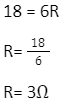
Q1. Find the resistance of a resistor if it has a voltage of 18V across it and a current of 6A flowing through it.
Ans. Using Ohm’s law,
V=IR
Q2. If the current flowing through a 4 resistor is 2 A, what will be the voltage across the given resistor?
Ans. V=IR
2 A= 2 10-6 A
V= 4 2 10-6
V= 8 10-6
V= 8 V
Q3. Which statement regarding Ohm’s law is correct?
Ans. Option a) is correct, as it follows Ohm’s law.
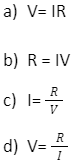
Q4. Which of the following is correct with respect to Ohm’s law?
Ans. Option b) is correct as it is in accordance with Ohm’s law.
Q5. Why is Ohm’s law valid only for a constant temperature?
Ans. Option d) is correct. Resistance depends on the temperature of the conductor, as the temperature is dependent on the material of the conductor.
Q6. Find the current flowing through a resistor if it has a voltage of 15V across it and electrical resistance of 3.
Ans. V = IR
15 = 3I
Q7. In a closed electrical circuit, the resistance of a few metres long wire conductor is:
Ans. Option d) is correct.
Q8. If there is a drop of IR across a given resistor, it is inferred that the resistor has experienced a change in potential. Does this potential change affect the current as well?
In this article, we saw an overview of Ohm’s law. It gives the expression of V.∝
I or V=RI, where R is the proportionality constant, commonly known as the resistance of a conductor. We also saw some of the limitations of Ohm’s law. Moving on, we took up some sample questions related to Ohm’s law and solved them.



 Profile
 Settings
 Refer your friends
 Sign out