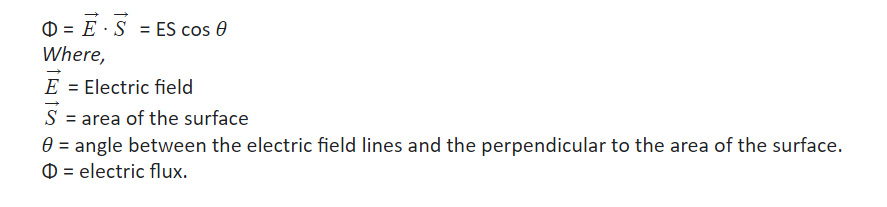
Electric flux is a measurement of how much electricity flows through a specific area. It aids in a better understanding of electrostatics. It’s linked to Gauss’s Law and electric lines of force, also known as electric field lines. Although flux is a broad term that does not have to do with electromagnetics, it may be used to describe any vector quantity. This notion aids in understanding the behaviour of the electric field and, in some situations, aids in determining the electric field.
The term flux refers to the amount of a quantity that passes through a specific area in an effective amount. It isn’t just restricted to electric or magnetic flux; any vector passing through a region can be defined as follows:E = Electric field
An electric field is equal to force charge
And Force is equal to m × a
The charge is equal to current × time ( I × T)
Electric flux = field × area
So, the dimensional formula of the electric flux is shown as:
Where
M stands for Mass
L stands for length
T stands for time
A stands for Ampere
Multiplying the electromagnetic field by the extent reflected during a perpendicular direction to the sector yields the electric flux via a region. Gauss’s Law is a universal principle that may be used on any closed path. It’s a valuable tool that lets you determine the confined charge by projecting the sphere on a region outside the charge distribution. For geometries with proper symmetry, it facilitates the computation of the electrical field.
To understand the electric flux through an area element, consider a sensor with an area of A that can detect the electric field perpendicular to the area. It can determine the net electrical charges inside any closed path by passing over it and multiplying the perpendicular fields with its surface, irrespective of the inner charge distribution.
After comprehending the principle of electrical flux, we can claim that if there are no charges inside the volume of a closed surface, the electric flux across the exterior surface is zero. But if there are certain charges within the surface quantity, Gauss’s Law has the solution to the current issue.
According to Gauss’s Law, the electric flux flowing through a closed path matches the ratio of the total charge confined by that surface to the permittivity of blank space.
The contained charge determines the total electric flux through the surface. The statement of Gauss’s Law provides the net electric flow through any closed surface.
In terms of formula, the Gauss law can be written as:
Gauss Law: Φ = Q /ϵ0
According to this formula, the symbols resemble different aspects of the Gauss law.
Φ this refers to the electric flux
Q refers to the electric charge
ϵ0 refers to the permittivity
This article explains electric flux in detail. Flux may be a broad term not confined to electromagnetics. It’s a scalar quantity and its unit (voltmeter). The number of electric field lines (amount of electrical field) travelling through a surface gives the electric flux. According to Gauss’s Law, the electric flux flowing through a closed path matches the ratio of the total charge confined by that surface to the permittivity of blank space.



 Profile
 Settings
 Refer your friends
 Sign out