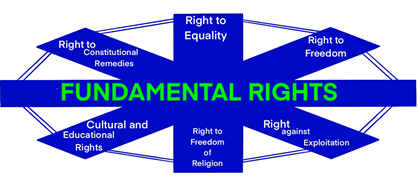
Rights refer to the claims that an ordinary person can claim over government, society, and other fellow human beings. A right is possible when a person makes a claim that is equally possible for others. Any right can’t be given to a person to harm and hurt others. These claims should be reasonable. Hence a right always comes with due respect being granted to other rights.
It is only by written laws that the socially accepted claims obtain legitimacy and authority or else they exist only as a moral obligation or a natural occurrence. The reasonable claims are accepted by the society and carry sanctions of the law becoming Rights.
Freedom means the absence of constraints. In practical life, it means the absence of interference in our affairs by others – be it other individuals or the government.
The Constitution refers to three explicit indecencies and proclaims these unlawful:
Need: Democracy gives power to the majority. So, the language, culture, and religion of minorities need special protection. Otherwise, they may get neglected or undermined under the impact of the language, religion, and culture of the majority.
The constitution specifies the cultural and educational rights of the minorities:
Rights acquire meaning only in a society. Certain rules exist in every society to control and regulate the conduct of the individual in that society. Whatever conduct that the society recognizes as rightful becomes the foundation of the rights granted. There are a total of 6 fundamental rights granted by the constituent to every individual living in India. These are the right to equality, right to freedom, right against exploitation, right to freedom of religion, cultural and educational rights, right to constitutional remedies.



 Profile
 Settings
 Refer your friends
 Sign out