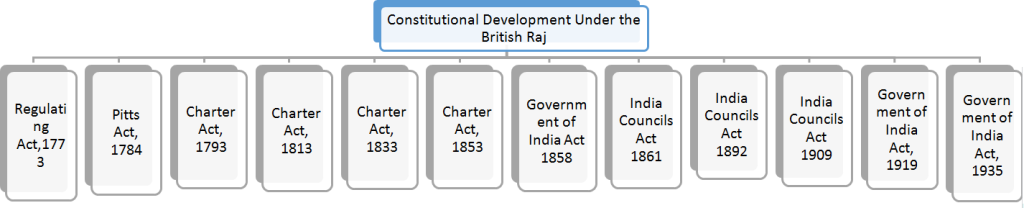
It was the British government’s first attempt to supervise and regulate the East India Company’s operations in India. It acknowledged the company’s political and administrative functions for the first time.
The 1773 Regulating Act laid the framework for India’s central government. The Governor-General had some jurisdiction over Bombay and Madras, but a nebulous clause led to a slew of problems. It was also the cause of Bengal’s ‘dual government’ being abolished.
To rectify defects and issues in the 1773 Regulating act, the Amending Act of 1781 was passed by the British parliament. This was known as the Act of Settlement or the Declaratory Act, 1781.
The British government will have direct influence over Indian issues in the future. The company’s Indian lands were dubbed “British possessions.” The statute established a distinction between the company’s commercial and political activities.
This Charter Act of 1793 extended the company’s trading privileges for another twenty years.
With this Charter Act, 1833, the Governor-General of Bengal was elevated to the position of Governor-General of India (with Lord William Bentick acting as India’s first Governor-General), with full civil and military authority.
Here’s the list of the features of the Charter Act 1833 –
By establishing British India’s constitutional status, the significance of the Charter Act of 1813 can be understood in terms of its function in affirming the Crown’s sovereignty over British India and so understanding the relevance of the Charter Act. It also broadens the range of options available to British merchants in private trading.



 Profile
 Settings
 Refer your friends
 Sign out