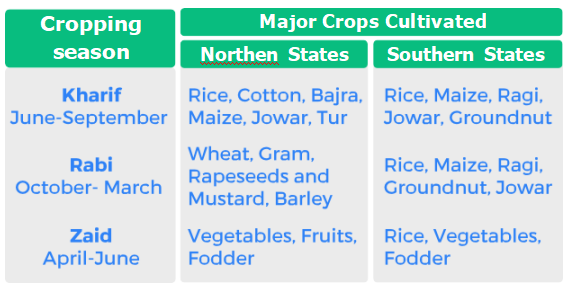
There are three major crops in India which grow according to seasonal pattern.
India has a net planted area of approximately 142 million hectares. This equates to 46 per cent of the land being cultivated. When compared to some of the more advanced countries, this is a fairly high rate.
The elements that influence cropping patterns, crop yields, and general agricultural development are as follows:
The existence of middlemen between farmers and markets is a concern in agricultural marketing in India. The farmers’ agricultural produce is paid very little by the intermediaries, who then sell it at a very high price in the open markets.
There are still lakhs of villages that are not properly connected to big routes or market centres. The majority of rural roads are Kutcha, which is rendered impassable during the wet season. Farmers are unable to get their produce to the major market and are compelled to sell it at a cheap price in the local market.
Even at the dawn of the twenty-first century, Indian agriculture is tradition-bound, notwithstanding occasional innovations. The mechanisms of a self-contained rural economy, established on caste-drain occupational laud tenure and complicated by absentee and predatory landlords, have been in place for generations. The largest impediment to modernization has been tradition-bound institutions, and Indian agriculture has been hesitant to respond to new inventive ideas.
Modern technology is only used in a few states, such as Punjab and Haryana. However, in the majority of states, reliance on rudimentary technologies is still common. This harms both production and productivity.



 Profile
 Settings
 Refer your friends
 Sign out