Ecosystems are complex, open, and dynamic systems. They perform certain functions. These are-
Energy flow through the food chain
Nutrient cycling (biogeochemical cycles)
Ecological succession or ecosystem development
Homeostasis (or cybernetic) or feedback control mechanisms
Energy Flow
Ecosystems properties that make them dynamic are energy flow and food chains
They connect the biotic and abiotic components of an ecosystem
Except for the deep-sea hydro-thermal ecosystem, the Sun is the only source of energy for all ecosystems on Earth
Of the total incident solar radiation, less than 50 percent of it is photo synthetically active radiation (PAR)
Plants absorb just 2-10% of PAR, but this small amount of energy is sufficient to support the entire living planet
All species, whether directly or indirectly, rely on producers for their food. So, there is a unidirectional flow of energy from the sun to producers and then to consumers
To combat the universal tendency toward increasing disorderliness, ecosystems need a constant supply of energy to synthesise the molecules they need
Energy flows in an ecosystem in a linear or one-way fashion
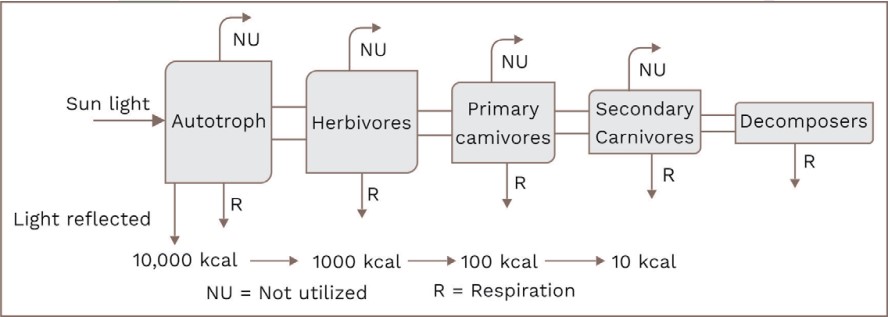
As the size of the boxes in fig 2.2 shows, the amount of energy flowing through the successive trophic stages decreases
The energy obtained by the organism at each point in a food chain or web is used to maintain the organism, and the remainder is passed on to the next trophic stage
Energy Flow at different levels in an ecosystem
Gross primary productivity (GPP) of an ecosystem is the rate of production of organic matter during photosynthesis
A considerable amount of GPP is utilized by plants in respiration
Gross primary productivity minus respiration losses (R), is the net primary productivity (NPP)
GPP – R = NPP
Net primary productivity is the available biomass for the consumption of heterotrophs (herbivores and decomposers)
Secondary productivity is defined as the rate of formation of new organic matter by consumers
Food chain
A food chain is described as the transfer of energy from producers (green plants) through a series of organisms with repeated eating and being eaten
Each step in the food chain is called a trophic level
Two types of food chains:
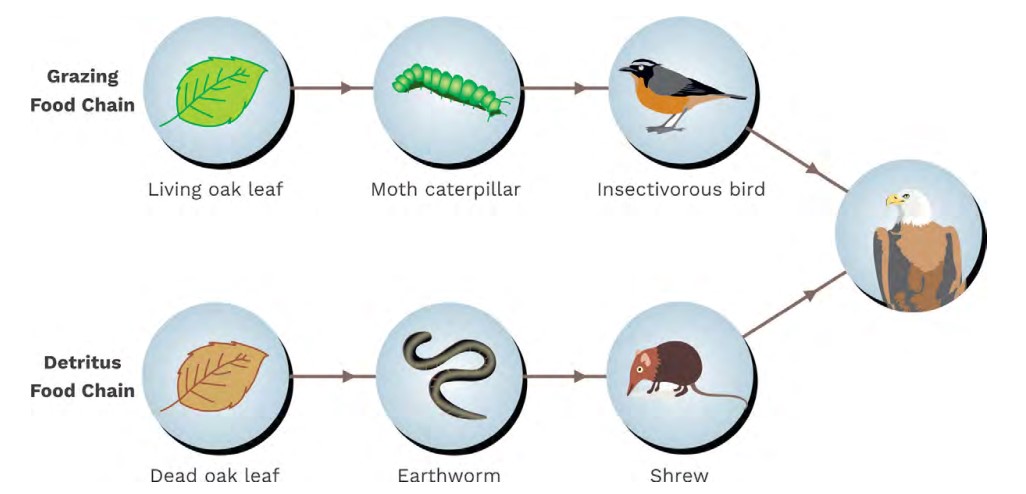
Grazing food chain: It starts from the green plants that make food for herbivores and herbivores in turn for the carnivores
A simple grazing food chain (GFC) in the terrestrial ecosystem is depicted below
In Aquatic ecosystem, phytoplankton’s (primary producers) are eaten by zooplankton which is eaten by fishes and fishes are eaten by pelicans
As energy is transferred, the number of trophic levels in the grazing food chain is restricted to 10 percent law – only 10 percent of the energy is transferred to each trophic level from the lower trophic level
Detritus food chain: It starts from the dead organic matter
The detritivore organisms in turn make food for protozoans carnivores etc.
The energy source for the first level customers is the difference between these two food chains
The prime source of power in the grazing food chain is living plant biomass, while the primary source of energy in the detritus food chain is dead organic matter or detritus
The two chains are functionally linked in an ecosystem and make a y-shaped food chain



 Profile
 Settings
 Refer your friends
 Sign out