Solubility is a state of being where one substance is soluble in another substance. It can also be defined as an ability of a solute to dissolve in the solvent. The solubility of a substance is often influenced by the solvent used, temperature and pressure. The degree of solubility increases from infinitely soluble to poorly soluble. When additional solute added to the solvent does not increase the concentration of the solution, it is called a saturated solution.
Solubility product is defined as the equilibrium constant at which solute dissolves in a solvent or aqueous solution. It is denoted by Ksp. The solubility product of a solution is constant at a constant temperature. If the solubility product is higher, then the solubility of the solution is higher and if the constant is lower, so as the solubility will be. The saturated solution of ionic compounds has less solubility. Molar solubility is related to solubility products, but they are not similar.
There are 3 different factors that affect the solubility product :-
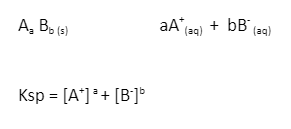
The solubility product constant is denoted by Ksp where,
K= constant
sp= solubility product
Here, we will take a general reaction example,
Example-
1) The expression for solubility product of Calcium fluoride-
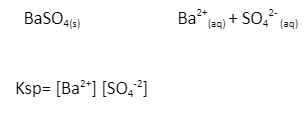
2) The expression for dissolution of barium sulphate-
The non-polar solvents do not have sufficient energy for overcoming the lattice enthalpy, so they have low solvation enthalpy. During solvation, the nature of the solvent is determined to find out the amount of energy released. For salt to be dissolved in a given solvent, it must have a solvation enthalpy that is greater than lattice enthalpy.
The solubility of different solids varies a great deal. Some solutes are highly soluble, while others of them are poorly commonly termed insoluble. When the rate of dissolution is similar to the rate of crystallisation, then the solution is said to be in equilibrium. The equilibrium concentration is denoted by the product of the concentration of ions in the solution.
A substance’s solubility is determined by the solvent employed, temperature and pressure. The solubility product is applicable for salts that are sparingly soluble in water. Each salt has its characteristic solubility, which depends on the temperature. So, as per the theory, we come to know that the solubility product remains constant at a given constant temperature. Temperature is one of the crucial factors affecting compound dissociation. Under certain reaction conditions, the equilibrium solubility surpasses and comes up with a supersaturated solution.



 Profile
 Settings
 Refer your friends
 Sign out