According to the Newton law of cooling formula, the amount of heat dissipation of a body is proportional to the temperature differential between both the system and its surroundings. The rule is typically tempered by the requirement that the difference in temperature is modest and the characteristics of the heat transmission process remain unchanged. Simply put, it is comparable to saying that the coefficient of heat transfer, which controls temperature variations as well as the level of heat dissipation, is fixed. This criterion is frequently satisfied in heat conduction because most substances’ thermal conductivity is just slightly temperature-dependent.
Newton was the one to conduct a systematic analysis of the link between a certain body’s heat loss in a specific enclosure with its temperature.
We may use Newton’s cooling law formula to calculate how rapidly a material at a specific temperature would cool in whatsoever specified context. It also illustrates how well the rate of the reaction of an entity is determined not just by the difference in temperature between both the substance and its settings, but by the substance’s cooling constant as well.
T(t) – the temperature of the body at the time ‘t’
Ts – surrounding temperature
T0 – initial temperature
t – time
k – proportionality constant
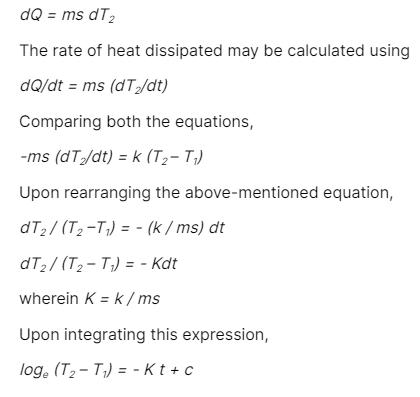
Let T2 be the temperature of a body of mass m with a specific heat potential s, and T1 be the temperature of its environment.
If the temperature drops by a little proportion dT2 in time dt, the quantity of heat lost can be expressed as:
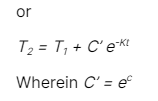
The above mathematical expression is utilized to estimate the time it takes for an object to cool within a certain temperature range.
The version of the Newton’s law of cooling formula employed in the heat transmission theory expressed mathematically the concept that a body’s pace of heat dissipation is proportional to the average temperature differential between the object and its external environment.
Newton’s law of cooling formula can be used for various applications such as calculating the amount of time required by a heated item to lower its temperature to a certain degree, and to measure the temperature of a liquid inside a freezer after a certain timeframe. It also aids in determining the exact death time by comparing the likely temperature of the body at the moment of death with the present body temperature.



 Profile
 Settings
 Refer your friends
 Sign out