Profile
 Settings
 Refer your friends
 Sign out




Why in News?
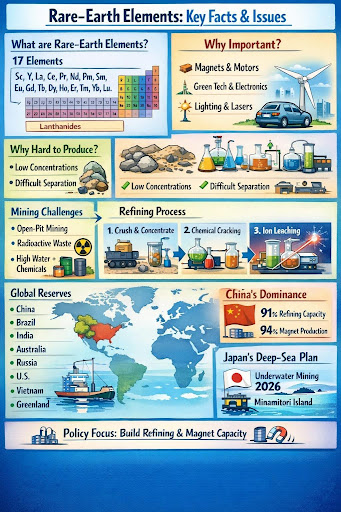
Japan has announced a world-first trial to excavate rare-earth-rich mud from the deep seabed (6,000 meters) near Minamitori Island in January 2026. Simultaneously, China has further tightened its global grip by mandating export licenses for products containing even 0.1% Chinese rare-earth content as of December 2025.
About Rare Earth Elements (REEs)
- Composition: A group of 17 elements comprising the 15 Lanthanides (atomic numbers 57 to 71), plus Scandium and Yttrium.
- The “Rare” Misnomer: They are relatively abundant in the Earth’s crust (e.g., Cerium is more common than Copper). They are called “rare” because they are seldom found in concentrated, economically mineable deposits.
- Unique Properties: Their 4f electrons are “localized” (stay close to the nucleus), providing strong magnetic moments and sharp, stable luminescence (color emission).
- Strategic Uses: * Magnets: Neodymium-Iron-Boron (NdFeB) magnets are essential for EV motors and wind turbines.
- Optics: Europium and Terbium are used in LEDs and fiber optics.
- Defense: Critical for guidance systems and stealth technology.
Why is REE Refining Difficult ?
Unlike crude oil, which can be separated by simple heating (fractional distillation), REEs are notoriously hard to refine due to:
- Chemical Similarity: Neighboring REEs have almost identical ionic sizes and the same common charge (+3), making them behave nearly identically in chemical reactions.
- Low Concentrations: They are often spread out in ore and mixed with other minerals, requiring massive volumes of material to be processed for tiny yields.
- Radioactive Co-occurrence: Minerals like Monazite often contain Thorium or Uranium, making waste management hazardous and radioactive.
- Non-Substitutability: A factory needing Neodymium cannot swap it for Lanthanum, unlike oil refineries that can often switch feedstocks.
The Multi-Step Refining Process
- Beneficiation: The ore is crushed and ground. Techniques like froth flotation or magnetic separation are used to create a “concentrate” (richer in REE minerals).
- Chemical Cracking: The concentrate is treated with strong acids or high heat to break the minerals into a soluble form.
- Leaching: The cracked material is mixed with an acidic solution so REE atoms move into the liquid as ions.
- Solvent Extraction (The Hardest Step): The liquid is repeatedly contacted with an organic solvent. Because different REE ions have a slight preference for the solvent, this process must be run through hundreds of stages to separate elements one by one at high purity.
- Precipitation & Calcination: Chemicals are added to make the ions fall out as solids. These are filtered and heated to produce Rare Earth Oxides.
- Reduction: If pure metal is needed, the oxygen is stripped from the oxide through further chemical reactions.