


 Profile
 Settings
 Refer your friends
 Sign out


Why in News:
- The India Meteorological Department (IMD) has launched a new granular forecast system to provide block-level monsoon arrival estimates across 3,196 blocks in 15 States.
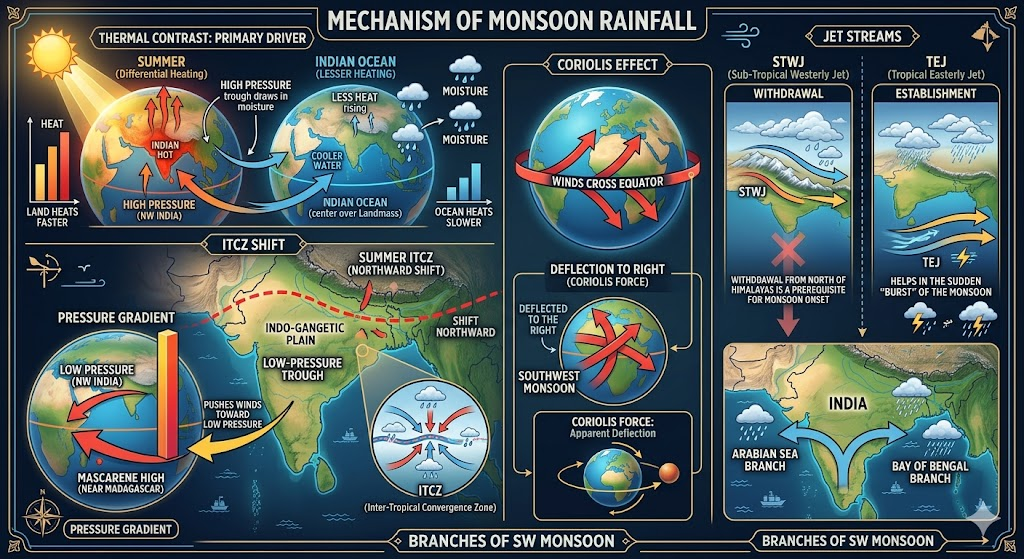
Basic Facts: Mechanism of Monsoon Rainfall
- Thermal Contrast: The primary driver is the differential heating of the Indian landmass and the surrounding Indian Ocean during summer.
- ITCZ Shift: The Inter-Tropical Convergence Zone (ITCZ) shifts northward over the Indo-Gangetic plain in summer, creating a low-pressure trough that draws in moisture-laden winds.
- Pressure Gradient: The Mascarene High (a high-pressure area near Madagascar) pushes winds toward the low-pressure center over Northwest India.
- Coriolis Effect: As these winds cross the equator, they are deflected to the right by the Coriolis force, becoming the Southwest Monsoon.
- Jet Streams:
- STWJ: The withdrawal of the Sub-Tropical Westerly Jet from the north of the Himalayas is a prerequisite for monsoon onset.
- TEJ: The Tropical Easterly Jet, established over the peninsula, helps in the sudden “burst” of the monsoon.
- Branches: The monsoon enters India in two branches: the Arabian Sea Branch and the Bay of Bengal Branch.
- Unique Points:
- Orographic Lift: Most of India’s monsoon rain is orographic, caused by mountains like the Western Ghats and Himalayas forcing air upwards.
- Break in Monsoon: Periods of little or no rain during the monsoon season are caused by the shifting of the monsoon trough or unfavorable tropical depressions.
