Profile
 Settings
 Refer your friends
 Sign out


Magnitude of the Field
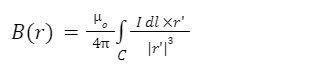
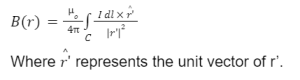
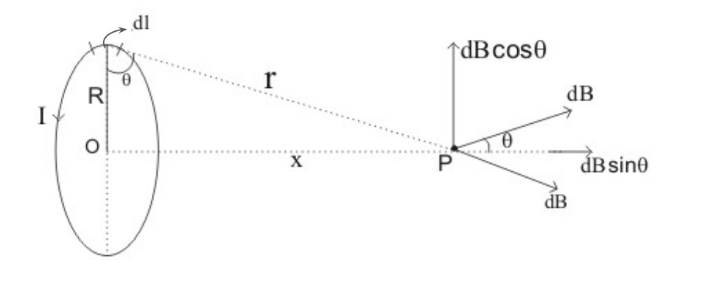
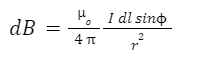
- Using Biot Savart’s Law, the magnitude of the magnetic field generated because of the presence of the current element at P can be written as,
-
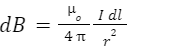
- As the element, Idl and r are perpendicular to each other and the value of ϕ is 90o. Therefore, the magnitude can be written as,
-
- Dividing dB into two components — dBsinθ, which is along the loop’s axis, and dBcosθ, which is perpendicular to the horizontal axis.
- As the coil is symmetrical about the horizontal axis, the vertical component will be cancelled out because of the presence of another element on the other side of the coil.
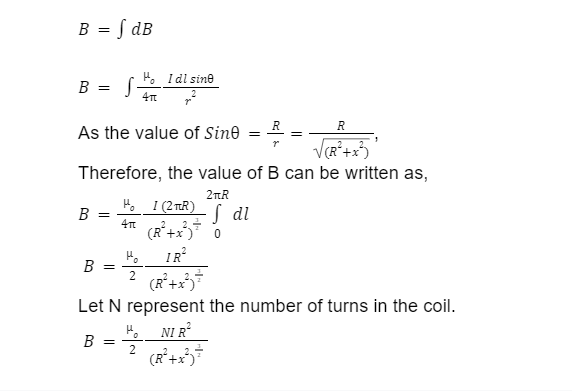
- The resultant B of the complete loop can be written as,
Direction of B
- The magnetic field at a location on a circular coil’s axis is along the axis, and its orientation may be determined using the right-hand thumb rule. The extended thumb will point towards the magnetic field if the fingers are folded along the current.
- For anti-clockwise current, the magnetic field will be out of the page, while for clockwise current, it will be on the page.
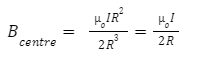
Field of the coil at its centre (when x=0)
The field at the centre of the coil, where the value of x is 0, can be written as,
Field of the coil that is far from the centre (when x>>>>R)
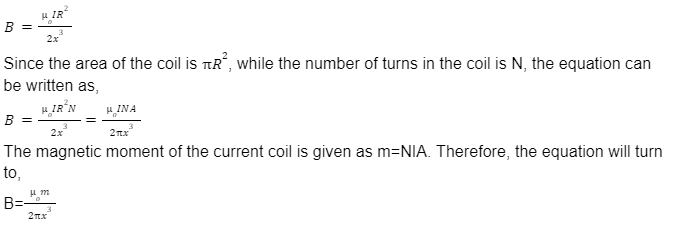
As the value of x will be much more than R, the value of R can be neglected as compared to x. Therefore, the value can be written as,