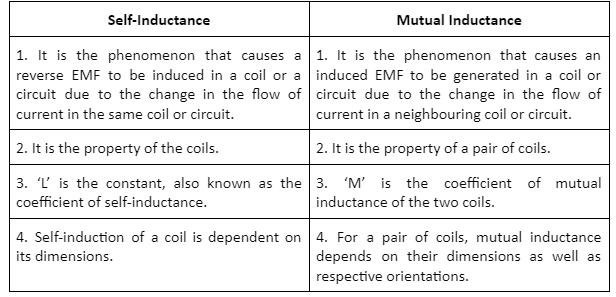
Sir Henry Joseph gave us the first introduction to self and mutual inductance in 1831. Inductance is one of the most highly regarded concepts in the study of physics. The SI unit for self and mutual inductance is henry (H). One henry is defined as the mutual inductance of a coil for producing an equivalent of one volt when the rate with which the current changes is one ampere per second. The main differences between self and mutual inductance are in the factors affecting inductance, some of which are discussed ahead.
It is known that:
Thus, when the current flowing through a coil or circuit changes, a self-induced EMF is created in it. As per a law given by the famous physicist Lenz, self-induced EMF tries to oppose its cause of creation.
This phenomenon of producing a self-induced EMF, which later opposes any change in a coil or a circuit’s electrical state, is known as self-inductance.
Mutual inductance, a fundamental property in the study of physics, talks about two coils placed next to each other.
Let’s say the two coils are named A and B. Consider a scenario when a current is made to pass through coil A. An EMF is induced in the coil kept next to A, i.e., coil B.
The magnetic flux (ɸ) linked with a coil is directly proportional to the current (I) that flows through it at any particular instance.
ɸ∝ I
To remove the proportionality sign, we can write the equation as:
ɸ = L I
Where L is the constant, also known as the coefficient of self-inductance.
Thus, the coefficient of self-inductance of any coil or circuit may be defined as the magnetic flux associated with it due to a one-ampere current flowing through it.
Due to the change in the magnetic flux of (ɸ2), the secondary coil will induce an EMF.
Thus, the magnetic flux (ɸ2) is dependent on the change in the flow of current in the primary coil. It is directly proportional to the current (I1).
ɸ2 ∝ I1
The proportionality symbol ‘∝’ is replaced by a constant, denoted as ‘M’. This is the mutual inductance of the two coils, A and B.
ɸ2 = M I1
Hence, the mutual inductance coefficient for a given pair of coils is defined as follows:
Or
Below are the factors that affect the self-inductance constant ‘L’:
Below are the factors affecting the mutual inductance constant ‘M’:
Self-inductance finds its applications in the following examples:
Mutual inductance finds its applications in the following examples:
Mutual inductance is simply the generation of an induced EMF in a coil as a result of current flowing in an adjacent coil. In self-inductance, changes in the flow of current in a coil are opposed by the coil itself by inducing an EMF in the same coil, i.e., no other coil is involved.
The examples of self and mutual inductance are plenty, with applications found in transformers, electric generators, motors, and airport metal detectors. Self-induction depends on a coil’s dimensions and length, whereas mutual inductance depends on dimensions as well as orientation.



 Profile
 Settings
 Refer your friends
 Sign out