Mensuration is a discipline of mathematics that studies geometric shapes, their area, volume, and other associated properties. A trapezium is a kind of quadrilateral in which two of its sides are parallel and two are non-parallel. The two parallel sides of a trapezium are known as base. And (h) is considered to be the height/ altitude of the trapezium or the distance between two parallel sides. If the non-parallel side of a trapezium is equal then it will be an isosceles trapezium.

Formula of trapezium

Area of trapezium = 1/2 x (sum of parallel sides) x (distance between them)

Area of trapezium formula proof

Let ABCD be a trapezium of height h and AB||DC 

Join AC and draw perpendicular CL on AB and produce DC and draw perpendicular AM on DC.

Let CL and AM = h 

Area of trapezium = area of ∆ABC x area of ∆ACD
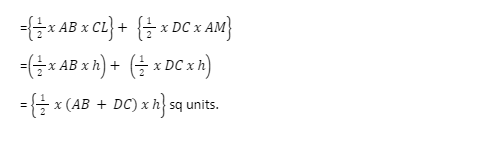
∴ Area of trapezium = 1/2 x sum of parallel sidesx( distance between them)

Properties of trapezium

  1. Trapezium is a closed figure in which sum of interior angles is equals to 360°
  2. It has a pair of the parallel side that are opposite to each other and both of them are known as base.
  3. The other two sides of a trapezium should be non-parallel and if these non-parallel sides of a trapezium are equal to each other then, the trapezium is said to be an isosceles trapezium.
  4. In trapezium sum of adjacent angles is equals to 180°
  5. At their intersection, the trapezoid’s diagonals cut each other in half.

Some questions based on trapezium

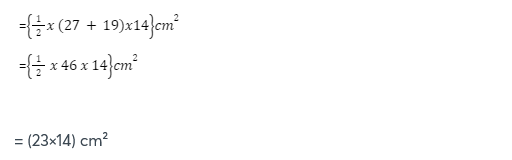
Q1. Two parallel sides of a trapezium are of lengths 27 cm and 19 cm respectively. And the distance between them is 14cm. Find the area of trapezium 

Solution –area of trapezium = ½ x (sum of parallel side) x (distance between them)

= 322 cm²

Q2. The area of a trapezium is 352 cm² and the distance between its parallel sides is 16cm. If one of the parallel sides is of length 25cm, find the length of the other. 

Solution – Given, the area of trapezium is 352 cm2. 

Distance between its parallel side = 16cm 

One side is 25 cm 

Let the other side be x 

Then by using formula –
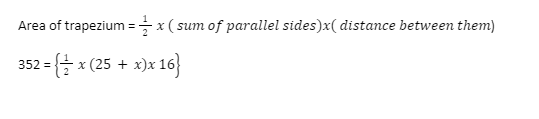
325 = (200 + 8x) cm². 

8x = (352 – 200) 

 8x = 152 

x = (152/8) 

 x = 19. 

Some practice questions based on the trapezium

Q1. Find the area of a trapezium whose parallel sides are 24 cm and 20 cm and the distance between them is 15 cm. 

Q2. Find the area of a trapezium whose parallel sides are 38.7 cm and 22.3 cm, and the distance between them is 16 cm. 

Q3. The area of a trapezium is 1080 cm². If the lengths of its parallel sides are 55 cm and 34.4 cm, find the distance between them. 

Q4. The area of a trapezium is 1586 cm² and the distance between its parallel sides is 26 cm. If one of the parallel sides is 84 cm, find the other. 

Q5. The area of a trapezium is 405cm². Its parallel sides are in the ratio

4 : 5 and the perpendicular distance between them is 18 cm. Find the length of each of the parallel sides.

Conclusion

Mensuration is a discipline of mathematics that studies geometric shapes, their area, volume, and other associated properties. A trapezium is a quadrilateral in which two of its sides are parallel and two are non-parallel. (h) is considered to be the height/ altitude of the trapezium or the distance between two parallel sides. It has a pair of parallel side that are opposite to each other and both of them are known as based. If the non-parallel side of a trapezium is equal then it will be an isosceles trapezium.