A cathetometer is a type of instrument mainly used for measuring variations of a minute in the level related to liquid surfaces with a high degree of precision and accuracy. This article will discuss a simple guide on a cathetometer, its uses, and its operation.
A digital cathetometer is a type of instrument mainly used to measure vertical distances in cases where we cannot place a scale at points close to each other, for example, to measure the distance between the mercury levels in a tube.
To move an instrument upward and downward in the vertical column for measuring the levels, the horizontal telescope is put on the vertical column to move up and down through the vertical column. Moreover, a cathetometer also uses a type of scale specially designed to read the specific location of the telescope. Therefore, preliminary measurements of a digital cathetometer are taken to read the precise location of the telescope. A primary measurement must be taken to ensure that the cathetometer is at its level when using the cathetometer. After that, the cross-hair in the eyepiece of the telescope should be appropriately adjusted to coincide with the image of another point so that another reading is taken. Thus, the difference between the two readings is correctly calculated as this difference is essential to determine the variations among surface levels.
Along with these, there are few other functional requirements of a cathetometer.
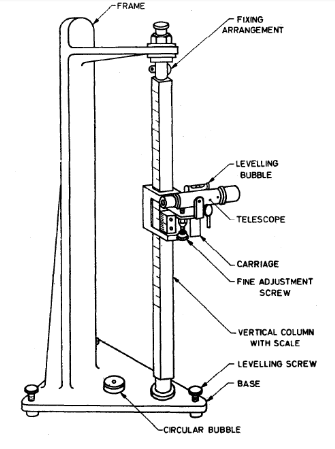
Following is a diagram of a cathetometer.
Cathetometer is used for various purposes, but its main use is in reading the levels of a liquid in a capillary tube for measuring the surface tension. Moreover, a cathetometer is often employed for determining the changes in the liquid level during a chemical reaction.



 Profile
 Settings
 Refer your friends
 Sign out