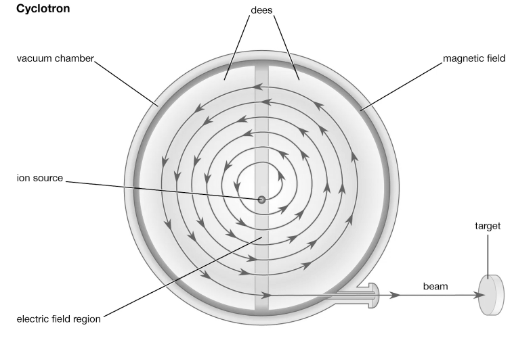
A cyclotron is an instrument used to accelerate particles. This instrument was invented in 1930 by Ernest O. Lawrence to investigate the structure of the nucleus. It was patented in 1932 by Lawrence. He was a nuclear physicist who got the Nobel Prize for the invention of the cyclotron in 1939.
A cyclotron is a device that boosts the energy of charged particles or ions. It is a circular particle accelerator. A charged particle is driven along a spiral route by either a static magnetic field or an electric field. In a cyclotron, the charged particle is injected so that its velocity is perpendicular to the static magnetic field. The particle rotates due to the magnetic field, and the particle accelerates after each turn due to the electric field.
A cyclotron is a circular vacuum chamber consisting of two D-shaped chambers. A high-frequency altering voltage is applied to it, which accelerates the charged particle. The dees are present in front of each other and are divided by a gap to create a cylindrical space between them. The electrons are injected into the cylindrical space.
There are two poles of an electromagnet that provide a magnetic field. Now, the magnetic field causes circular movement due to Lorentz’s force, which is always perpendicular to the motion’s direction.
Between the dees, more than a thousand volts of alternating voltage is supplied. The voltage accelerates the particles by creating an electric field in the space present between the dees, and the electric current is oscillating. The voltage’s frequency is set as the particles complete one circuit in the duration of a single cycle of the voltage.
These are the four types of cyclotrons differentiated on the basis of functionality.
Furthermore, cyclotrons are divided based on types of beams and targets.
A cyclotron is a circular scientific instrument used in different scientific research. It is a round instrument divided into two halves, making two D shape compartments. The halves are divided from the middle, and the electrons are injected from the middle passage. An alternating voltage is also produced, which helps in accelerating the charged ions and particles. This instrument was invented by a nuclear physicist named Ernst O. Lawrence, who was awarded a Nobel Prize. Because this instrument has a linear acceleration, it is still used in medical, physics experiments, and other experimental fields.



 Profile
 Settings
 Refer your friends
 Sign out