Figures need to be drawn for various applications such as the construction of a building, tool design, and other engineering design purposes. To draw such figures, we need the following geometric tools:
The instruments mentioned above are used for geometrical figure drawing of specific measurements. These figures are mainly drawn using a compass, scale, and protractor. Here we will understand the basic concepts regarding the construction. With those concepts, it will help us in solving construction problems.
Steps for geometric construction:
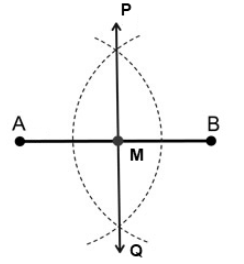
Step1 – Draw a line AB with a scale.
Step2 – Now take a compass and put a point on A to extend the compass more than half of the line.
Step3 – From the same point A, make a semi-circular arc above and below the line.
Step4 – Repeat the same step at point B without changes in compass extension.
Step5 – You will get two intersected points above and below the line. Name these points P and Q.
Step6 – Now join the line PQ, and you will see we get ∠ 90° at ∠ PMB.
Step7- So ∠ PMB is our Perpendicular Bisector so ,∠ PMB=∠ PMA=∠ AMQ=∠ QMB.
Steps for geometric construction:
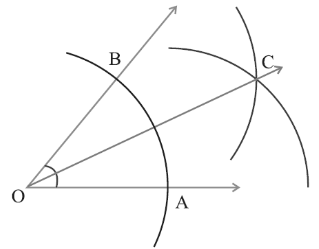
Step1 – Construct a line that bisects an acute angle into two congruent parts.
Step2 – Name the vertex as point O, and we need one more point C to detriment the angle bisector line.
Step3 – Take a compass with an arbitrary extension that intersects the given lines, and we will get points A and B.
Step4 – Now, from points A and B, make the arc to form an intersection point C.
Step5 – Now join points C and O.
Step6 – From OC we get angle bisector ∠COA and ∠COA=∠COB.
Steps for geometric construction:
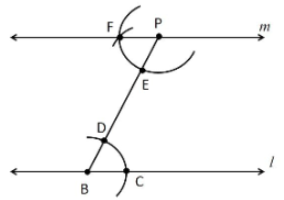
Step1 – In the given line l take any arbitrary point as B.
Step2 – From point B make an acute angle which you prefer using a protractor.
Step3 – Using a compass, make an arc intersecting the lines from vertex B.
Step4 – Name the two intersecting points D and C.
Step5 – Use a compass to measure the distance between D and C.
Step6 – Now with that distance, place it in the line which has point D, and in that choose any position from which you want to make a parallel line.
Step7 – Name it point E and make an arc. Position the compass at some distance and name it as point P such that BD=PE.
Step8 – From point P make an arc such that it intersects the arc. Name the arc intersection point as E and join points P and F.
Step9 – Hence the construction of the parallel line is done.
Steps for geometric construction:
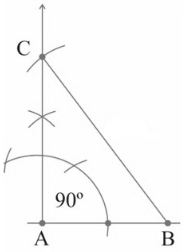
Step1 – Draw a line of the required length AB.
Step2 – Now at point A draw a perpendicular bisector and mark it as point C at the required distance from C.
Step3 – Join points B and C.
Step4 – You now have a basic right-angled triangle.
Solved Example:
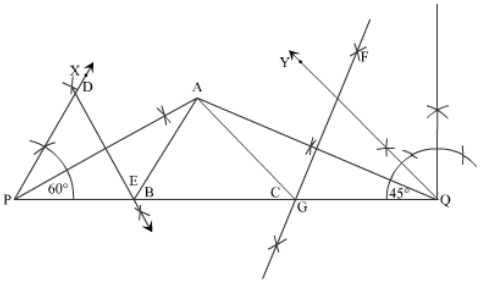
Construct a triangle ABC in which ∠B=60°,∠C=45°,and AB+BC+CA=11cm.
Solution:
Steps for Construction:
Step1 – With a scale draw line PQ=11 cm (AB+BC+CA=11 cm).
Step2 – Now point P using the compass makes a 60° at point P by first making an arc at point P of any arbitrary extension.
Step3 – At the point where the arc bisects PQ, place the compass and again bisect the previous arc, which was made from point P.
Step4 – Now again, make the arc on the left-hand side from the same point and now go to that previous point by bisecting the arc.
Step5 – From that point, bisect the arc on the left-hand side and from point P join it, and a 60° angle is formed.
Step6 – Follow the same steps to further bisect the 60° angle to get 30° angle.
Step7 – Name that line segment as PA and ∠APQ=30°.
Step8 – Now at point Q construct a perpendicular bisector to form a 90° angle at Q.
Step9 – Now using the angle-bisector method make 45° at point Q and name that as line MQ.
Step10 – So we will get ∠MQG=45°, now again by using the angle bisector method make an angle of 22.5°.
Step11 – Extend the angle bisector line to intersect line PA. Now keeping A as a common point the formed line is AQ.
Step12 – Draw perpendicular bisectors DE and AP such that they intersect PQ at B and FG of AQ to intersect PQ at C.
Step13 – Join AB and AC.
Step14 – ABC is the required triangle.
The above example used all basic concepts of constructions, as listed below: