To begin this article, we will have a brief discussion about the definition of analytical geometry, its features, and characterisations. After dealing with the definitions, we will focus on its impact and significance in the field of mathematics and also explore its various facets. Finally, we will also be discussing how analytical geometry is used in real life.
Often referred to as coordinate geometry, analytical geometry is a branch of algebra that deals with cartesian points. In this geometry, we use a pair of points (referred to as coordinates) to find out the exact location of a point in the 2-dimensional plane. The coordinates considered at the most general level are the x coordinates and the y coordinates. The coordinates are real numbers. Analytical geometry also emphasises the use of algebraic symbols and methods to solve a given problem. Analytical geometry can also be utilised in 3-dimension using the x, y, and z coordinates. It also has uses in multidimensional space for performing some complex calculations and studies. Since analytical geometry uses a coordinate system, it gives us accurate and precise positioning of points or objects.
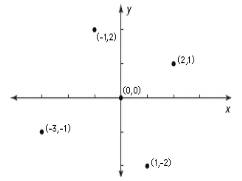
A typical example of coordinate geometry representation is as follows:
A pair of coordinates works like an address that gives us the exact location of a point in a 2-dimensional plane. The coordinates can be both positive and negative real values. The x coordinate is called abscissa, and the y coordinate is called ordinate.
Based on the sign of the coordinate points, the coordinate plane has been divided into four quadrants. The 1st quadrant contains both x and y coordinates as positive. The 2nd quadrant contains x as negative and y as positive. The 3rd quadrant contains both x and y coordinates as negative, while the 4th quadrant contains a positive x coordinate and negative y coordinate.
Analytical geometry or coordinate geometry mainly uses the concepts of algebra combined with the concept of coordinates.
Analytical geometry has a number of uses in day-to-day life as well as in performing various experiments and studies. Analytical geometry is mainly used in determining and analysing various coordinate structures such as straight lines, circles, parabolas, and hyperbolas.
Let’s take a look at the various formulas to find equations of a straight line, circle, parabola, and hyperbola, respectively.
The equation of a straight line using coordinate geometry is as follows:
(y−y1)={(y2−y1)/(x2−x1)}(x−x1)
The equation of a circle using coordinate geometry is as follows:
(x−h)²+(y−k)²=r²
The equation of a parabola using coordinate geometry is as follows:
y² = 4ax;
y² = – 4ax
x² = 4ay
The equation of a hyperbola using coordinate geometry is as follows:
(x−h)² / a²−(y−k)² / b²=1
Apart from the above-mentioned uses, coordinate geometry is the only means to establish a connection between two distinct branches of mathematics, that is, algebra and geometry. Analytical geometry is the fusion of both of these methodologies, which is used to solve problems. It is also widely used in the branches of trigonometry, calculus, and others. To conclude, analytical geometry is a connector between different branches of mathematics.
In this segment, let’s look at how the expertise and knowledge of analytical geometry are utilised in our everyday life.
Some of its significant uses are listed below:
In this article, we learned about the definition of coordinates and their uses. We focused on learning what analytical geometry is and acquired knowledge about its basic methods and terminology. After acquiring this basic knowledge, we learned about the various uses of coordinate geometry, and also grasped the general formulas of various coordinate figures such as the straight line, circle, parabola, and hyperbola. We saw how analytical geometry establishes a connection between the various branches of mathematics and has a wide array of applications in solving day-to-day problems.



 Profile
 Settings
 Refer your friends
 Sign out